
The Death of Old SEO: What the Data Says About AI Search and Web Traffic (2024-2026)
What Google actually changed
Start with the concrete events, because the narrative has run ahead of the facts in both directions.
At its I/O conference on May 19, 2026, Google announced what its search lead called a new era for AI Search. The numbers it disclosed were the real news. AI Mode, Google's conversational search experience, had crossed one billion monthly users roughly a year after launch, with queries more than doubling every quarter, while AI Overviews had crossed 2.5 billion monthly users. Google also upgraded AI Mode to run on its newest model, Gemini 3.5 Flash, as the default for everyone globally.
The interface changed too. Google launched the biggest upgrade to its search box in over 25 years, rebuilt to accept text, images, files, videos, and browser tabs and to reason across all of them, and it merged AI Overviews and AI Mode into one experience so a user can move from a question to an AI summary to a back-and-forth conversation without leaving the page.
Then it went further than answering questions. Google introduced Search agents, starting with information agents that run in the background around the clock, reasoning across blogs, news, social posts, and real-time data to surface what a user needs without being asked again. It also launched Generative UI, which builds custom interactive dashboards, tools, and simulations inside the results page on the fly, and Universal Cart, a shopping experience that lets users buy through Search, Gemini, YouTube, and Gmail without visiting a website.
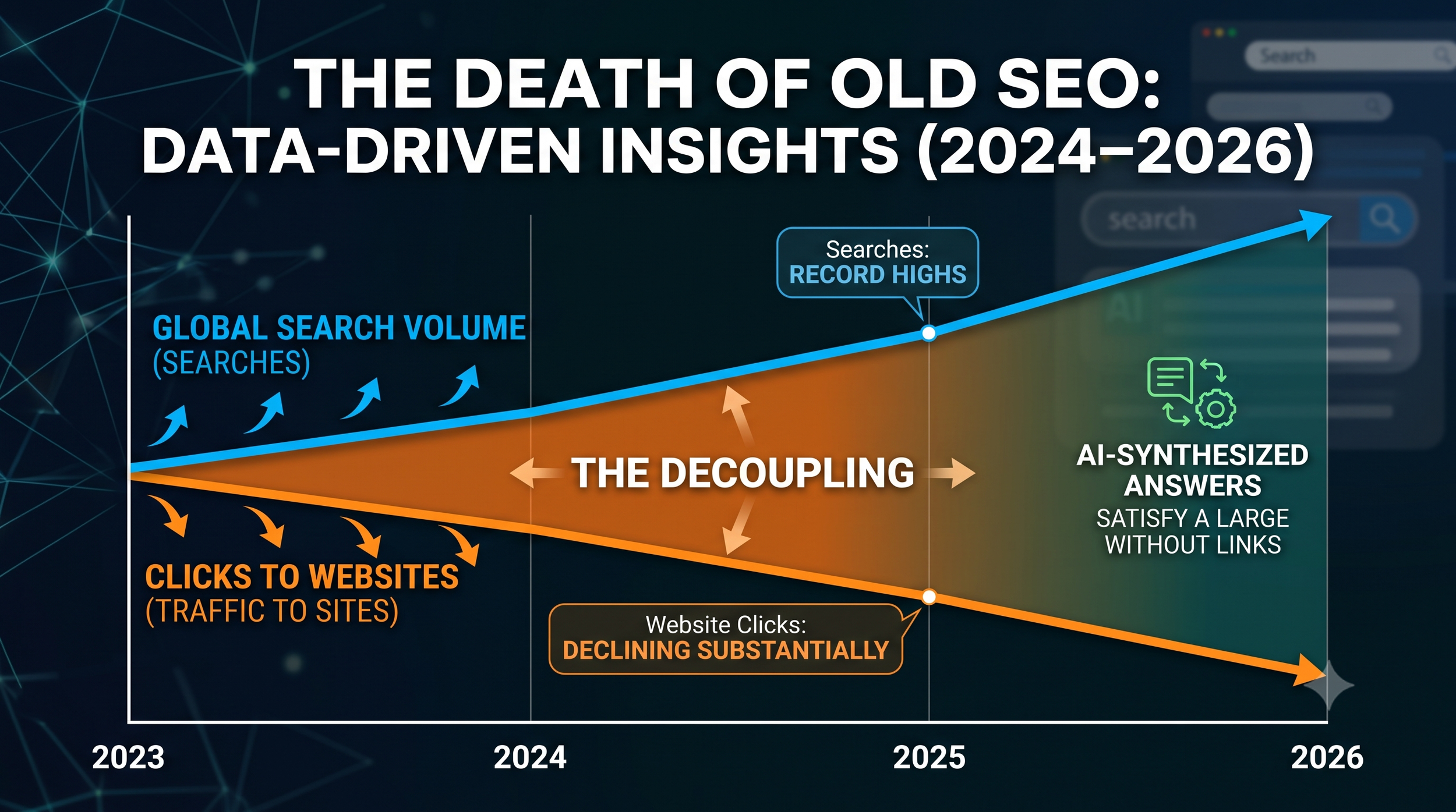
The scale underneath all this is hard to overstate. Google said it now processes 3.2 quadrillion tokens per month across its surfaces, roughly seven times the prior year, and that Search queries hit an all-time high last quarter. That last point matters and cuts against the simplest doom narrative: people are not searching less. They are searching more. The traffic crisis is not about search shrinking. It is about what happens to the click after the search.
One careful observer summarized the strategy well: Google is not shutting down classic search and replacing it with AI overnight. It is absorbing traditional search into AI Mode piece by piece, keeping the ten blue links on the page while building an answer layer on top that increasingly makes them unnecessary.
The Great Decoupling, in numbers
The pattern analysts now call the Great Decoupling is the core of the story: search impressions keep rising while clicks to websites fall. The supporting data has piled up across many independent studies, and while they disagree on magnitude, they agree on direction.
Begin with zero-click searches, meaning searches that end without the user visiting any website. According to Similarweb data, zero-click searches rose from 56% to 69% between May 2024 and May 2025. A separate compilation put it at roughly 60% of Google searches ending without a click, up from 58% in 2024. The exact figure depends on the dataset, but a clear majority of searches now resolve on the results page itself.
The most rigorous behavioral study came from Pew Research Center, which tracked the actual browsing of 900 US adults rather than relying on estimates. It found that when an AI summary appeared, users clicked a traditional search result only 8% of the time, compared with 15% when no summary was present, close to a 50% reduction, and that they clicked a link inside the AI summary itself just 1% of the time. Even more telling, 26% of searches with an AI Overview ended the user's Google session entirely, versus 16% without one, meaning the summaries are not just redirecting traffic but removing people from the search funnel altogether.
Industry studies using different methods reached similar conclusions with varying severity. Ahrefs, re-running an earlier analysis on December 2025 data, found that the presence of an AI Overview correlated with a 58% lower click-through rate for the top-ranking page, worsening from a 34.5% reduction it measured back in April 2025. A study by Search Engine Land and the researcher Kevin Indig found desktop click-through rates fell by around 50% when an AI Overview was present, while mobile clicks fell about a third, and Authoritas reported that traffic to top-ranked news sites dropped as much as 79% when their link sat below an overview.
At the publisher level, the damage was uneven. The median publisher saw a 10% year-over-year traffic decline in the first half of 2025, with news sites down 7% and non-news content sites down 14%. The extremes were brutal in both directions. HubSpot reportedly lost 70 to 80% of its organic traffic, DMG Media saw an 89% click-through drop, and CNN fell 27 to 38%, while a few sites such as People.com gained and Men's Journal rose sharply. The dividing line was not content quality. It was whether a site got cited inside the AI answer.
That dividing line shows up cleanly in the data. Brands cited in AI Overviews earn roughly 35% more organic clicks, and far more paid clicks, than uncited competitors on the same queries. In a world where the overview eats most of the clicks, the remaining clicks concentrate on whoever the AI chose to name.
The honest caveats
A credible read of this data has to include the places where it is contested or more nuanced than the scary headlines suggest, because there are several.
First, Google disputes the methodology. It questioned the Pew study, arguing that the analysis period overlapped with unrelated algorithm testing, though the consistency of the finding across many independent studies makes the overall direction hard to wave away.
Second, the magnitude varies a lot. The measured click-through drop ranges from about 34% to about 58% depending on who ran the study, what queries they sampled, and when. Anyone citing a single precise figure as the truth is overstating the precision of the field. The honest statement is that AI Overviews substantially reduce clicks to the top results, by something in the range of a third to a half.
Third, there is a subtle point about who loses the click rather than whether a click happens at all. Semrush, looking at the same keywords before and after AI Overviews appeared, found the zero-click rate moved only slightly, from 38.1% to 36.2%, which suggests that part of what is happening is a redistribution of clicks toward the sources cited inside the overview, not only their disappearance. Both effects are real. The overview takes clicks overall, and it reroutes the survivors to whoever it cites.
And fourth, the framing of search dying is wrong. Search volume is at record highs. The problem for website owners is not fewer searches. It is that a rising share of those searches never produce a visit.
Why ranking no longer equals traffic
The deeper structural shift, the one that breaks the old SEO model, is that ranking and visibility have come apart.
Traditional search showed a ranked list of links, and being in the top few meant being seen. AI Mode does something different: it synthesizes an answer from multiple sources and presents that answer directly. Your page might be one of the sources it drew from, or it might not, and the user never has to click to find out.
The overlap between the two systems is surprisingly small. By one analysis, only about 14% of the URLs cited by AI Mode rank in Google's top 10, and other studies put the cited-versus-ranked overlap somewhere in the teens to mid-thirties. The practical consequence, in the words of one I/O analysis, is that the old playbook of ranking in ten blue links no longer predicts whether AI systems will cite you. A page can rank first and be absent from the AI answer, or be cited heavily while ranking nowhere near the top.
The AI answer is also unstable in a way rankings never were. Research found that AI Overview content changes roughly 70% of the time for the same query, that nearly half the citations get replaced when an answer updates, and that only about 30% of brands remain visible in back-to-back AI responses to the same query. Where a number-one ranking was a relatively durable asset, an AI citation is a flickering one.
It helps to know which sources the answers tend to favor. Among the most-cited sources in AI Overviews are YouTube at around 23%, Wikipedia at around 18%, and Google's own properties at around 16%, which tilts the citation economy toward large, structured, heavily trusted platforms and away from the long tail of independent sites.
The other half of the shift: being cited by AI
Google is not the only place this is happening. The same query a person used to type into a search box, they increasingly type into ChatGPT, Perplexity, or Gemini, and that creates an entirely separate surface where being cited matters. This is the smaller but faster-growing side of the story.
The volume is still tiny next to Google, but it is compounding quickly. AI platforms collectively generated about 1.13 billion referral visits in June 2025, up 357% year over year, and other trackers put the annual growth of AI referral traffic even higher. From a rounding error, it is becoming a measurable channel.
Within that channel, the distribution is lopsided and shifting. ChatGPT drives the large majority of AI referral traffic, on the order of 77 to 87% by various measures, with Perplexity and Gemini splitting most of the rest, though the picture is fragmenting fast. One panel found ChatGPT's share of measurable business referrals falling from about 89% in mid-2025 to roughly 63% by early 2026, as Claude, Gemini, and Perplexity each took meaningful share. The single-engine era is giving way to a handful of engines that cite different sources, which means visibility on one tells you little about the others.
The interesting twist is quality. Across multiple studies, traffic that does arrive from AI tends to convert better than classic organic traffic. Semrush found AI-search visitors convert about 4.4 times better on average than visitors from traditional organic search, and Similarweb's clickstream data put ChatGPT referral conversion at 7.1%, second only to paid search. The reason is that AI tends to pre-qualify intent: the user has already described their problem in detail and arrives further along in their decision.
But even this has a caveat, and it is an important one. A 12-month study covering 973 websites and roughly $20 billion in revenue found that ChatGPT referrals actually underperformed Google organic on transactional purchases by about 13%, with AI traffic over-performing in research-heavy categories like B2B software and finance and under-performing in impulse categories like apparel and grocery. So AI traffic converts well for considered, comparison-driven decisions, which is precisely the kind of thing AI is good at researching, and less well elsewhere.
It is also worth knowing how rare citations still are. In January 2025, only 0.6% of ChatGPT answers included a citation, growing to 2.8% by August 2025. The direction is up, but most AI answers still send no one anywhere.
The publisher's raw deal: crawl-to-referral
There is one more dataset that captures the underlying economic tension better than any click-through chart, and it is the one publishers find most uncomfortable.
AI systems crawl websites enormously to build their answers, but send back very little traffic in return. As of late May 2026, Cloudflare data showed Anthropic's crawler fetching roughly 11,122 pages for every single referral it sent back, OpenAI at about 857 to 1, and Perplexity at about 190 to 1. AI bots now crawl around 3.6 times more than Google's traditional crawler. The content is being harvested at industrial scale to produce answers that, by design, often remove the need to visit the source.
This has triggered a defensive response that itself reshapes the game. Cloudflare changed its default settings to block AI crawlers, which means many sites are now invisible to AI systems without realizing it, turning the humble robots.txt file into a strategic decision about whether to let AI read you at all.
The big-picture trajectory
Step back, and the direction is consistent even where the exact numbers are fuzzy.
Google still dominates conventional search, but its grip on actual web visits is loosening. One referral-traffic tracker showed Google's share of measured visits sliding from about 35% in June 2025 to under 27% by May 2026, the first time it had dropped below that level since tracking began. The losses are not going wholesale to AI engines yet, but the curve bends the same way each month.
The forecasts point the same direction. Gartner has predicted that traffic to websites from search engines will fall 25% by 2026 as AI experiences handle more queries without sending users onward, and Semrush has suggested AI search could overtake traditional organic search as a traffic source by around 2028 in research-heavy verticals. The Brookings Institution put the underlying dynamic bluntly, describing it as AI eating the web that enabled it: as models summarize existing content, generic and easily-summarized material gets absorbed into answers with less and less reason to click through to the original.
That is the structural threat beneath the traffic numbers. If original content stops earning visits, the economic incentive to produce it weakens, even as the AI systems depend on it existing.
What this means for content, SaaS, and agencies
The focus here has been the data rather than a playbook, but the data carries a few clear implications worth stating plainly.
The first is that ranking and traffic are now separate metrics and have to be measured separately. A page can hold its rankings while its clicks quietly fall, because the loss is happening above the links, inside the AI answer. Watching only your average position will hide the decline until it is severe.
The second is that the cited-versus-uncited gap is becoming the thing that matters. The clicks that survive concentrate on whoever the AI names, so visibility increasingly means being one of the sources an answer is built from, across both Google's AI surfaces and the separate ecosystems of ChatGPT, Perplexity, and the rest, which cite different things and have to be tracked as distinct channels.
The third is a reframing of what traffic is for. With AI traffic converting several times better than classic organic but arriving in far smaller volumes, raw session counts become a weaker measure of success than the revenue or sign-ups behind each visit. A site that loses traffic but gains higher-intent visitors may be healthier than its analytics suggest, and a site optimizing purely for volume may be optimizing for a number that no longer pays.
A closing note of honesty, since this space is full of confident advice: the data on what AI search has done to clicks is robust and consistent. The data on how to reliably get cited by AI is not. The optimization side is genuinely emergent, the answers are volatile, and much of the published guidance is informed guessing. The measurable reality is the decoupling. The cure is still being worked out, and anyone selling certainty about it is ahead of the evidence.
Frequently asked questions
Is SEO dead because of AI search?
Not dead, but fundamentally changed. Traditional SEO aimed to rank a page in order to win a click, and that link between ranking and traffic has broken: studies show AI Overviews cut clicks to top results by roughly a third to a half, and a page can rank first yet be absent from the AI answer. The discipline is shifting from ranking for clicks toward being cited inside AI-generated answers.
What is the Great Decoupling in SEO?
It is the pattern where search impressions keep rising while clicks to websites fall. Google reports record search volume, but a majority of searches now end without a visit to any site. The cause is AI summaries that answer the query directly on the results page, so users see more results but click far less often.
How much do Google's AI Overviews actually reduce clicks?
Estimates range from about 34% to about 58% depending on the study and query set. Pew Research found users clicked a result 8% of the time with an AI summary present versus 15% without, close to a halving, and clicked links inside the summary only 1% of the time. The exact figure varies, but the direction is consistent across independent studies.
Does traffic from AI tools like ChatGPT convert better than Google?
Generally yes, but with a caveat. Studies put AI-referred conversion at several times the rate of traditional organic, because AI pre-qualifies intent and users arrive further along in their decision. However, AI traffic over-performs mainly in research-heavy categories like B2B software and finance, and one large study found it underperformed Google on impulse transactional purchases by about 13%.
Why does ranking number one no longer guarantee traffic?
Because AI Mode synthesizes an answer from multiple sources instead of showing a ranked list, and the user often gets what they need without clicking. The overlap is small: by some analyses only around 14% of URLs cited by AI Mode rank in Google's top 10. Ranking still happens, but its economic value without an AI citation has fallen sharply.
How is Google search changing in 2026?
At I/O 2026, Google made AI Mode the default conversational experience for over a billion users on its newest model, rebuilt its search box for the first time in 25 years to handle text, images, files, and video together, merged AI Overviews and AI Mode, and introduced background Search agents, generative dashboards built inside results, and in-search shopping. The interface is being rebuilt around AI-synthesized answers rather than lists of links.
Should I block AI crawlers from my website?
It is now a real strategic decision. AI bots crawl far more than they refer, in some cases thousands of pages per single visit sent back, so the trade is lopsided. But blocking them also makes you invisible inside AI answers, which is the fastest-growing discovery surface. For most sites that want AI visibility, the answer is to allow the major AI crawlers while tracking what they send back.