
Do Vibe-Coded Apps Actually Succeed? Real Numbers, Real Failures, and What to Fix Before Launch
Vibe coding went from a Twitter meme to a multi-billion dollar industry in about eighteen months. Anyone can describe an app in plain English and get working software back.
The platforms are thriving. The harder questions are the ones nobody puts in the launch video: do apps built this way actually make money, and what is really inside them when someone looks under the hood?
We build and rescue web apps for a living, so we spend a lot of time looking under that hood. Here is the honest picture.
Where the vibe coding platforms stand right now
A quick snapshot as of mid-2026:
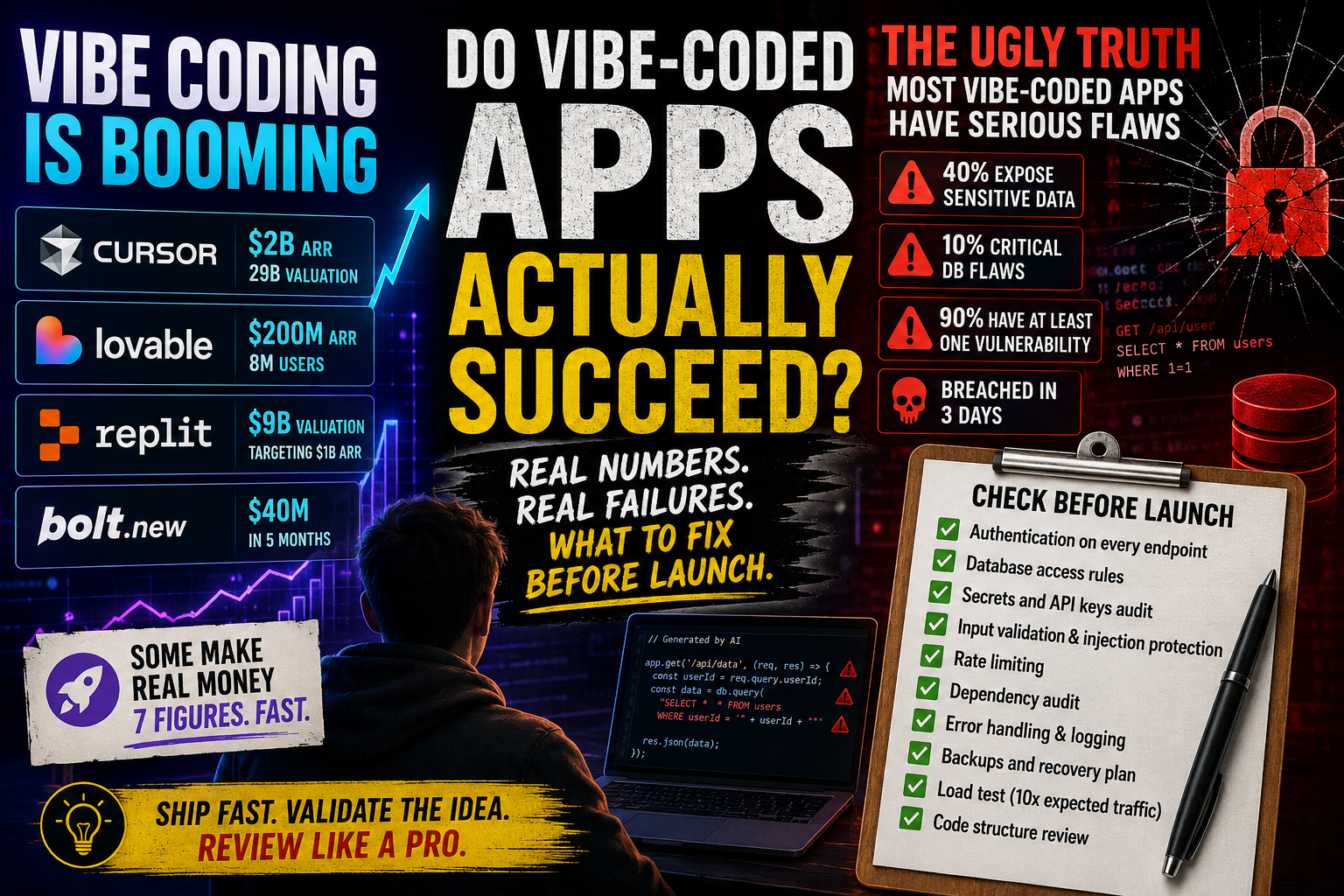
Cursor reached a roughly 2 billion dollar annual revenue run rate in early 2026, after a 29 billion dollar valuation late last year, with reports of an even larger round in progress
Lovable entered 2026 around 200 million dollars in annual recurring revenue, with about 8 million users and a reported 100,000 new projects created every day
Replit tripled its valuation to 9 billion dollars in early 2026 and is publicly targeting 1 billion dollars in revenue by year end
Bolt.new went from zero to 40 million dollars in revenue in roughly five months
So the platforms themselves are wildly profitable bets. That part is settled. The open question is whether the apps built on them succeed.
Yes, some vibe-coded apps make real money
The success stories exist, and they are not all tiny:
A healthcare staffing product built on Lovable reached 1 million euros in annual revenue within five months
An AI fashion platform hit 800,000 euros in annual revenue in nine months
A women's safety app built in 45 days by a founder with no coding background now does around 450,000 dollars in annual revenue
A browser-based sailing game built almost entirely with AI tools brings in about 8,000 dollars a month
In one recent Y Combinator batch, a quarter of the startups had codebases that were 95 percent AI-generated
Look closer at these wins and a pattern appears. None of them succeeded because of the code. They succeeded because the founder had distribution, a sharp niche, or perfect timing - and vibe coding compressed the time from idea to market from months to weeks. The AI wrote the first version. It did not find the customers.
How many actually succeed? The honest answer
Nobody has a reliable number, and you should be suspicious of anyone who claims one. Figures like "0.02 percent of vibe-coded apps succeed" circulate online with no methodology behind them.
What we can say from the visible data: Lovable alone reports around 100,000 new projects per day. The number of vibe-coded products that reach meaningful revenue in a year is, generously, in the hundreds. Whatever the exact ratio is, it rounds to zero.
That sounds damning, but it is the wrong way to read it. Most of those 100,000 daily projects were never meant to be businesses. They are prototypes, experiments, internal tools, and weekend ideas. The real shift is that failure has become almost free. Testing a startup idea used to cost 30,000 dollars and four months. Now it costs a subscription and a weekend.
The success rate per project is tiny. The cost per attempt collapsed even faster.
What is actually inside these apps
Here is where it stops being a fun story, because the security record of vibe-coded apps in production is genuinely bad.
Researchers who scanned over 5,000 publicly deployed vibe-coded apps in 2026 found that around 40 percent exposed sensitive data - medical records, financial information, customer details
A separate study of 1,645 Lovable-built apps found that over 10 percent had critical database security flaws that let anyone read user data
A vibe-coded social network was breached within three days of launch this year, leaking 1.5 million authentication tokens. Its founder had proudly said he did not write a single line of code
One first-quarter 2026 assessment found that over 90 percent of tested vibe-coded apps contained at least one vulnerability traceable to AI-generated code
CVEs directly attributed to AI-generated code are climbing month over month
The pattern in almost every incident is the same: the app worked. It demoed perfectly. Users signed up. The problems were invisible until someone hostile went looking.
The recurring problems professional developers find
When we review AI-generated codebases, the same issues come up again and again.
On the security side:
API endpoints with no authentication checks - the interface hides the buttons, but the endpoint answers to anyone
Databases with no row-level security, so any logged-in user can query other users' data
API keys and secrets shipped in client-side code, visible to anyone who opens developer tools
No input validation, leaving classic injection attacks wide open
No rate limiting, so a single script can scrape the entire database or run up your AI API bill overnight
On the architecture side:
Entire applications in a handful of giant files, because the AI kept appending instead of structuring
The same logic duplicated in five places, each version slightly different
No tests at all, so every change is a gamble
Errors swallowed silently, so things fail without anyone knowing
Hallucinated or abandoned dependencies pulled into the project
Database schemas that work for 100 users and fall over at 10,000
None of this means the app was a bad idea. It means the AI optimized for "works in the demo," because that is what it was asked for.
What to check before you make it public
If you have a vibe-coded app with real users on the horizon, this is the minimum review a professional should do before launch:
Authentication and authorization on every single endpoint, not just the visible pages
Database access rules - can one user ever read or modify another user's data
A full secrets audit - nothing sensitive in client code, repositories, or logs
Input validation and protection against injection on every form and API route
Rate limiting on anything expensive or scrapable
A dependency audit - is every package real, maintained, and needed
Error handling and logging - will you actually know when something breaks
Backups and a plan for restoring data
A basic load sanity check at 10x your expected traffic
A code structure triage - what must be refactored now versus what can wait
This kind of review takes days, not months. Compared to the cost of a breach, an exposed customer database, or a rewrite at 10,000 users, it is the cheapest insurance a founder can buy.
Takeaways
Vibe coding platforms are massive, well funded, and not going away
Real vibe-coded businesses exist, and some reached seven figures fast - almost always powered by distribution and niche, not by code quality
Per project, the success rate rounds to zero. Per attempt, the cost of trying has collapsed - that trade is still historically great for founders
The security record is the real problem: a large share of deployed vibe-coded apps leak data, and most contain at least one serious vulnerability
Ship the vibe-coded version to validate the idea. Get it professionally reviewed before real users and real data arrive
The founders winning with vibe coding in 2026 are not the ones who avoid professional developers.
They are the ones who know exactly when to bring them in.