
Has AI Sped Up Software Development? A Metric-by-Metric Look Since 2024
First, when did AI tools actually mature?
A fair comparison needs a clear before and after, so it helps to fix the timeline.
The consumer moment was late 2022, when ChatGPT launched and GitHub Copilot became generally available. The capability jump came in 2023 with more powerful models. But the tools that let you build whole features or apps from a prompt, the agentic ones, only started working reliably in 2025, according to developers who tested them closely.
Two later events matter most for adoption. GitHub released a free tier of Copilot in December 2024, which put AI assistance in front of millions of developers who had never paid for it. And in February 2025, the researcher Andrej Karpathy coined the term vibe coding to describe building software by describing it in plain language and letting AI write the code. By the end of that year, a dictionary named it word of the year.
So the honest framing is this. The capability arrived in 2023, but the mass adoption and the prompt-to-app workflows landed in late 2024 and through 2025. That is the period where you would expect to see a real change in output, and it is the window this comparison uses.
Metric 1: App store releases, the number that goes the wrong way
Start with the most visible public metric, because it is the one that quietly disproves the simple version of the story.
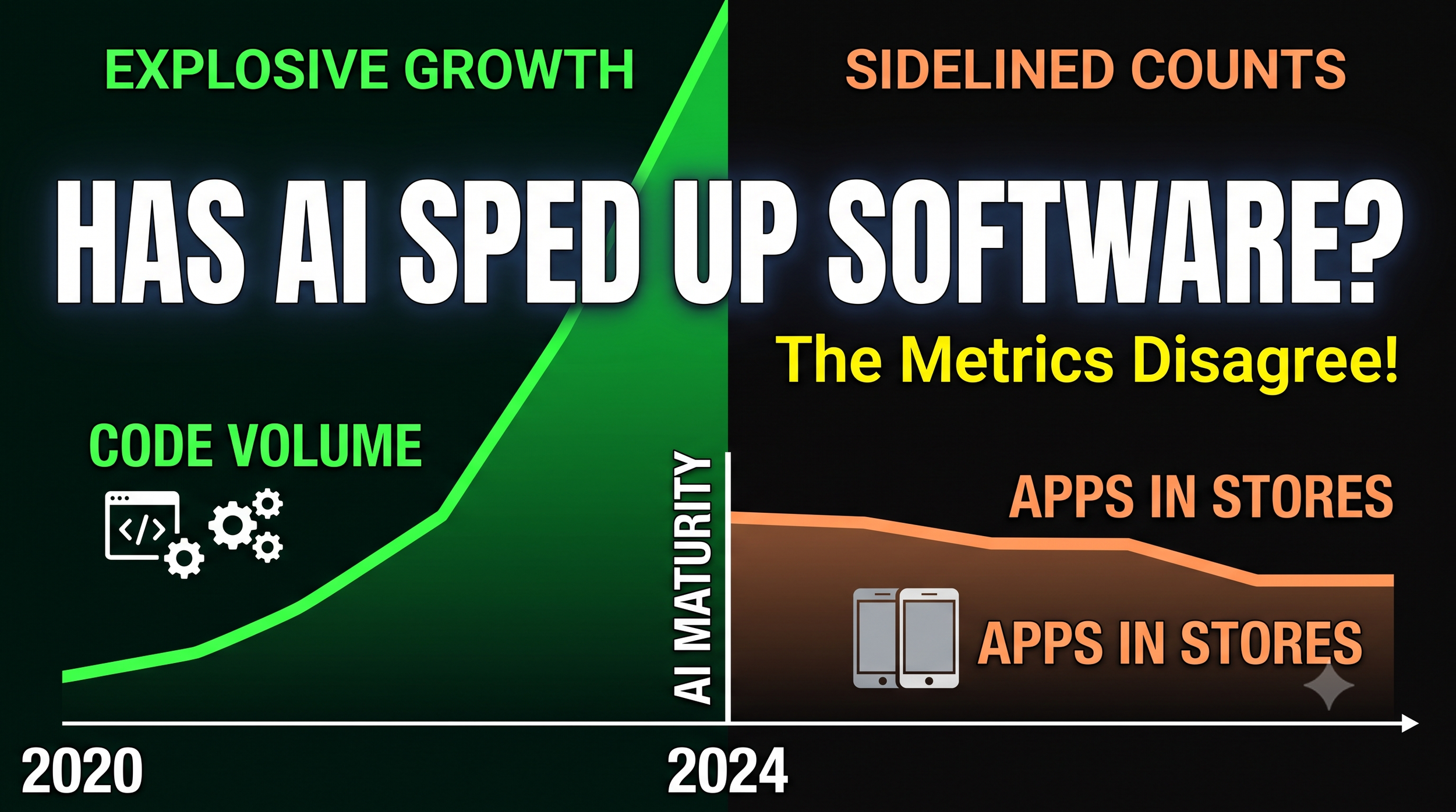
If AI made apps easier to build, you might expect more apps in the stores. The opposite happened on Android. According to the app intelligence firm Appfigures, the Google Play Store went from hosting roughly 3.4 million apps in early 2024 to about 1.8 million by spring 2025, a decline of around 47 percent. Apple's App Store stayed roughly flat over the same period, edging up from about 1.6 million to 1.64 million.
That looks like a collapse in app creation. It is not. The Google Play drop was a deliberate purge. In July 2024, Google raised its minimum quality requirements, banning apps with limited functionality and content, requiring new accounts to test apps with at least 20 users over two weeks, and tightening verification. The decline reflects apps being removed, not apps not being made.
In fact, new releases ticked up even as the total fell. In the first months of 2025, developers published more than 10,400 new apps on Google Play, a roughly 7 percent year-over-year increase. Submissions also kept flooding in: Google rejected over 1.75 million app submissions in 2025 for policy violations, down only modestly from the prior year.
There is a twist worth noting. Part of what the stores are fighting is a rising tide of low-effort, thin, and spammy apps, exactly the kind that cheap generation makes easier to produce. So AI may be increasing the volume of low-quality submissions at the same time the platforms are purging them, which leaves the headline count flat or falling.
The lesson for this whole comparison: app store counts are a broken proxy. They moved sideways or down for reasons that have little to do with whether building got easier.
Metric 2: Developers and code volume, the number that explodes
Now the metric that shows the opposite, and shows it clearly.
GitHub's annual Octoverse report, covering the year to August 2025, recorded the fastest absolute growth in its history: more than 36 million new developers in twelve months, roughly one per second, bringing the total past 180 million. The platform hosts over 630 million repositories. Developers created more than 230 new repositories every minute, merged around 23 percent more pull requests year over year, and pushed close to a billion commits in 2025, up about 25 percent.
Crucially, GitHub itself notes that this broke the historical pattern. Developer signups and repository creation used to follow predictable curves, and the launch of free Copilot in December 2024 sent those curves sharply upward, beyond prior projections. Eighty percent of new developers now use Copilot within their first week.
The split between private and public work is telling too. Private repositories, where most company work happens, grew about 33 percent year over year, faster than the 19 percent growth in public ones. More people are building, and more of the building is organizational rather than hobby projects.
On this metric, the pre-AI era was genuinely slower, and the change since 2024 looks like a step-change rather than a smooth trend.
Metric 3: How much of that code AI now writes
If more code is being produced, the next question is how much of it humans are actually typing.
The estimates vary by source and method, but they cluster high. By various accounts, somewhere between 40 and 46 percent of new code is now AI-generated across the industry. Google's leadership said on an earnings call that more than 30 percent of the company's new code is AI-generated, up from around 25 percent in late 2024. Microsoft has cited 20 to 30 percent in some repositories. Anthropic has said 70 to 90 percent of its own code is AI-written. The research firm Gartner has forecast that 60 percent of new software code will be AI-generated by 2026.
The footprint of AI inside software is growing just as fast. GitHub reported that more than 1.1 million public repositories now use a large language model toolkit, with nearly 694,000 of those created in a single year, a 178 percent increase. The count of AI-related repositories roughly doubled from 2023 to reach about 4.3 million.
This is a genuine break from the pre-AI baseline, because there is no earlier equivalent. A meaningful and rising share of the world's new code is now machine-generated, which simply was not true before this window.
Metric 4: Tool adoption, how universal it became
The volume numbers are downstream of how quickly developers adopted the tools, and that adoption was unusually fast.
Stack Overflow's developer survey, which polls tens of thousands of developers, found that around 84 percent use or plan to use AI tools as of 2025, up from 70 percent in 2023, a 14-point jump in two years. More recent industry figures put daily usage among US developers around 90 percent. GitHub Copilot passed 20 million all-time users by mid-2025, and the AI editor Cursor reached more than a million daily active users.
The plain reading is that AI coding moved from a niche curiosity to a near-default part of the workflow between 2023 and 2025. The pre-AI comparison is straightforward here: most developers were not using these tools, and now most are.
Metric 5: New builders, who can build now
This is where the claim that the pre-AI era was slower is most clearly true, and it is the most consequential shift of all.
Before these tools, a non-technical founder generally could not build working software without hiring an engineer. That barrier has partly fallen. By various reports, around 63 percent of people using vibe-coding tools identify as non-developers. People who could never have shipped their own product are now doing it.
The growth of the tools that enable this quantifies the demand better than any survey. The app-builder Lovable went from launch to 100 million dollars in annualized revenue in about eight months, described as the fastest-growing startup on record, and reportedly reached several hundred million in annualized revenue and tens of millions of created projects within roughly a year, at a valuation of 6.6 billion dollars. Bolt reached 40 million in annualized revenue within months of launch. Replit went from about 10 million to 100 million in annualized revenue in nine months after launching its agent, and raised at a 9 billion dollar valuation. Cursor scaled from around 1 million to over a billion in annualized revenue, among the fastest growth ever recorded for a software company. The combined valuation of the leading tools in this category grew several times over in a single year.
Even at the serious end, the shift shows up. The startup accelerator Y Combinator reported that roughly a quarter of its early-2025 batch had codebases that were over 90 percent AI-generated, a figure that would have been unthinkable a couple of years earlier.
Whatever else is contested, this is not: software creation extended to a large group of people who previously could not do it, and that happened almost entirely within this window.
Metric 6: Speed to a first version, weeks to hours
Closely related is how fast something working appears in the first place.
The repeated description across the industry is that the distance from idea to a deployed, working app compressed from weeks to hours, and that the six-to-twelve-month engineering cycle traditionally needed to reach a minimum viable product can now be partly bypassed for simple cases. Generating a basic working API across several files in a minute or two is now ordinary.
This is real and dramatic, with one important boundary. It describes the speed of getting a first version, a prototype, or an internal tool. It does not automatically describe the speed of shipping and maintaining production software, which is where the picture gets more complicated, and which is the next metric.
Metric 7: Does AI make developers faster? The contested one
Here the data genuinely splits, and an honest comparison has to hold both sides.
On one side, several studies show speedups. A controlled GitHub study found developers completed a specific task about 55 percent faster with AI assistance, with success rates also improving. A longitudinal study across companies including Microsoft and Accenture found roughly a 26 percent increase in completed tasks for developers using Copilot. And a large real-world analysis by Faros AI, covering more than 10,000 developers, found that AI clearly increased individual throughput, the number of tasks completed.
On the other side sits the most rigorous study to date, and it points the opposite way. In a randomized controlled trial published in July 2025, the nonprofit METR had 16 experienced open-source developers work on their own large, mature codebases, the kind they knew intimately, using leading AI tools of the time. The developers took 19 percent longer to complete tasks with AI than without it. The striking part was the perception gap: they had expected a 24 percent speedup, and even after finishing they believed AI had sped them up by about 20 percent, despite being measurably slower. Their result also contradicted predictions from economists and machine-learning experts, who had expected speedups of nearly 40 percent.
The two findings are less contradictory than they look once you reconcile them. The same Faros analysis that found higher throughput also found no correlation between AI adoption and the time it took a task or pull request to actually ship. In other words, individuals produce more, but the organization does not deliver faster, because the bottleneck moves downstream to code review, testing, deployment, and coordination. And the METR slowdown concentrated in exactly the hardest setting: expert developers working in complex code they already understood, where the time spent reviewing and correcting AI output outweighed the time it saved.
A few honest caveats cut in AI's favor. The METR study used early-2025 tools, before the more capable agents that arrived later in the year. Its sample was small and its setting unusually demanding. And the one participant most experienced with the AI editor actually sped up. METR tried to run a follow-up with newer tools in late 2025 but could not get a clean reading, partly because too many developers refused to work without AI at all, which itself says something about how entrenched the tools have become.
The defensible conclusion is narrow. AI clearly increases the volume of output and helps with certain kinds of work, especially scaffolding, boilerplate, and unfamiliar code. The claim that it makes experienced developers reliably faster on complex production systems is not established, and there is a real gap between how fast people feel and how fast they are.
Metric 8: Quality, the cost that rose with the speed
A neutral comparison cannot stop at quantity and speed, because the same window shows a measurable quality cost.
Developer trust in the accuracy of AI-generated code actually fell, from around 40 percent in 2024 to about 29 percent in 2025. A December 2025 analysis by CodeRabbit of several hundred open-source pull requests found that code co-authored with AI contained roughly 1.7 times more major issues and about 2.74 times more security vulnerabilities than human-written code. Security researchers found that more than 10 percent of a large sample of apps built with one popular tool shipped with flaws that exposed user data. In one widely reported incident, an AI agent deleted a production database despite instructions not to make changes.
There is also a structural mismatch. Generation got much faster while testing largely did not, because test suites are still mostly written and maintained by hand. Teams report shipping several times faster while their quality checks run at human speed, and a large share of developers admit to pushing AI-generated code to production without fully reviewing it. A meaningful number also report that debugging AI output has, at least once, cost them more time than writing the code themselves would have.
So the volume and speed gains are real, and so is the rising review, security, and maintenance debt that came with them. More and faster is not the same as better.
So, is more software being built, faster, than before AI?
Putting the metrics together gives a clear, if layered, answer.
On volume and access, the answer is unambiguously yes, and the change is a step-change rather than a trend. There are far more developers, far more repositories, far more code, a rising share of it machine-generated, a large new population of non-technical builders, and a dramatic compression in the time to a first working version. On these measures the pre-AI era was genuinely slower and narrower, and the shift happened mostly since 2024.
On the speed of skilled work on complex systems, the answer is contested. The one rigorous controlled trial found a slowdown, broader data shows individual throughput rising while organizational delivery often does not, and perceived speed consistently runs ahead of measured speed.
And on quality, the gains came with a cost: more bugs, more vulnerabilities, falling trust, and a widening gap between how fast code is generated and how fast it is reviewed and tested.
The honest headline is that AI massively increased the quantity, accessibility, and prototyping speed of software since 2024, while the claim that it makes experienced developers reliably faster on production work remains unproven, and quality assurance has become the new constraint.
The app store paradox is the clean illustration of why you have to read the metrics carefully. The most visible public number, apps in the stores, is one of the worst measures of all of this, because it is distorted by quality purges and by the same flood of low-effort output that cheap generation enables. The real change is upstream, in who is building, how much they are producing, and how quickly a first version appears. That is where the pre-AI era really was slower, and where the last two years genuinely broke the trend.
Frequently asked questions
Did AI actually make software development faster since 2024?
It depends on the measure. The volume of code and the speed of building a first prototype clearly increased, with idea-to-working-app times compressing from weeks to hours. But whether experienced developers are faster on complex production work is contested. The most rigorous controlled trial, by METR in 2025, found they were actually about 19 percent slower, even though they believed they were faster.
Why did the number of apps in the app stores go down?
Because of deliberate quality purges, not a drop in app creation. Google Play removed roughly 47 percent of its apps between early 2024 and spring 2025 after tightening its quality and verification rules, while Apple's count stayed flat. New app releases actually rose slightly during the same period, so the falling total reflects cleanup rather than less building.
How much code is now written by AI?
Estimates vary but cluster between roughly 40 and 46 percent of new code industry-wide. Google has said more than 30 percent of its new code is AI-generated, Microsoft has cited 20 to 30 percent in some repositories, and Anthropic has reported 70 to 90 percent internally. Gartner has forecast 60 percent of new code being AI-generated by 2026.
How many developers use AI coding tools now?
Adoption became near-universal between 2023 and 2025. Stack Overflow's survey found about 84 percent of developers use or plan to use AI tools in 2025, up from 70 percent in 2023, and more recent figures put daily usage among US developers around 90 percent. GitHub also reported that 80 percent of new developers use Copilot within their first week.
What is vibe coding and how big did it get?
Vibe coding, a term coined in early 2025, means building software by describing it in plain language and letting AI write the code, often without reviewing every line. It grew fast: around 63 percent of users of these tools are non-developers, and platforms like Lovable, Bolt, Replit, and Cursor reached tens or hundreds of millions in annualized revenue within months to a couple of years of launching.
Is AI-generated code lower quality?
The data suggests added risk. Developer trust in AI code accuracy fell from around 40 percent in 2024 to 29 percent in 2025, and one analysis found AI co-authored code had roughly 1.7 times more major issues and 2.74 times more security vulnerabilities than human-written code. Testing has not kept pace with generation speed, which has created a review and security backlog.
Was software development really slower before AI?
For getting a first version built and for letting non-technical people build at all, yes, clearly. Prototypes that once took weeks can now appear in hours, and people who could not code previously can now ship working apps. For shipping and maintaining complex production software reliably, the evidence that AI is faster is much weaker and still debated.