
Alex Hormozi's Playbook, Translated for SaaS and Online Founders
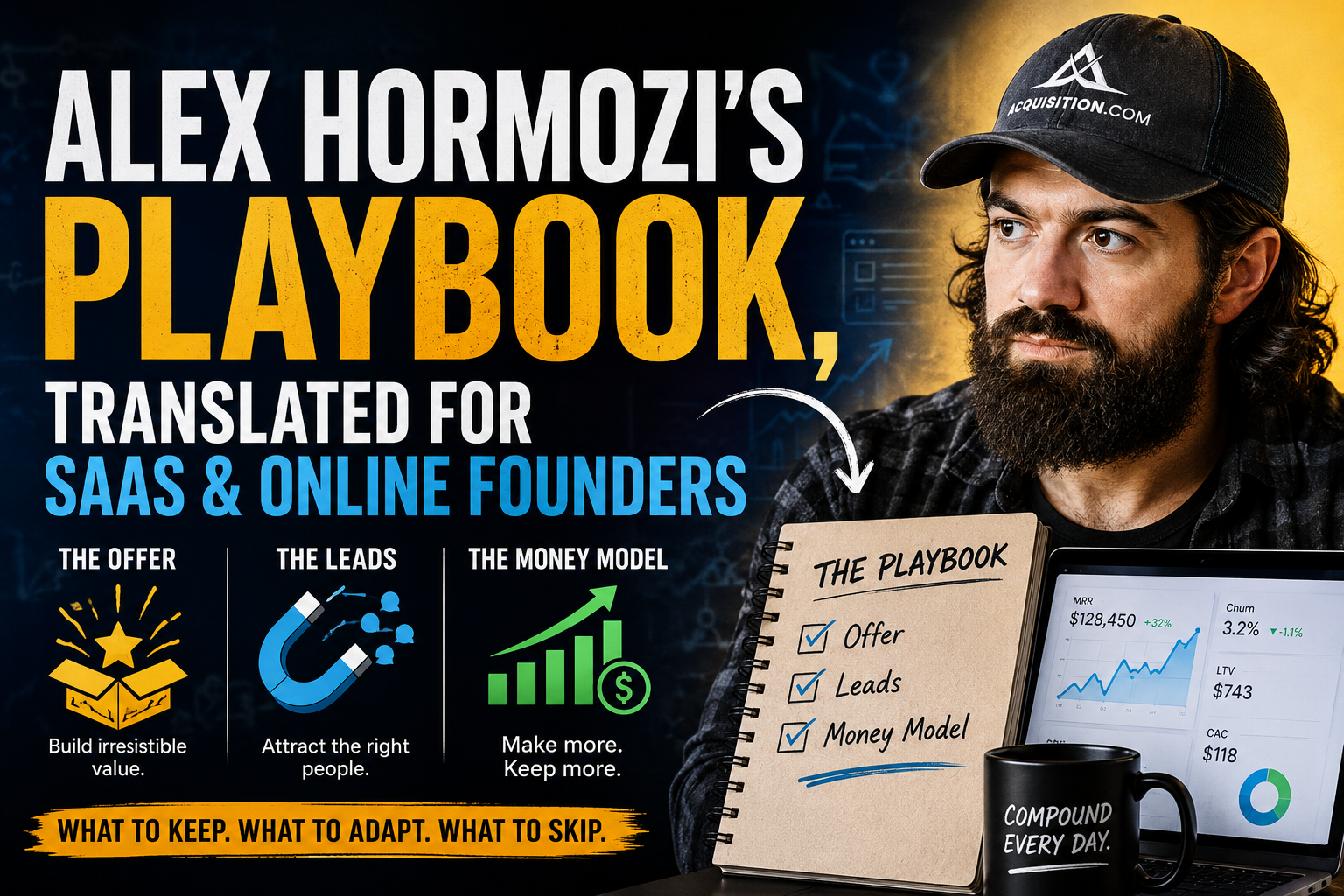
First, who Hormozi actually is, and why it matters here
A quick grounding, because the context shapes the advice.
Hormozi built his name and money in physical and service businesses. He scaled a gym-launching company to a large exit, ran a supplement brand, and sold done-for-you services and high-ticket information products. His current company operates more like a private-equity firm, acquiring and improving businesses by applying his frameworks. His own numbers come from running enormous paid-advertising operations, reportedly generating tens of thousands of leads a day across many industries at a lifetime return on ad spend most companies will never see.
That background matters because it quietly biases the advice. His examples assume a high-ticket offer, a sales team or a sales call, and a big, profitable paid-ads engine. When his advice leans on those assumptions, it needs translating before a software founder copies it. When it does not, it often transfers almost word for word. The trick is telling the two apart, which is what the rest of this does.
Part 1: The offer
Hormozi's first book argues that most businesses do not have a product problem. They have an offer problem. The product might be fine, but the way it is packaged, priced, and presented is weak. For software founders who believe their problem is purely the code, that reframing alone is worth the price of entry.
The Value Equation, translated to your landing page and onboarding
His central framework is the Value Equation. In plain terms, perceived value goes up when you increase the dream outcome and the customer's belief that they will actually achieve it, and goes down as you increase the time it takes and the effort it requires. Raise the top two, lower the bottom two.
This maps onto SaaS almost perfectly, and most founders only optimize half of it.
The dream outcome is the transformation your product delivers, not its feature list. "Track your tasks" is a feature. "Never drop a commitment again" is a dream outcome. The perceived likelihood of achievement is everything that makes a visitor believe it will work for them specifically: social proof, case studies, guarantees, a free trial, transparent pricing.
The two levers almost everyone ignores are the bottom of the equation. Time delay, in software, is time-to-value, the gap between signing up and the first real win. Effort and sacrifice is onboarding friction, setup, the learning curve, and the pain of migrating from whatever they use now. Reducing those two is often the highest-return work a SaaS founder can do, and it is exactly where the Value Equation points.
There is a bonus here that Hormozi himself notes: solutions that cost a lot to create once but almost nothing to deliver afterward are the most valuable kind. That is a precise description of software. It means you can stack genuine value into your product cheaply, where a service business would have to pay a human to deliver each addition. The equation works in your favor more than it works in his.
Verdict: keep this one as-is. It is arguably more useful for SaaS than for the services it was written for.
The Grand Slam Offer, translated to positioning and the reason to switch
Hormozi's term for an irresistible offer is the Grand Slam Offer, built so the value so clearly outweighs the price that saying no feels irrational. He stacks guarantees, bonuses, urgency, and naming to get there.
The translatable core for SaaS is that the offer is rarely your code. It is the packaging around it: the positioning, the proof, the onboarding, the guarantee, and the help switching. Two products with identical features can convert very differently based on the offer wrapped around them. A risk-reversal like a real money-back guarantee, hands-on onboarding, or free migration can matter more than another feature.
This is where the first adaptation comes in, though. His offer-stacking was designed for high-ticket, one-time or coaching sales, where a buyer makes a single considered decision. A self-serve product at twenty dollars a month cannot stack the same way, and "feel stupid saying no" matters far less when the cost of trying is a free trial and a credit card.
So split it by motion. For self-serve SaaS, the real offer is the free trial plus fast activation plus obvious return on investment, not a pile of bonuses. For sales-led or enterprise SaaS, the full grand-slam approach, a pilot, a guarantee, white-glove onboarding, a service-level agreement, transfers much more directly, because there is a real sales conversation to put it in.
Verdict: keep the principle, adapt the tactics to your sales motion.
Escaping commoditization, translated to positioning
Hormozi argues you escape being a commodity by changing one of three things: what you sell, who you sell to, or how you sell it. The goal is to become a category of one, where direct comparison stops working.
This is some of the most transferable advice in his catalog, because commoditization is the default fate of most SaaS. There are forty project management tools, and being marginally better than the others is not a strategy. Changing who you sell to is often the cleanest escape: a project management tool built specifically for, say, architecture firms can charge more and convert better than a general one, because it speaks to a narrow audience in their own language. Changing how you deliver, a different model or a sharper wedge, works too.
Verdict: keep it. This is positioning and verticalization, and it is exactly right for software.
Part 2: The leads
Once you have an offer, the next problem is getting people to see it. Hormozi's framework here is refreshingly simple, and most of it carries over.
The Core Four, translated to SaaS distribution
He argues there are only four ways to get attention: post free content to many people, run paid ads to many people, reach out one-to-one to people who already know you, and reach out one-to-one to strangers. Content, paid ads, warm outreach, cold outreach. Every channel is a version of one of these.
For a software founder, each maps to something concrete, but with very different fit.
Content, meaning SEO, writing, video, and building in public, is usually the highest-leverage channel for a bootstrapped SaaS, because it compounds and does not require a budget you do not have. Warm outreach, your network, a waitlist, communities you already belong to, is how most products get their first hundred users, and it is underrated precisely because it does not scale, which makes founders skip it. Cold outreach, cold email and direct messages, transfers for business-focused and sales-led products, and is mostly irrelevant for consumer self-serve software.
Paid ads are where his playbook breaks hardest for most online founders, and it is worth being blunt about it. Hormozi runs paid acquisition at a scale and a return that depend on a high-ticket offer and years of optimization. A bootstrapped SaaS founder selling a low-priced subscription usually cannot make paid ads pencil out, because the payback period on a small monthly fee is long and the early targeting is rough. The lesson to take is not "run ads like Hormozi." It is "earn attention with content first, and layer paid on later, once you actually know your lifetime value and acquisition cost."
Verdict: keep the framework, lean on content and warm outreach early, and treat his paid-ads intensity as something to grow into, not start with.
Lead magnets, translated to free tools and freemium
Hormozi's idea of a lead magnet is to solve a small, adjacent problem for free in order to capture someone who is interested, then sell them the bigger solution. He calls the interested contact an engaged lead, and treats it as the real output of advertising.
This is the single cleanest translation in the whole playbook, because online builders already do it. A free tool that solves one narrow problem, a calculator, a generator, a template, a checklist, is a lead magnet. A free tier is a lead magnet. A free trial is a lead magnet. They all solve a small adjacent problem to pull in someone who might pay for the full product.
The practical move is to look at the problems sitting next to your core product and turn the smallest, most useful ones into free tools. They rank in search, they get shared, and they bring in exactly the people who have the problem you charge to solve.
Verdict: keep it, and lean into it harder than you probably are. It fits software almost perfectly.
Pick a narrow, painful, valuable problem
Underneath the offer and the leads sits Hormozi's advice on which problem to build around in the first place: pick one that is narrow, painful, and attached to people who can pay. He favors painkillers over vitamins, the urgent over the nice-to-have.
This is essentially product-market-fit advice, and it transfers without modification. It also lines up with the most common reason startups die, which is building something not enough people needed badly enough. A narrow, painful problem with people who can pay is the whole game, and Hormozi states it more plainly than most startup writing does.
Verdict: keep it. It is the foundation everything else sits on.
Part 3: The money model
His most recent book is about the money model, the deliberate sequence of how you make money from a customer rather than just what you sell them. This is where SaaS founders need to translate most carefully, because software's economics are genuinely different from his.
Get cash, get more cash, get the most cash, translated to SaaS monetization
He breaks the money model into three stages. First, get cash by designing an attraction offer that brings in customers profitably, even at a slim margin, so you can fund acquisition. Then get more cash through upsells and downsells that raise revenue per customer. Then get the most cash through continuity, recurring revenue that maximizes lifetime value.
Here is the interesting twist for SaaS. His third stage, recurring revenue, is where software starts. A subscription product lives in continuity by default. So the part Hormozi treats as the hard-won endgame is your baseline.
That flips the lesson. SaaS founders usually have recurring revenue handled and neglect the other two stages. They often have no real front-end attraction offer and a weak expansion engine. So the move is to borrow his first two stages rather than his third. The first stage translates to thinking hard about acquisition economics: a low-priced entry tier, a trial that converts, or an annual-upfront discount that pulls cash forward to fund growth, with attention to how fast a customer pays back what it cost to acquire them. The second stage translates to expansion revenue: upgrades, additional seats, usage-based growth, and add-ons, which for healthy SaaS is where a large share of growth comes from.
The adaptation, again, is on acquisition. His model often funds aggressive paid acquisition with immediate upsells, which works for high-velocity transactional businesses. SaaS payback periods are longer and churn matters more, so you cannot run the same play at the same intensity. Take the structure, run it on SaaS math.
Verdict: borrow the front-end offer and the expansion engine, ignore the assumption of immediate paid-funded acquisition.
Premium pricing, translated
Hormozi makes a strong case for premium pricing, arguing that higher prices attract more committed customers, fund a better product, and create a virtuous cycle. He warns against competing on price, which erodes margins and attracts the worst customers.
This transfers reasonably well. Plenty of SaaS founders underprice out of fear, sell on feature lists instead of value, and fill their support queue with low-paying, high-maintenance users. Pricing to value rather than to the bottom of the market is sound.
The caveat is segment. Premium pricing works most cleanly in business and value-based contexts, where a buyer can tie your price to a return. Consumer and self-serve software has real price sensitivity that his high-ticket world does not, so "just charge more" has limits. Charge to value, but know which market you are in.
Verdict: keep the principle, respect the price ceiling your market actually has.
Part 4: The operating philosophy
Beyond the frameworks, Hormozi repeats a set of operating principles, and this is the part that transfers most cleanly of all, because it is not tied to any particular business model.
He preaches systematizing everything, documenting and automating repeatable processes. For a solo or lean software team, that is gold: templatize your onboarding emails, automate your support, document your release process. He preaches sticking with the boring fundamentals and avoiding shiny objects, which for a SaaS founder means not rewriting your stack every quarter and not chasing every new trend instead of talking to users. He preaches the long game, and his own story, years of quiet groundwork before a breakout, is a useful antidote to the expectation that content or SEO should work in a month. And he preaches volume, simply doing more reps, shipping, and publishing than feels comfortable.
One honest caveat belongs here. Hormozi's work ethic shades into a grind-everything message that is worth holding at arm's length. The useful version is obsession in service of the work and a refusal to quit. The unhelpful version is treating overwork as a badge, which burns founders out and is survived by a minority who then write about how it was worth it. Take the discipline, not the martyrdom.
Verdict: keep almost all of it. This is the most portable part of the playbook.
What to skip, or heavily adapt, for an online business
To pull the caveats into one place, here is what does not transfer cleanly to a bootstrapped, low-priced software business.
Paid-advertising-first acquisition is built for high-ticket offers and rarely pencils out for low-priced SaaS early on. Earn attention with content first. The full high-ticket offer-stacking machinery is built for coaching and done-for-you sales, not self-serve subscriptions, so adapt it to your sales motion. Cold-outreach armies fit business-focused products and are mostly noise for consumer self-serve. And his acquisition-firm model, buying and improving existing businesses, is closer to private equity than to building one product, so it is largely irrelevant to a first-time founder shipping software.
None of this is a knock on the advice. It is just advice shaped by a different business, and copying it without translating it is how founders waste months.
The honest bottom line
Hormozi's frameworks are genuinely useful for SaaS and online founders, more than the skeptics assume and less universally than the fans claim. The Value Equation, the lead-magnet idea, the discipline of picking a narrow and painful problem, and the operating principles transfer almost directly, and a few of them suit software better than they suit the businesses he built them in.
What does not transfer is the capital-heavy, high-ticket, paid-acquisition machinery, which is downstream of the specific kind of business he runs. Take the thinking, adapt the tactics to your own economics, and skip the parts built for a different sport.
If there is a single meta-lesson here, it is one Hormozi would probably endorse: do not copy any operator's tactics wholesale. Copy the reasoning, then translate it to the realities of your own business. For a software founder, that means treating his playbook as a strong set of frameworks to adapt, not a script to run.
Frequently asked questions
Do Alex Hormozi's frameworks work for SaaS and online businesses?
Many of them do, with some translation. His Value Equation, lead-magnet concept, advice on picking a narrow and painful problem, and operating principles transfer well to software, and in a few cases fit better than they fit his own service businesses. What needs adapting is his reliance on high-ticket offers and heavy paid advertising, which do not suit most low-priced subscription products.
What is Hormozi's Value Equation, in SaaS terms?
It says perceived value rises when you increase the dream outcome and the customer's belief they will achieve it, and decreases as time and effort go up. For SaaS, that translates to selling the transformation rather than features, backing it with proof and trials, and ruthlessly reducing time-to-value and onboarding friction. The last two are the most commonly neglected levers in software.
How does Hormozi's lead-magnet idea apply to software?
Almost directly. A lead magnet solves a small adjacent problem for free to capture an interested user. In software that is a free tool, a free tier, a free trial, or a template. Building free tools around the edges of your core product is one of the cleanest ways to apply his thinking.
What part of Hormozi's advice should SaaS founders ignore?
The parts built for his specific businesses: starting with heavy paid advertising, stacking high-ticket offers meant for coaching or done-for-you sales, running large cold-outreach operations for self-serve products, and his acquisition-firm model, which is closer to private equity than to building a single product.
How does the money model apply to a subscription business?
His model runs from getting cash to upselling to building recurring revenue. Since SaaS already starts with recurring revenue, the useful move is to borrow his first two stages, a strong front-end offer and a real expansion or upsell engine, rather than his third, which you already have. Just run them on SaaS economics, where payback periods are longer and churn matters.
Should online founders use premium pricing like Hormozi recommends?
Often yes, with limits. Pricing to value rather than to the bottom of the market attracts more committed customers and funds a better product. But premium pricing works most cleanly in business and value-based contexts, while consumer and self-serve software faces real price sensitivity, so there is a ceiling his high-ticket world does not have.