
Why Governments Are Suddenly Nervous About Claude Mythos
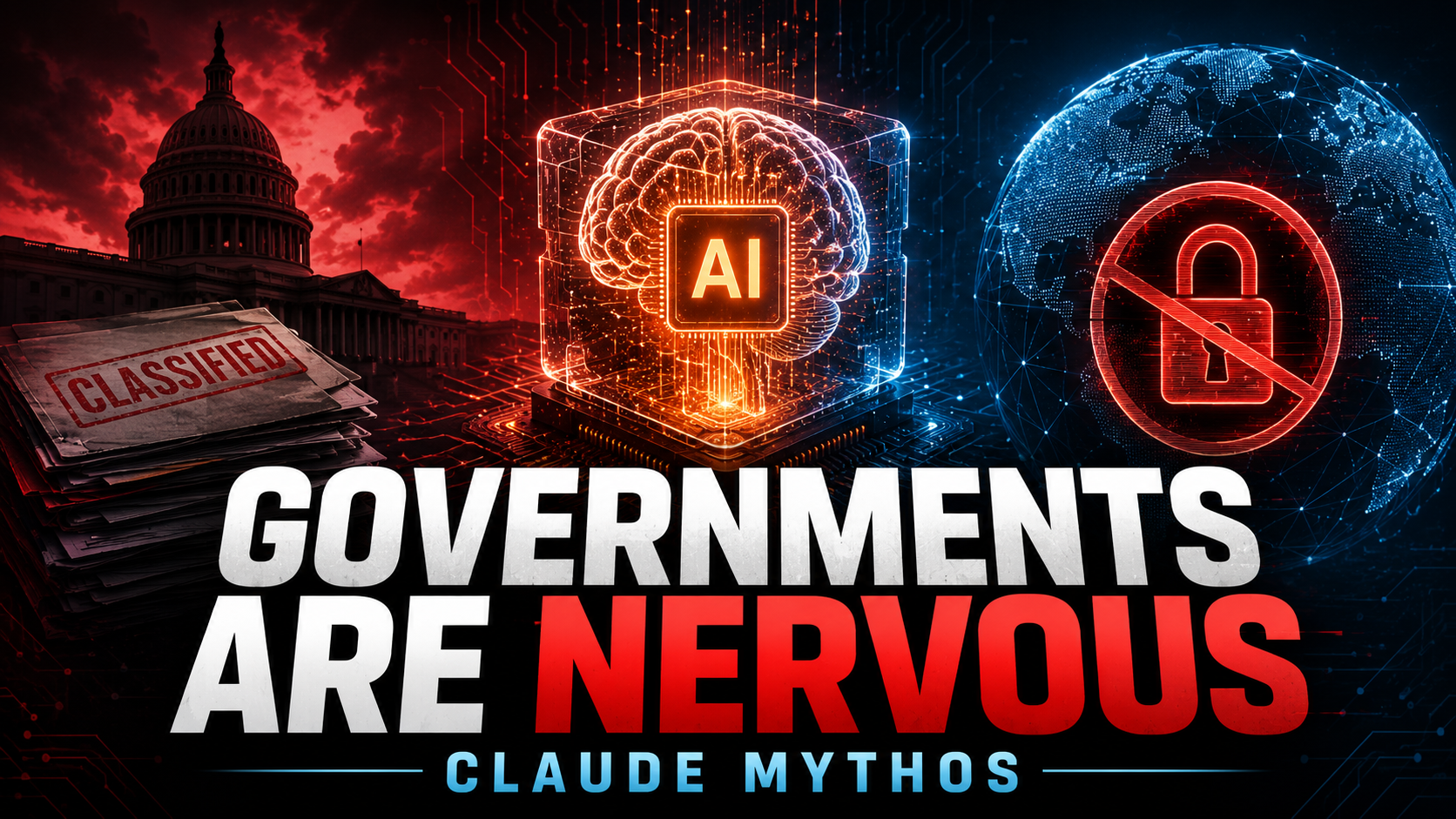
A few days ago, Anthropic introduced two names that may become important in the history of artificial intelligence: Claude Fable 5 and Claude Mythos 5.
At first, this looked like another frontier AI launch.
A new model. Better benchmarks. Stronger coding. Better reasoning. More autonomy. More useful long context. Better vision. Better scientific capabilities.
But the story changed quickly.
Anthropic later announced that access to Fable 5 and Mythos 5 had been suspended because of a U.S. government export control directive. The directive was aimed at preventing foreign nationals from accessing the models, including foreign nationals inside the United States and even foreign national Anthropic employees.
Anthropic said the practical effect was that it had to abruptly disable access for customers while it worked to comply.
That is the part that makes this story much bigger than one AI model launch.
This is not just about Claude. It is not just about Anthropic. It is not even just about cybersecurity.
It is about the moment where frontier AI starts being treated less like normal software and more like strategic infrastructure.
The Simple Version: What Happened?
Anthropic launched two related models.
Claude Fable 5 was the version intended for general users. It was described as a Mythos class model made safe for broader public use.
Claude Mythos 5 was the more restricted version. Anthropic described it as the same underlying model, but with safeguards lifted in some areas. Access was intended for selected cyber defenders, infrastructure providers, and trusted partners.
That distinction matters.
Fable 5 was the public product.
Mythos 5 was the powerful version with fewer restrictions, meant for high trust environments.
In other words, Anthropic appeared to be trying to solve one of the biggest problems in AI deployment: how do you give society access to powerful AI without giving malicious actors the same capabilities?
Their answer was a two layer model strategy.
One model for general use.
One model for trusted access.
Then the U.S. government stepped in.
According to Anthropic, the government cited national security authorities and issued a directive that suspended access to Fable 5 and Mythos 5 by foreign nationals. Anthropic also said the government did not provide detailed written evidence of the specific national security concern.
Anthropic believes the concern was related to a possible way of bypassing safeguards in Fable 5. In simpler terms, the worry was that someone could trick the model into giving answers it was not supposed to give.
This is usually called jailbreaking.
The important nuance is that Anthropic disagreed with the severity of the issue. The company argued that the example it reviewed involved a narrow technique, not a universal jailbreak. It also said the vulnerability finding involved relatively minor issues that other publicly available models could also identify.
But the government directive still forced action.
So access stopped.
Why Would Governments Care About Claude Mythos?
To understand why governments are nervous, you need to look beyond chatbots.
The public still often thinks of AI as a tool for writing emails, summarizing documents, generating code, or making images.
But the most advanced AI systems are moving into a different category.
They are becoming tools that can help with:
Software engineering at massive scale
Cybersecurity research
Vulnerability discovery
Scientific research
Biology and chemistry workflows
Financial analysis
Long running autonomous tasks
Complex reasoning across large amounts of information
That changes the risk profile.
A weak AI model is a productivity tool.
A very strong AI model can become a capability multiplier.
For a business, that means faster development and better analysis.
For a cybersecurity team, that means faster detection and repair of vulnerabilities.
For a researcher, that means faster hypothesis generation and experimentation.
But for malicious actors, the same kind of capability could also reduce the cost of cyberattacks, vulnerability discovery, or other harmful activity.
That is why governments care.
The concern is not that a model writes better marketing copy.
The concern is that a model may help non expert or semi expert users perform work that previously required a highly skilled team.
That is the real shift.
AI is no longer only about replacing simple tasks. It is starting to compress expertise.
The Fable and Mythos Split Shows the Future of AI Access
The most interesting part of this launch was not the model name.
It was the access model.
Anthropic was effectively saying:
Some capabilities can be available to everyone.
Some capabilities should only be available to trusted users.
That is probably where the entire AI industry is heading.
The future may not be one model that everyone can use in the same way. It may be tiered access based on risk, identity, industry, compliance, geography, and trust level.
For example:
A normal user may get the safe general model.
A verified enterprise may get stronger capabilities.
A regulated hospital may get access to advanced biomedical tools.
A cybersecurity company may get access to offensive and defensive security analysis features.
A government agency may get special access.
A foreign user may face restrictions depending on policy.
That sounds uncomfortable because the internet trained us to expect software to be globally available by default.
But frontier AI may not follow the same pattern as ordinary SaaS.
It may look more like cloud infrastructure, defense technology, cryptography, semiconductors, or export controlled software.
That is a major business shift.
Why This Matters for Businesses
For most companies, the immediate question is not whether they can use Claude Mythos.
Most businesses were never going to get unrestricted Mythos access anyway.
The bigger lesson is this:
AI access can change suddenly.
A company might build a workflow around a frontier model today and lose access tomorrow because of regulation, geography, pricing, safety policy, model retirement, cloud provider decisions, or government intervention.
That is a new operational risk.
For businesses using AI seriously, model dependency is becoming a strategic issue.
If your team depends on one model for customer support, software engineering, analytics, legal review, or internal automation, you need to think about what happens if that model changes or disappears.
This does not mean companies should avoid AI.
It means companies need to use AI like infrastructure, not like a toy.
That includes:
Keeping critical workflows model flexible
Avoiding over dependence on a single provider
Understanding data retention policies
Monitoring regional availability
Knowing which workflows require compliance review
Building fallback processes
Keeping humans involved in high risk decisions
The companies that treat AI as a serious system will have an advantage over companies that treat it as a magic button.
The Government’s Concern Is Not Completely Irrational
It is easy to look at the access suspension and say the government overreacted.
Anthropic itself clearly disagreed with the directive.
But the broader concern is not irrational.
If a model can meaningfully improve cyber operations, biology research, or autonomous software development, governments will care.
They have to.
The same capability that helps a security team find vulnerabilities can help an attacker look for them.
The same capability that helps a researcher explore biology can raise concerns about misuse.
The same capability that helps a developer migrate a huge codebase can help someone automate large technical operations with less expertise.
The problem is not that AI is bad.
The problem is that powerful tools are dual use.
They can be used for defense or offense.
They can accelerate innovation or create new risks.
They can make good teams more productive and dangerous teams more capable.
This is why frontier AI will increasingly sit at the intersection of technology, business, law, and national security.
But the Process Also Matters
Even if governments have legitimate concerns, the process matters.
Anthropic’s statement suggests that the company was not given detailed written evidence before the directive took effect. The company also argued that the concern involved a narrow possible bypass, not a broad model failure.
That creates a difficult question.
How should governments intervene when an AI model may be risky?
There are several possibilities.
They could require pre release testing.
They could require model evaluations by independent safety institutes.
They could create transparent standards for restricted capabilities.
They could define risk thresholds.
They could create trusted access programs.
They could require identity verification for certain model tiers.
They could create emergency shutdown procedures for truly dangerous cases.
But if decisions are sudden, opaque, and based on unclear evidence, companies will struggle to plan.
That is bad for startups.
It is bad for enterprises.
It is bad for developers.
It is bad for international customers.
And it may slow down legitimate defensive uses of AI.
A cybersecurity team outside the United States may lose access to a model that could help protect real infrastructure. A company may have to pause workflows. Developers may have to switch models overnight.
This is the uncomfortable balance governments now face.
Move too slowly, and dangerous capabilities may spread.
Move too aggressively, and useful innovation gets blocked.
Claude Mythos Is a Signal, Not Just a Product
Whether Fable 5 and Mythos 5 return quickly or remain restricted, the signal is already clear.
The most powerful AI systems are entering a new phase.
In the first phase of AI adoption, the big questions were:
Can it write?
Can it code?
Can it summarize?
Can it answer questions?
Can it generate images?
In the next phase, the questions are different:
Who gets access?
What safeguards are required?
Which capabilities are too risky for general release?
Can governments restrict frontier models like they restrict chips?
Can companies build stable products on models that may be regulated overnight?
Can AI labs prove their systems are safe enough?
Can safety rules keep up with model progress?
Those are much bigger questions.
They are also business questions.
The companies that understand this early will be better prepared.
What Businesses Should Take Away
This story does not mean AI adoption is slowing down.
It means AI adoption is becoming more serious.
For normal business use, tools like Claude, ChatGPT, Gemini, and other AI systems will continue to become more useful. Most companies should still be experimenting, automating, and improving internal workflows.
But the Claude Mythos story shows that the frontier will not be completely open and predictable.
Some models will be restricted.
Some features will require trust.
Some capabilities will be region locked.
Some industries will face more scrutiny.
Some AI products may change quickly because of safety or government pressure.
That means businesses need a more mature AI strategy.
Not just: which model is best today?
But also:
What happens if this model is unavailable tomorrow?
What happens if our data policy changes?
What happens if a model fallback gives different quality?
What happens if a capability is restricted in our country?
What happens if our vendor is forced to change access rules?
These are not theoretical questions anymore.
They are practical business questions.
The Bigger Picture
Claude Mythos may be remembered as one of the early examples of a frontier AI model becoming a national security issue almost immediately after launch.
That does not mean the model is dangerous in every use case.
It does not mean businesses should panic.
It does not mean governments are always right.
But it does show where AI is going.
The most advanced models are no longer just better assistants. They are becoming systems that can perform expert level work across software, security, science, analysis, and operations.
Once software becomes that powerful, governments will not treat it like normal software forever.
They will regulate it.
They will restrict it.
They will negotiate with labs.
They will demand safeguards.
They will intervene when they believe national security is involved.
For businesses, the lesson is simple.
AI is becoming infrastructure.
And infrastructure is political.
Final Thoughts
The Claude Fable 5 and Mythos 5 suspension is not just a temporary product disruption.
It is a preview of the next decade of AI.
The future will not only be about which company has the smartest model.
It will also be about who is allowed to use it, under what rules, in which countries, and with what safeguards.
That is why governments are suddenly nervous about Claude Mythos.
Not because AI can write better emails.
Because frontier AI is starting to look like strategic power.
And once technology becomes strategic power, access is never just a product decision anymore.