
Claude Fable 5 and Mythos 5: Anthropic Just Shipped a Model Above Opus, and the Real Story Is How It's Gated
What Anthropic Actually Shipped
Anthropic introduced a new tier of models called Mythos-class. These sit above the Opus class in raw capability. The first one, Claude Mythos Preview, went out in April to a small group through Project Glasswing, a cybersecurity collaboration with the US government.
Fable 5 and Mythos 5 are the next step. Here's the clean version:
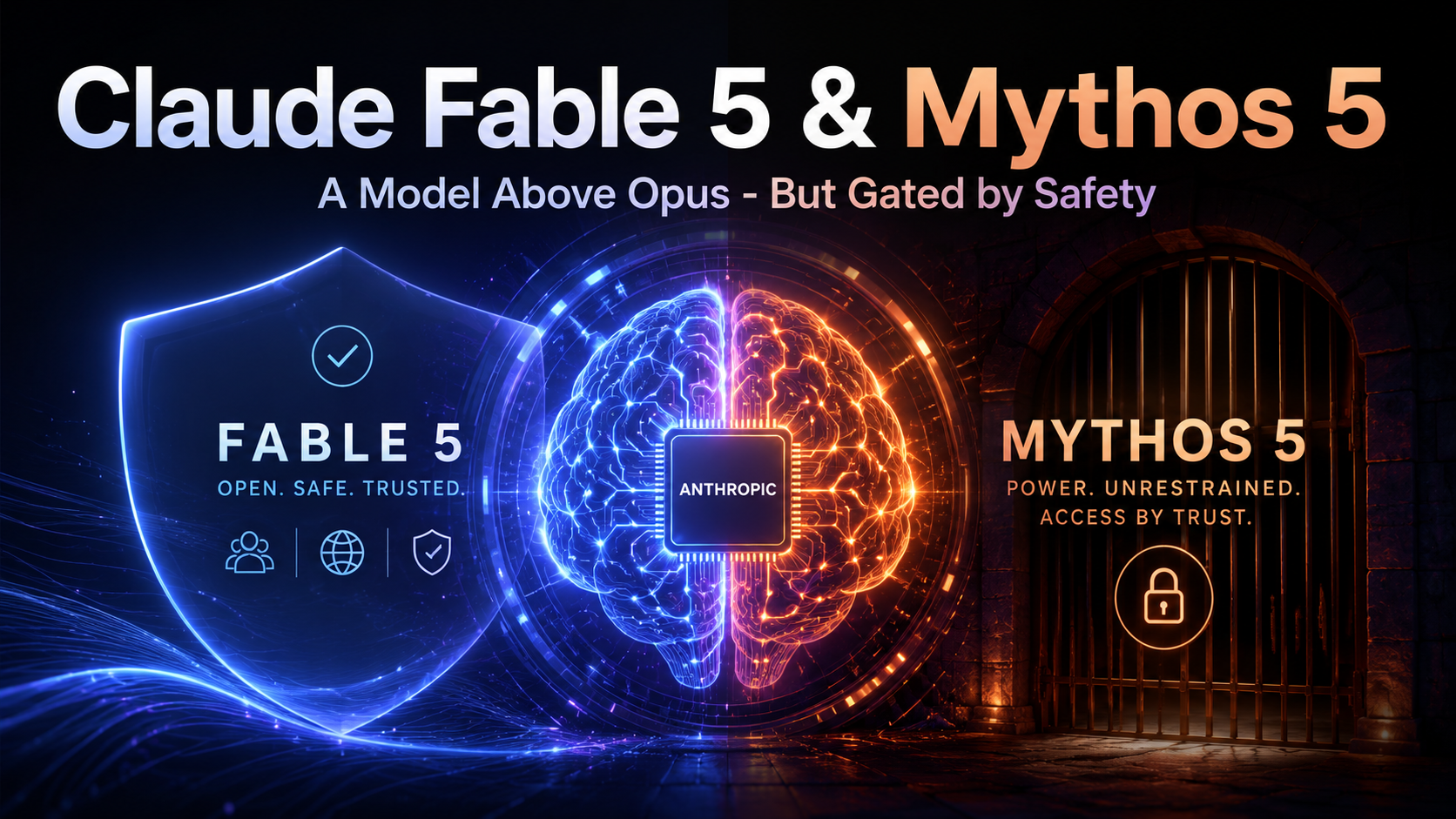
Fable 5 is the Mythos-class model made safe for general use. It's available everywhere, today. This is the one you and I can actually use.
Mythos 5 is the exact same model with some safeguards removed. It's restricted to vetted cyberdefenders and infrastructure providers, deployed through Project Glasswing.
The naming choice is deliberate and a little poetic. Fable comes from the Latin fabula, "that which is told," which is close kin to the Greek mythos. Two names, one model. The safeguards are the only thing separating them.
That framing matters because it sets the tone for everything else. Anthropic is essentially saying: the model is powerful enough that who gets the unguarded version is now a policy question, not a pricing tier.
What Changed: The Capability Jump
Fable 5 is described as state-of-the-art on nearly every benchmark Anthropic tested, across software engineering, knowledge work, vision, and scientific research. The interesting pattern is this: the longer and more complex the task, the bigger Fable 5's lead grows over Anthropic's other models.
That's the headline shift for anyone doing real work. Short prompts have been "solved" for a while. The frontier now is whether a model can stay coherent across a long, messy, multi-step job. Fable 5 is built for exactly that.
Here's where it shows up.
Software engineering
During early testing, Stripe ran Fable 5 against a 50-million-line Ruby codebase and had it perform a codebase-wide migration in a single day. By hand, that work would have taken a full team more than two months.
Sit with that number for a second. Not a toy repo. A 50-million-line production codebase. One day.
Fable 5 is also more token-efficient than earlier Claude models, which matters directly to your bill. On Cognition's FrontierCode evaluation, which tests whether a model can pass hard coding tasks while still meeting the standards of a high-quality production codebase, Fable 5 scored highest among frontier models even at medium effort. Cognition's Scott Wu confirmed it topped their frontier coding eval and generalized to unfamiliar tools out of the box.
Cursor's team reported it as state-of-the-art on their internal benchmark, opening up long-horizon problems that were previously out of reach. GitHub's product lead pointed to the same thing: complex, long-horizon coding tasks handled with a level of autonomy that pushed past their prior benchmarks.
The throughline across all of it is autonomy over long tasks. Not "writes a function faster." More like "takes a multi-day engineering job and finishes it."
Knowledge work
This is the part agencies and operators should not skim past.
On a senior-level finance reasoning benchmark, Fable 5 posted the highest score of any model, with real gains in document-based reasoning, reading charts and tables, and structured problem solving. A trading firm reported it aced their analysis evaluations almost across the board, covering factual lookup, conceptual reasoning, root-cause analysis, and expected-value work.
Another team noted Fable 5 was the first model to break 90% on their core analytics benchmark of complex, long-running analytical tasks, a ten-point jump over Opus.
Translation: the model is now good enough at the boring, high-value, document-heavy reasoning that consultants, analysts, and ops people actually get paid for.
Vision
Fable 5 is the new state-of-the-art for vision tasks. Two examples that should make builders pay attention:
It can pull precise numbers out of detailed scientific figures.
It can rebuild a web app's source code from screenshots alone.
It also needs less scaffolding than before. The demo Anthropic leaned on: earlier Claude models struggled to play Pokémon FireRed even when given a complex helper harness with maps and game-state tools. Fable 5 finished the game using only raw screenshots and a minimal, vision-only setup.
That "rebuild source code from a screenshot" line is the one to remember. For anyone doing front-end work, design-to-code, or competitive teardowns, that capability changes the starting line.
Memory and long context
Fable 5 stays focused across millions of tokens in long-running tasks, and it improves its own output using notes it writes for itself.
Anthropic tested this with the deck-building game Slay the Spire. Giving Fable 5 access to persistent, file-based memory improved its performance three times more than the same setup improved Opus 4.8. It also reached the game's final act three times more often.
The takeaway for builders: persistent memory plus this model is a meaningfully different tool than a stateless chat call. If you're designing agent workflows, the memory scaffolding is now doing real work, not just preventing the model from forgetting the last message.
Science, for context
A few of the demos point further out: a solar system simulation that derives orbital motion from first principles to predict eclipses, autonomous play in the factory game Factorio, and a browser-based CAD tool that Fable 5 both built and then used to design a 3D-printable model.
On the Mythos 5 side, the science results get more serious. Internal protein-design experts accelerated parts of the drug-design process by roughly ten times. In a genomics project, Mythos 5 worked largely autonomously for over a week, assembled single-cell data across 138 animal species, trained a custom model, and beat a recently published model that was 100 times larger.
You probably won't touch that directly. But it's the reason the safety story exists, so it's worth knowing it's real.
The Pricing Story (And the Catch)
Both models are priced at $10 per million input tokens and $50 per million output tokens. That's less than half the price of Claude Mythos Preview.
For a model that sits above Opus, that's aggressive. The direction of travel is clear: frontier capability is getting cheaper fast, and Anthropic is using price to get this into as many hands as possible.
But there's a catch on the subscription side, and you should plan around it.
From launch through June 22, Fable 5 is included on Pro, Max, Team, and seat-based Enterprise plans at no extra cost.
On June 23, Anthropic removes it from those plans. After that, using it requires usage credits.
Later, once they have the capacity, they intend to bring Fable 5 back as a standard part of subscription plans.
On the Claude API and consumption-based Enterprise plans, Fable 5 is fully available from day one with no rollout games.
The honest read: Anthropic expects demand to be high and hard to predict, so they're rationing the all-you-can-eat subscription access while protecting API customers who pay per token. If Fable 5 becomes core to your workflow, build on the API and treat the subscription inclusion as a free trial window, not a permanent perk.
The Real Story: Safety Is Now the Product
Here's where this launch is different from every "new model, bigger numbers" announcement.
Anthropic is openly saying a model this capable is dangerous without guardrails, specifically in cybersecurity and biology. So they built the safeguards directly into how Fable 5 responds.
The fallback mechanic
Fable 5 ships with a set of classifiers, which are separate AI systems whose only job is to detect potential misuse and jailbreak attempts. When a classifier flags a request in one of three areas, Fable 5 does not answer. The request is instead handled by Claude Opus 4.8, and you're told it happened.
The three flagged areas are:
Cybersecurity. Mythos-class models are unusually good at finding and exploiting software vulnerabilities, plus the broader steps of an attack like reconnaissance and lateral movement. The classifiers are tuned to block Fable from making progress on offensive cyber work entirely.
Biology and chemistry. Anthropic used to block only a narrow set of bioweapons-related queries. They've widened it, because the model is now genuinely capable at real scientific tasks. For now, most biology and chemistry requests fall back to Opus.
Distillation. Requests flagged as attempts to extract Fable 5's capabilities to train competing models also fall back to Opus.
Anthropic admits the safeguards are tuned conservatively, which means harmless requests sometimes get caught. But they say fallback triggers in less than 5% of sessions on average, and that more than 95% of Fable sessions involve no fallback at all. For those sessions, you're getting the full Mythos-class model.
The framing here is smart and worth stealing as a product lesson: a fallback to a slightly less capable model is a far better user experience than a flat refusal. Instead of "I can't help with that," you get a real answer from Opus 4.8 and a note explaining why. Builders designing their own AI guardrails should take that pattern seriously.
How hard is it to break
Anthropic ran a public bug bounty and reported no universal jailbreaks found in over 1,000 hours of testing. External red-teaming organizations also failed to find a universal jailbreak on long-form agentic tasks, though the UK's AI Safety Institute made progress toward one in early testing.
They're upfront that completely preventing jailbreaks is probably impossible. The goal is to make any remaining ones slow and expensive enough to catch before they're used at scale.
The data policy change you should actually read
This one has direct implications for businesses, and it's buried near the bottom of the announcement.
Anthropic now requires 30-day data retention for all traffic on Mythos-class models, on both their own surfaces and third-party ones. They say they won't use it to train models or for any non-safety purpose, that human access to it is logged, and that it's deleted after 30 days in almost all cases.
If your organization has strict data-handling rules, that retention requirement is a real consideration before you route sensitive workloads through Fable 5. It's not a dealbreaker for most, but it's a conversation to have with whoever owns your compliance posture, not a detail to discover later.
Why It Matters for Builders, Agencies, and Businesses
Benchmarks are nice. Here's the part that affects how you actually work.
For agencies
The 50-million-line migration in a day is the number to internalize. Large refactors, framework migrations, and legacy-codebase modernization have always been the painful, hard-to-scope, hard-to-price work agencies either avoid or lose money on.
That work is becoming tractable. The agencies that win the next couple of years won't be the ones with the most engineers. They'll be the ones who learn to scope, supervise, and ship long-horizon agent work, then charge for the outcome instead of the hours.
If you sell time, this compresses your margins. If you sell results, this expands them.
For solo builders and indie hackers
One early tester said it plainly: apps that took a hundred prompts a year ago, Fable 5 now one-shots. The vision and long-context gains mean the gap between "I have an idea" and "I have a working thing" keeps shrinking.
The practical move is to stop treating the model as an autocomplete and start treating it as a contractor you delegate whole jobs to. Set up persistent memory, give it the full context, and let it run long. That's the workflow the memory results are pointing at.
The pricing window is also a gift. Use the free subscription period through June 22 to push Fable 5 hard on real work, learn where it shines and where it stalls, and decide whether it's worth wiring into your stack on the API before the credit gate comes down.
For businesses
Two things to weigh against each other.
The upside: senior-level reasoning on documents, finance, and analytics is now strong enough to take real load off expensive teams. The "first model past 90% on complex analytical tasks" result is the signal that this is no longer just a coding tool.
The friction: the conservative safeguards mean some legitimate work, especially anything touching security research or life sciences, will get bounced to Opus. And the 30-day retention rule is a genuine governance item. Neither is a reason to stay away. Both are reasons to pilot deliberately rather than flip a switch company-wide.
Where This Is Going
Step back and the shape of the next year gets clearer.
Capability is being decoupled from access. Mythos 5 and Fable 5 are the same brain. What you get depends on who you are and what you're asking. That's a structural change. We're moving from "pay more, get a better model" toward "get vetted, get the unguarded model." Anthropic is already running trusted-access programs for cybersecurity and planning one for biology.
For most builders, that's invisible, because you'll live in the 95% of sessions that never hit a guardrail. But it sets the template for how frontier models get distributed from here: a broadly available safe version, and a gated version for verified, high-trust use cases.
The other signal is price. A model above Opus, at less than half the price of the previous Mythos-class model, points at a future where frontier capability is cheap and abundant, and the scarce, expensive thing is trust and access.
Plan your business around that. The edge isn't going to be "I have access to a good model." Everyone will. The edge will be how well you wrap it: your context, your memory design, your workflows, your judgment about where to point it.
How to Start Using It
If you want to actually try this rather than just read about it:
On a subscription plan, Fable 5 is free to use through June 22. Use that window. After June 23 you'll need usage credits until Anthropic restores standard access.
On the API, it's available now as claude-fable-5, with no rollout staging. If you're building anything production-grade, start here.
Lean into long tasks. The model's advantage grows with task length and complexity, so this is where to test it, not on one-line prompts you could give any model.
Use persistent memory. The memory results were dramatic for a reason. If you're building agents, the scaffolding around the model is now part of the performance story.
Expect the occasional fallback. If a request touches cybersecurity, biology, chemistry, or looks like model distillation, you'll get an Opus 4.8 answer with a note. That's working as designed.
Takeaways
Fable 5 and Mythos 5 are the same model. Safeguards are the only difference. That's the whole story in one line.
Fable 5 is state-of-the-art on most benchmarks, and its lead grows on long, complex tasks. A 50-million-line migration in a day is the proof point.
Pricing is aggressive at $10 in / $50 out, but subscription access is free only through June 22, then moves to usage credits. The API has it fully, now.
The safety design is the real innovation: flagged requests fall back to Opus 4.8 instead of refusing, and fallback hits under 5% of sessions.
The 30-day data retention rule on Mythos-class models is a genuine governance item for businesses to check before routing sensitive work.
The bigger shift is capability being gated by access and trust, not price. Build your edge in the workflow layer, because the model layer is becoming a commodity.
FAQ
What is the difference between Claude Fable 5 and Claude Mythos 5? They are the same underlying model. Fable 5 is the version made safe for general use and is available to everyone. Mythos 5 has some safeguards lifted and is restricted to vetted cyberdefenders and infrastructure providers through Project Glasswing. The safeguards are the only thing that separates them, which is also why they have different names.
What is a Mythos-class model? It's a new tier of Claude models that sits above the Opus class in capability. The first was Claude Mythos Preview, released in April 2026. Fable 5 and Mythos 5 are the next models in that tier.
Is Claude Fable 5 better than Claude Opus 4.8? On capability, yes. Fable 5 is reported as state-of-the-art on nearly all tested benchmarks and pulls further ahead of Opus the longer and more complex the task. Opus 4.8 still plays a role, though: it handles any Fable 5 request that gets flagged by the safety classifiers.
How much does Claude Fable 5 cost? $10 per million input tokens and $50 per million output tokens. That's less than half the price of the earlier Claude Mythos Preview.
Can I use Claude Fable 5 on my Pro or Max subscription? Yes, for free, from launch through June 22, 2026. On June 23 it's removed from those plans and using it requires usage credits. Anthropic intends to bring it back as a standard plan feature later once capacity allows. On the API and consumption-based Enterprise plans, it's fully available now.
Why does Fable 5 sometimes answer with a different model? Fable 5 runs safety classifiers that flag requests related to cybersecurity, biology and chemistry, or model distillation. When a request is flagged, Opus 4.8 answers instead and you're told it happened. Anthropic says this affects less than 5% of sessions on average, and that over 95% of sessions involve no fallback at all.
Is Claude Fable 5 safe for sensitive business data? There's a specific thing to know: Anthropic requires 30-day data retention for all traffic on Mythos-class models, including on third-party surfaces. They say the data won't be used for training or any non-safety purpose, that human access is logged, and that it's deleted after 30 days in almost all cases. If you handle regulated or sensitive data, review that policy before routing it through Fable 5.
How do I access Claude Fable 5 through the API? It's available now using the model identifier claude-fable-5 through the Claude API. Unlike subscription plans, API access is fully available from launch with no staged rollout.
Will I be able to access Claude Mythos 5? For most people, no, not yet. It's currently limited to Project Glasswing partners with cyber safeguards lifted, and soon to a small set of biology researchers. Anthropic plans to expand access through trusted-access programs that organizations can apply to over time.