
SpaceX Buys Cursor for $60 Billion: Inside Musk's Vertical Integration Play
What SpaceX actually bought
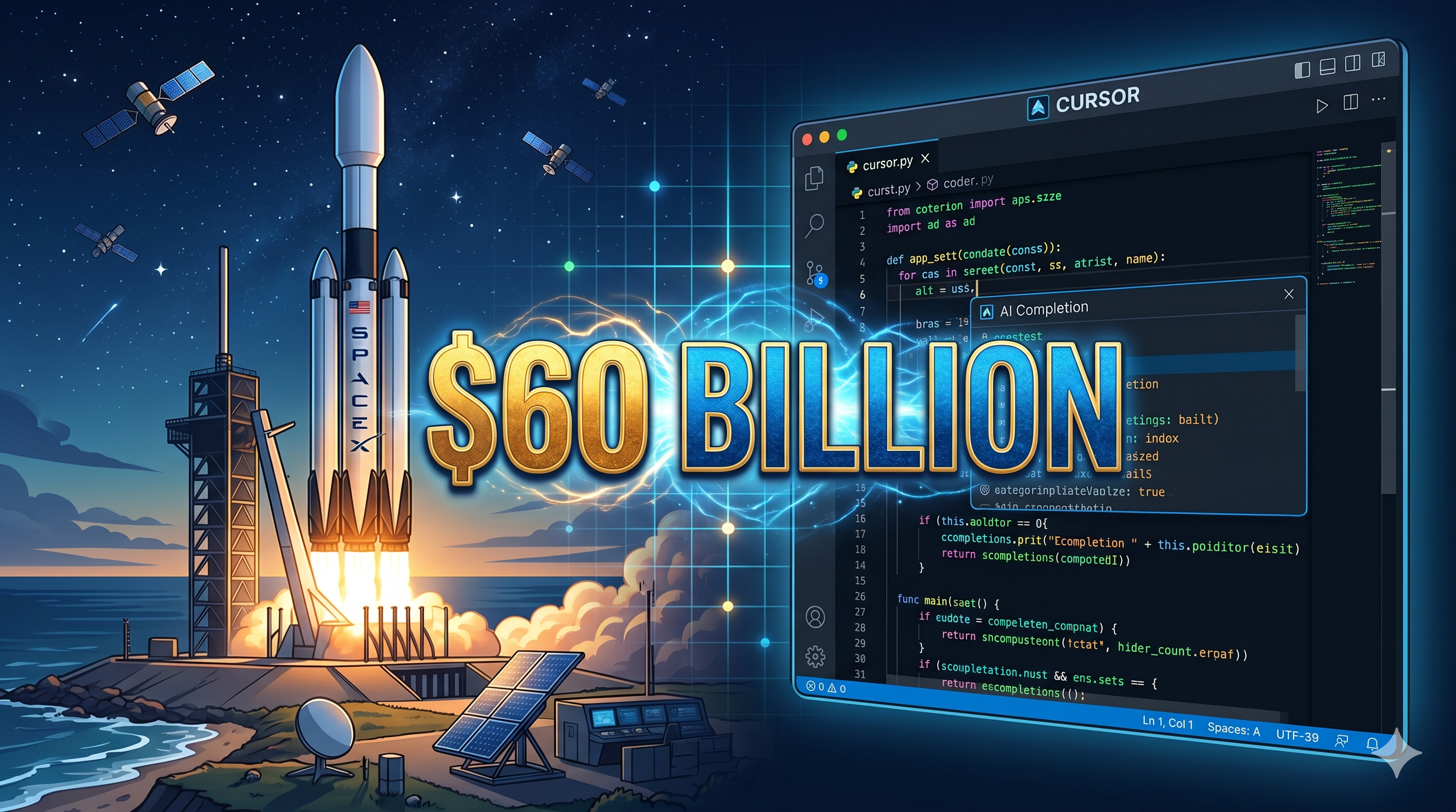
The structure of the deal is straightforward, even if the price is not. SpaceX is paying for Cursor entirely in stock, not cash. The agreement is technically an exercise of an option that SpaceX disclosed back in April, when it secured the right to buy the company for $60 billion or to pay a $10 billion fee for the joint work the two had already started.
Cursor, made by the San Francisco startup Anysphere, will become a wholly owned subsidiary once the deal closes. SpaceX expects that to happen in the third quarter of this year. At $60 billion, it is the largest acquisition of a venture-backed startup on record.
The timing was not accidental. SpaceX went public on June 12 in the biggest IPO ever, raising roughly $85.7 billion and debuting at a valuation north of $2 trillion. By the time the Cursor news broke the following week, the stock had climbed well above its offer price, briefly pushing SpaceX past Amazon by market capitalization.
That run-up is the whole point of the structure. Paying in freshly minted, highly valued shares meant the company could absorb a $60 billion target while giving up only a small slice of itself, a reported dilution of a few percent. As one prominent investor noted, a deal like this costs far less in dilution precisely because the buyer's valuation is so high. In the days after the listing, SpaceX added close to a trillion dollars in market value, an amount equal to many Cursors over.
Cursor's chief executive, Michael Truell, framed the move as a step toward building more capable AI models. The two companies have spent the past several months jointly training a model that is expected to ship inside Cursor and inside Grok Build, SpaceX's developer-facing AI product.
Why Cursor, and why now
To understand the logic, it helps to know where SpaceX's AI ambitions stood before the deal.
SpaceX absorbed Musk's AI company, xAI, in February. That brought the Grok models, the X social platform, and the Colossus supercomputer under one roof. But the AI division struggled after the merger. It went through a restructuring following a series of controversies, including reports that its image tools had been used to generate non-consensual and abusive content, and nearly all of xAI's original co-founders left during the transition.
The departures were not quiet. Reporting attributed them to a culture clash between xAI's research-driven origins and SpaceX's milestone-driven engineering style, along with disagreements over model strategy. The people who left included senior technical leaders. Musk himself described the unit as something that had not been built correctly the first time and was being rebuilt from the foundations up.
The bigger gap was on the product side. Grok had reach as a consumer chatbot wired into a large social network, but it never gained meaningful traction with professional software developers. That is precisely the audience Cursor owns.
Cursor grew quickly after its 2022 founding and crossed a billion dollars in annualized revenue late last year. It became one of the default tools for engineers who use AI to write, edit, and review code. Buying it hands SpaceX an established product and a built-in base of expert users, rather than asking it to build developer credibility from scratch.
There is a complicating detail. Cursor's market share has been slipping, from around 41 percent in the middle of last year to roughly 26 percent by May, as rivals caught up. So SpaceX is buying a leader in a category that is getting more crowded, not a company with a widening lead. Before SpaceX stepped in, Cursor had been close to raising about $2 billion at a $50 billion valuation from investors including Andreessen Horowitz, Thrive, and Nvidia.
The stack Musk is assembling
The clearest way to read this acquisition is as the last visible layer in a vertically integrated AI company. Most AI players specialize in one or two parts of the chain. SpaceX is trying to own the whole thing.
Here is the stack, layer by layer.
Compute
At the base sits Colossus, the supercomputer xAI built in South Memphis, Tennessee. By early this year it housed roughly 555,000 Nvidia GPUs across about two gigawatts of power capacity, with the hardware alone estimated to have cost around $18 billion. SpaceX describes its compute as the equivalent of a million high-end training chips.
Compute at that scale is the scarcest resource in AI right now, and SpaceX controls a large supply of it directly. In a telling sign of how valuable that capacity is, Colossus is reportedly being leased to Anthropic, the maker of the Claude models. The company that owns the supercomputer is renting it to one of its own competitors.
Musk has also tied SpaceX's longer-term compute story to orbit. The stated rationale for the xAI merger was building solar-powered data centers in space, on the argument that the planet cannot supply enough power and cooling for AI demand without straining communities and the grid. Whether orbital data centers prove practical is an open question, but it signals where the infrastructure ambition points.
Models
One layer up are the models. SpaceXAI ships Grok, and the division now also has the model it has been training jointly with Cursor. Owning both a general-purpose model line and a coding-specific model gives SpaceX something to put in front of consumers through X and in front of developers through Cursor and Grok Build.
This is where the strategy gets pointed. Cursor today is model-agnostic. It runs on Anthropic's Claude, on OpenAI's GPT models, and on Cursor's own Composer models, letting users pick the best tool for a task. Now its owner also makes a competing model and has every commercial reason to promote it.
Data
Models improve with data, and SpaceX sits on unusual sources of it. The company generates enormous volumes of proprietary engineering data across Starship development, Falcon 9 operations, and the Starlink network. Through X, it also has a constant stream of real-world language and behavior from hundreds of millions of users.
Cursor adds another stream that is hard to buy: how professional engineers actually work with AI on real codebases, including what they accept, reject, and rewrite. That kind of signal is exactly what a coding model needs to get better, and SpaceX would now own it end to end.
Distribution
The top layer is distribution, the part most companies struggle with. SpaceX already reaches a mass consumer audience through X. With Cursor, it gains direct distribution to the expert developers who build the software everyone else uses. Grok Build sits alongside that as a second developer channel.
Put together, the layers form a single picture: chips and power, then models, then data to refine them, then the platforms that put them in users' hands. SpaceX described its goal after the xAI merger as building the most ambitious vertically integrated innovation engine on and off Earth, spanning AI, rockets, space-based internet, and direct-to-device communications. The Cursor deal slots the developer tool into that frame.
A twelve-month consolidation, step by step
The Cursor purchase makes more sense as the latest move in a steady consolidation of Musk's companies than as a one-off. The sequence is worth laying out.
March 2025: X, formerly Twitter, is folded into xAI, combining the social platform with the AI company.
December 2025: an insider share sale values SpaceX at around $800 billion, setting a marker ahead of a public listing.
January 2026: two new Nevada entities are created to facilitate a SpaceX and xAI combination.
February 2026: SpaceX acquires xAI in an all-stock deal that values the combined company at about $1.25 trillion.
May 2026: xAI is dissolved as a separate company and its assets become the SpaceXAI division, with a Starlink executive installed as president.
June 12, 2026: SpaceX completes the largest IPO in history.
June 16, 2026: SpaceX exercises its option to buy Cursor for $60 billion.
Read in order, the steps show a pattern. Each move pulled a separate Musk entity into a single corporate structure, raised the combined valuation, and set up the next step. By the time Cursor came along, SpaceX had the currency, the compute, and the corporate structure to absorb it quickly.
What it means for the tools developers actually use
For the people who use these products day to day, the most important question is what happens to Cursor's neutrality.
Cursor's appeal has rested partly on choice. A developer can route work to Claude, to GPT, or to Cursor's own models depending on the task. That flexibility is now owned by a company that also sells a competing model and wants it adopted. Nothing has to change immediately, and SpaceX has not said it will restrict other models. But the incentive to favor its own model inside its own product is real, and it is the thing builders and agencies should watch most closely.
The Anthropic relationship shows how tangled this has become. Anthropic rents compute from Colossus, which SpaceX owns. Anthropic's Claude models run inside Cursor, which SpaceX now owns. And Anthropic competes directly with SpaceXAI's models. One company is at once a supplier, a customer, and a rival. Arrangements like that tend to hold only as long as they serve everyone involved.
There is also a precedent worth noting. When Grok's developer API moved under the SpaceX umbrella, customers were given a transition window and migration instructions rather than a sudden cutoff, and some teams that depended on it lined up fallback providers anyway. Anyone who has built a workflow, a product, or a client deliverable on top of Cursor would be wise to do the same: know which model you are actually depending on, and know what your backup is if the defaults or the terms shift.
None of this means Cursor gets worse. More compute and a dedicated training effort could make the product better. The point is that the tool now sits inside a strategy, and that strategy may not always align with an individual developer's preference for neutrality.
Where this leaves the AI coding race
The deal also reshapes a category that was already consolidating. AI coding has become one of the most valuable arenas in software, and most of the largest technology companies now have a horse in it.
Anthropic has its own coding product and supplies the Claude models that many developers reach for first. OpenAI offers its own coding tools on top of the GPT models. Microsoft has GitHub Copilot wired into the world's largest code host. Google has its own assistants and models. Against that field, an independent Cursor was a fast-moving specialist that won by being the best place to combine the strongest models from several providers in one editor.
SpaceX entering as an owner rather than a partner changes the math. The category is shifting from a contest among focused tools to a contest among giants that each control models, distribution, and increasingly compute. For smaller and independent coding tools, the competitive bar just rose, because they are now up against companies that can subsidize a product with profits from somewhere else entirely.
For developers, agencies, and businesses, the practical effect is a narrowing of who ultimately owns the tools they rely on. The choice of editor starts to look less like picking a piece of software and more like picking which large company's ecosystem to stand inside.
The case for the strategy, and the case against
Vertical integration is a real strategy with a real track record, and it is also a real risk. A neutral read has to hold both.
Why it could work
Supporters of the approach point to a few advantages. Owning compute means not bidding against everyone else for scarce chips and power. Owning models, data, and distribution in one company means tighter feedback loops, where usage from Cursor and X can inform training and better models flow straight back to those same users.
SpaceX has also shown, with rockets and with Starlink, that it can build hard infrastructure at scale and drive costs down over time. If any team can make an expensive, capital-heavy AI stack pay off, the argument goes, it is one with that operating record and a multi-trillion-dollar balance sheet behind it.
Why it might not
Skeptics raise an equally concrete list. Vertical integration concentrates risk, so if one layer underperforms, the whole chain feels it. The AI division has already lost most of its founding technical leadership, and raw compute does not replace the research expertise that determines whether models are actually good.
Cursor's slipping market share suggests the coding category is becoming a price-competitive race rather than a defensible lead. The model-agnostic feature that helped Cursor win could erode under new ownership and push some users elsewhere. And a company this large, combining social media, AI, satellites, and developer tools, invites regulatory and antitrust attention that smaller, focused rivals avoid.
Both cases rest on the same set of facts. The disagreement is about whether owning everything is a durable advantage or an expensive way to multiply points of failure.
What to watch next
A few signals will show whether the integration play is working.
Model neutrality in Cursor: whether Claude and GPT stay first-class options or quietly lose priority to SpaceX's own model.
Developer retention: whether Cursor's user base grows, holds, or drifts to alternatives after the deal closes.
Talent: whether SpaceX can rebuild the research depth it lost without the original xAI founders.
Product cadence: whether the jointly trained coding model actually ships, and whether it is competitive when it does.
Regulatory response: whether the scale of the combined company draws scrutiny at home or abroad.
The orbital compute story: whether space-based data centers move from talking point to anything concrete.
The bottom line
Stripped of the headline number, this is not really a story about one code editor. It is the moment a rocket and satellite company finished assembling a full AI stack: the compute to train models, the models themselves, the data to sharpen them, and now the developer platform to put them to work.
Whether that bet pays off is genuinely unsettled. Vertical integration can compound advantages or compound problems, and SpaceX has placed itself in a position to find out which, at a scale almost no one else can match.
For the developers, agencies, and businesses that already rely on these tools, the takeaway is simpler. The software you build on is increasingly owned by a small number of very large companies, each running a strategy of its own. The smart move is to know whose stack you are standing on, and to keep your options open.
Here is an FAQ block to paste at the very bottom, after "The bottom line." Questions are H3 so they map to your heading style and so AI answer engines can extract each pair cleanly. Each answer leads with the direct answer, which is what AIO surfaces.
Frequently asked questions
How much did SpaceX pay for Cursor?
SpaceX agreed to acquire Cursor for $60 billion in an all-stock deal. It is the largest acquisition of a venture-backed startup on record.
When did SpaceX buy Cursor, and when does the deal close?
SpaceX announced the acquisition on June 16, 2026, four days after its record IPO. The deal is expected to close in the third quarter of 2026.
Why did SpaceX buy Cursor?
SpaceX wanted a product with strong adoption among professional developers, something its own Grok models never achieved. Cursor gives it a developer platform and completes a vertically integrated AI stack that already spans compute, models, and a large consumer audience.
Who makes Cursor?
Cursor is built by Anysphere, a San Francisco startup founded in 2022. Once the deal closes, Anysphere becomes a wholly owned subsidiary of SpaceX.
Will Cursor still support Claude and GPT?
For now, Cursor remains model-agnostic and runs Anthropic's Claude, OpenAI's GPT models, and its own Composer models. SpaceX has not announced any restriction, but it now owns a competing model, so its long-term commitment to rival models is an open question worth watching.
Does the acquisition change anything for current Cursor users?
No immediate changes have been announced, and the product continues to work as before. The open questions are whether model choice and pricing shift after the deal closes.
Is Cursor connected to xAI and Grok now?
Yes. SpaceX absorbed Musk's AI company xAI in February 2026 and runs it as the SpaceXAI division, which includes Grok. Cursor joins that structure and is expected to use SpaceX's Colossus supercomputer for training.
What does the SpaceX and Cursor deal mean for developers and agencies?
It signals that AI coding tools are increasingly owned by a few very large companies rather than independent specialists. The practical move is to know which model your workflow depends on and to keep a fallback option in case defaults or terms change.