
The First Fully Online Generation: What the Research Actually Says About Screens and Teen Mental Health
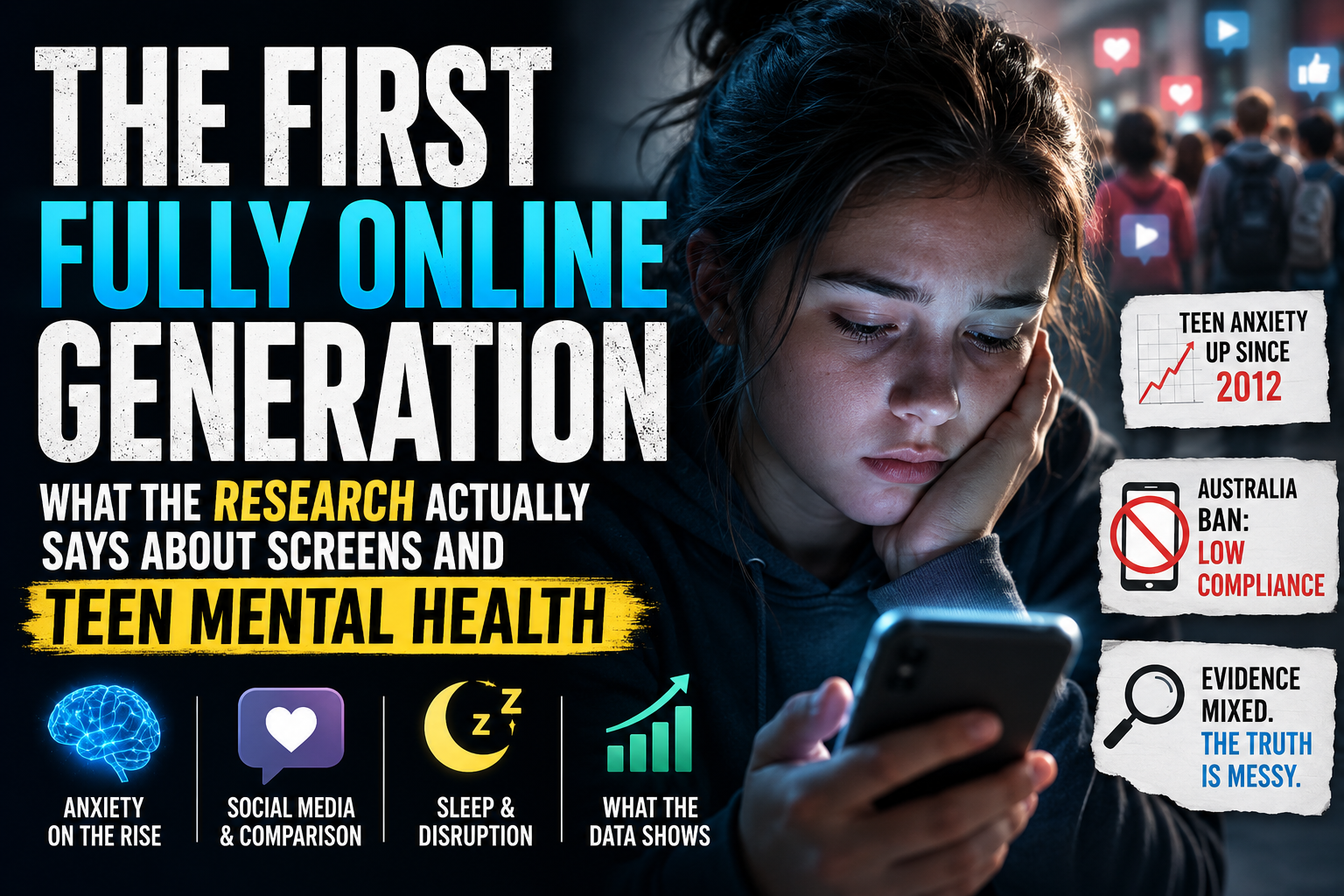
The generation that grew up online
Start with how saturated this cohort's life is, because the numbers are not subtle.
In the United States, Pew Research Center found that 95 percent of teens aged 13 to 17 have access to a smartphone, and 96 percent use the internet every day. The share who say they are online "almost constantly" reached 46 percent in 2024. That is roughly double the 24 percent who said the same a decade earlier.
The platforms have shifted too. YouTube leads, used by about nine in ten teens. TikTok, Instagram, and Snapchat follow in the range of 55 to 63 percent. Facebook, once dominant, has fallen to around a third. Teen girls are more likely than boys to describe their use as almost constant.
What makes this cohort distinct is not just the volume. It is the timing.
The qualitative change happened around 2012, when smartphones, front-facing cameras, and algorithmic feeds all became standard at once. This is the first generation to pass through puberty, identity formation, and early friendship with a curated, public, always-available version of social life in their pocket.
Whatever effect that has, it is being run as a real experiment on a real generation, without a control group.
The trend that started the alarm
The reason researchers started paying attention is a genuine shift in the data. It is worth being precise about it, because both sides of the debate accept this part.
Beginning around 2010 to 2012, several English-speaking countries reported sharp increases in adolescent anxiety, depression, and self-harm. This was true across the United States, the United Kingdom, Canada, and Australia.
In US national survey data between 2011 and 2021:
The share of high school students reporting persistent sadness or hopelessness rose by roughly 14 percentage points.
The share who seriously considered suicide rose by about 6 points.
The increases were largest among girls.
This is the starting point for the whole argument. The trend is real, it is not confined to one country, and it lines up in time with the smartphone-based adolescence described above.
The disagreement is not about whether teen mental health worsened. It is about why, and how much of it the phones explain.
The case that screens are a major cause
The leading version of the "yes, it is mostly the phones" argument comes from social psychologist Jonathan Haidt, building on earlier work by Jean Twenge.
Haidt's framing is what he calls the Great Rewiring of childhood. A shift from a play-based childhood spent largely unsupervised in the physical world, to a phone-based childhood spent largely alone in front of a screen.
He argues this brought four foundational harms:
Social deprivation, as time spent with friends in person fell sharply, by his account around 50 percent since 2012.
Sleep deprivation, as devices ate into rest.
Attention fragmentation, as constant interruption made focus harder.
Addiction, as apps engineered for compulsive use captured young attention.
He frames this as a two-factor story, not a single villain. The decline of real-world play and the rise of the phone-based childhood work together, and they hit different children in different ways.
The strongest single study
Beyond the trend lines, the strongest causal evidence comes from economists Luca Braghieri, Ro'ee Levy, and Alexey Makarin, published in the American Economic Review.
They used the staggered rollout of Facebook across US college campuses between 2004 and 2006 as a natural experiment. They matched the date each school gained access against a survey of about 430,000 students.
The result: when Facebook arrived on a campus, student mental health worsened relative to comparable students at schools that did not yet have it. The estimates pointed to meaningful increases in depression and anxiety symptoms, heaviest among students prone to comparing themselves to peers.
The mechanism they identified was social comparison and fear of missing out. The study was notable enough to be cited in the US Surgeon General's advisory.
The official position
That advisory, issued in 2023 by Surgeon General Vivek Murthy, added official weight.
It reported that teens who spend more than three hours a day on social media face roughly double the risk of poor mental health outcomes. Average teen use at the time sat around three and a half hours daily. It highlighted body image pressure, disordered eating, and low self-esteem, especially among girls.
A long-running study from the Murdoch Children's Research Institute in Australia found something similar. Among roughly 1,200 young people, those spending at least two hours a day on social media were more likely to report poor mental health, with the strongest effect on girls aged 12 to 13.
So the case is: a cross-national trend that starts at the right time, a strong natural experiment showing harm, official advisories, and longitudinal signals pointing the same way, especially for girls.
The case that the evidence is weaker than it looks
The counter-argument is not that screens are harmless. It is that the evidence for large, population-wide harm is thinner than the headlines imply, and that the field overstates what it has found.
The most cited work here comes from Amy Orben and Andrew Przybylski.
In a 2019 paper in Nature Human Behaviour, they analyzed data on more than 300,000 adolescents. Their conclusion: digital technology use explained at most about 0.4 percent of the variation in adolescent wellbeing.
To make the size concrete, they noted that regularly eating potatoes was associated with a similar dent in wellbeing, and wearing glasses with a larger one. Their broader point was that the same datasets could be sliced to produce a positive, negative, or null result depending on the analyst.
There is also a measurement problem that undercuts much of the field. Most studies rely on people self-reporting their screen time, and self-reports correlate only weakly with actual measured use. Light users overestimate, heavy users underestimate. When the core variable is measured that poorly, both the size and the shape of any effect become unreliable.
The sharpest critique
The hardest scholarly pushback came from Candice Odgers, a developmental researcher who reviewed Haidt's book in Nature.
She argued he had largely mistaken correlation for causation. She wrote that there is no good evidence these platforms are rewiring children's brains or driving an epidemic of mental illness.
She compared the reasoning to a first-day statistics exercise, where students see two lines rising together and immediately invent a causal story. Her summary of the wider literature was blunt: hundreds of researchers have looked for large effects, and have mostly found a mix of no, small, and mixed associations.
Haidt has rebutted this directly, pointing to a collection of experimental studies he maintains and arguing his critics underweight them.
That exchange is itself a signal. When two careful people look at the same body of work and reach opposite headline conclusions, the honest takeaway is that the evidence is unsettled, not that one of them is a fool.
The replication problem makes this worse. Psychology has spent a decade discovering that many famous findings do not hold up when repeated, and this field is not exempt. One well-known result on phones and attention, discussed below, failed to replicate.
Why both sides can be partly right
The two camps look irreconcilable. A lot of the gap dissolves once you separate the questions they are actually answering.
Three distinctions do most of the work.
Averages versus subgroups. A tiny average effect across millions of teens is fully compatible with serious effects on a vulnerable minority. If heavy use mainly harms girls and already-at-risk kids, the population average looks small while the concentrated harm is real.
Screen time versus specific uses. Lumping a coding tutorial, a video call with grandparents, and three hours of passive scrolling into one number guarantees a weak, noisy result. The careful work suggests the type of use matters more than the quantity. Passive consumption and social comparison look worse than active creating and direct connecting.
The mechanism. Twenge and Haidt's strongest argument is not really about screens as objects. It is about displacement. Time on a phone is time not spent sleeping, exercising, or being with people in person, and those three things are among the most reliable supports for mental health there are.
On that reading, the phone is harmful less because of what it does to the brain and more because of what it crowds out. That framing is both more defensible and more actionable than a claim about rewired neurons.
So the reasonable position sits between the poles. The catastrophe framing overstates the average causal evidence. The potatoes framing understates the concentrated harms and the displacement effects. Neither extreme survives contact with the full literature.
The "always-on" question
A specific version of the worry is that constant connectivity keeps the brain switched on, taxing attention and leaving little room to rest. Here the evidence is uneven, and it is worth being honest about which parts are solid.
Attention
The most cited study on the attention cost is by Adrian Ward and colleagues.
They tested whether the mere presence of a smartphone drains mental resources. Across experiments with nearly 800 people, those who left their phone in another room outperformed those who kept it on the desk. This held even when the phone was off and even though participants felt fully focused.
The proposed explanation is that actively not attending to a salient phone quietly consumes attention. The effect was strongest for the most phone-dependent users.
The important caveat: a later replication attempt did not reproduce this result. That places it among findings to treat as suggestive rather than settled.
Smaller studies report related effects. Awareness of an unanswered notification can impair performance on tasks needing focus. Being separated from a ringing phone can raise heart rate and anxiety. These point in a consistent direction, but they are modest in scale and should not be oversold.
Sleep
Where the evidence is genuinely strong is sleep.
The displacement of sleep by late-night device use is one of the most consistent findings in the whole area. And poor sleep is itself a well-established driver of anxiety, low mood, irritability, and impaired learning.
If you are looking for the clearest line from phones to worse adolescent wellbeing, it runs through the bedroom and the clock. Not through any exotic claim about a rewired nervous system.
So on the always-on question: the idea that constant interruption fragments attention, and that late-night use harms rest, is well supported. The more dramatic image of a permanently overstimulated nervous system that can no longer relax is intuitive and probably contains truth, but it currently outruns what the data can demonstrate.
What teens themselves say
It is easy to discuss this generation as passive victims of their devices. Their own reported views are more mixed, and worth including.
In Pew's surveys, most teens say the benefits of having a smartphone outweigh the downsides for people their age, by roughly 70 to 30.
At the same time, close to seven in ten say they like having downtime without their phone. About four in ten admit that being without it makes them feel anxious.
Many describe a kind of trap that the Surgeon General also heard repeatedly. The apps can make them feel worse about themselves or their friendships, and they still find it hard to stop.
That ambivalence is data too. It points to a generation that often dislikes how the products make them feel but is enmeshed in them anyway. That is a description of compelling design, not simple preference.
What the policy wave tells us, and what it does not
While the science argues, governments have started acting. Their experiments are now producing early evidence of their own.
The boldest move came from Australia. On 10 December 2025 it became the first country to bar under-16s from major social media platforms, putting the burden on the platforms to deactivate and prevent those accounts.
Early results have been humbling:
Research in the months after the ban found a large majority of 14- and 15-year-olds still using restricted platforms.
In many cases the platforms simply had not removed the accounts.
Few teens complied when they saw that few others were complying.
One survey found most affected teens still had access, and about half said the ban had made no difference to their safety.
The open question researchers keep raising is whether risky behavior is being reduced, or simply shifting to gaming and messaging platforms the ban does not cover.
School phone bans show a similar split between promising headlines and cautious research. Some regions report large drops in classroom incidents and bullying after strict all-day bans, which is plausible for the school environment itself. But studies on mental health outcomes often find that bans limited to school hours do little, because what seems to matter is total daily use, not the slice between bells.
The wider movement is real regardless. Several European countries are weighing age limits and sleep-protecting curfews. South Korea has restricted phones in schools. A number of US states have passed laws targeting age verification and addictive feed design.
Academic reviewers tend to land on harm minimization rather than pure prohibition. Teach digital literacy and resilience, involve parents and schools, and accept that blunt bans are hard to enforce.
The honest reading: lawmakers are moving ahead of settled evidence, and the next few years of natural experiments will teach us more than another round of correlational studies.
What it means for the people who build and use technology
For anyone building products, this is not just a parenting story.
This cohort is entering the workforce and is the audience consumer technology is increasingly designed for and by. That makes the mechanisms under dispute directly relevant to product decisions.
The features most often blamed are not accidents. Infinite scroll, variable rewards, streaks, autoplay, and feeds tuned to maximize time-on-app are deliberate design choices aimed at engagement.
So the contested question of whether social media harms teens is, in practice, a question about whether engagement-maximizing design has costs that fall hardest on the youngest users. That reframing matters, because it puts the issue in choices a product team can change, not in some inevitable property of screens.
The regulatory direction is fairly clear even while the science is not. Age verification, limits on addictive feed mechanics for minors, default privacy and time controls, and safety-by-design expectations are all moving from advocacy to law in various places.
For founders and agencies building for younger users, the signal is simple. Attention-respecting design is shifting from a nice-to-have to a trust and compliance issue. Designing for genuine usefulness rather than maximum capture is starting to look less like idealism and more like risk management.
None of this requires accepting the strongest version of the harm thesis. It only requires noticing that the burden of proof is moving.
The honest bottom line
Strip away the certainty on both sides and a defensible summary emerges.
Something real changed in teen mental health around the smartphone transition. The change appeared across multiple countries, and it lines up in time with a phone-based adolescence. The correlation is not in serious doubt.
The causal evidence is mixed but not empty:
The best natural experiment available shows harm.
Average effect sizes look modest.
The harm appears concentrated among girls and already-vulnerable kids.
The most robust mechanisms are unglamorous: lost sleep, lost in-person time, and fragmented attention, rather than any proven rewiring of the brain.
The two loudest stories both overshoot. It is not a simple catastrophe caused entirely by phones, and it is not a moral panic about something as trivial as eating potatoes.
The reasonable position lives in the messy middle. And the policy experiments now running in Australia, Europe, and US states will tell us more over the next few years than another decade of arguing about the same datasets.
For a generation that has never known an offline childhood, that uncertainty is not very comforting. But pretending the science is settled, in either direction, helps no one who has to make decisions for them.
Frequently asked questions
Do smartphones and social media cause anxiety in teenagers?
The evidence is mixed. There is a clear correlation between the rise of smartphones and worsening teen mental health since around 2012, and the strongest natural experiment available found that social media access caused measurable increases in depression and anxiety symptoms. But average effect sizes across the wider research are small, and leading critics argue causation is not proven at the population level. The most defensible view is a real effect concentrated among girls and vulnerable teens, rather than a uniform harm to everyone.
What does Jonathan Haidt argue in The Anxious Generation?
He argues that a shift from a play-based childhood to a phone-based childhood has driven a teen mental health crisis through four harms: social deprivation, sleep deprivation, attention fragmentation, and addiction. He frames it as a two-factor story combining less real-world independence with more screen-based life.
What do critics like Amy Orben and Candice Odgers say?
They argue the effects are small and the causal claims overstated. Orben and Przybylski found that technology use explained at most about 0.4 percent of the variation in adolescent wellbeing, comparable to eating potatoes. Odgers argued in Nature that much of the case mistakes correlation for causation and that most studies show a mix of small, null, and inconsistent associations.
Is it the screen time itself or something else?
The most useful framing points to displacement rather than screens directly. Time on a phone is time not spent sleeping, exercising, or socializing in person, and those are strong supports for mental health. The type of use also matters: passive scrolling and social comparison appear more harmful than active creating and direct connecting.
Does constant connectivity really keep the brain switched on?
Partly. There is solid evidence that interruptions fragment attention and that late-night device use displaces sleep, which reliably harms mood and focus. One famous study suggested the mere presence of a phone reduces available mental capacity, but it failed to replicate, so treat it as suggestive. The dramatic idea of a permanently overstimulated nervous system is plausible but not yet well demonstrated.
Are teenagers themselves worried about it?
Their views are mixed. Most US teens say a smartphone's benefits outweigh its harms, yet most also say they like downtime without it, and a large share feel anxious when separated from it. Many report that social media makes them feel worse while still being hard to put down.
Do social media bans and school phone bans work?
So far the results are uneven. Australia's under-16 social media ban saw low compliance in its early months, with most affected teens still accessing platforms. Strict school phone bans appear to cut classroom incidents, but bans limited to school hours often show little effect on mental health, because total daily use seems to matter more.
What does this mean for people building technology?
The features most often blamed, such as infinite feeds and engagement-maximizing design, are deliberate choices, which means they can be changed. Regulation is moving toward age verification, limits on addictive feeds for minors, and safety-by-design expectations. For builders, designing around genuine usefulness rather than maximum attention capture is becoming both a trust and a compliance issue.