
Why We Have So Many Programming Languages Instead of One
The dream is older than you think
The idea of one language to cover everything is not a modern fantasy. It is a recurring project, and its track record is instructive.
In the 1960s, IBM built PL/I to merge two worlds that until then used different languages: scientific computing, which lived in FORTRAN, and business data processing, which lived in COBOL. The goal was a single general-purpose language for both. It worked, in the sense that people used it. It did not work in the sense of replacing the others. It grew large and complicated, and the languages it was meant to absorb outlived it.
In the early 1980s, the US Department of Defense tried a different approach with Ada. Rather than persuade, it mandated. Defense projects were required to use Ada to escape the sprawl of languages then in use. Ada was carefully designed and is still used in aerospace and safety-critical systems. But the mandate was eventually relaxed, and Ada never became the universal language by decree.
In the 1990s, Java arrived with the slogan "write once, run anywhere." The Java Virtual Machine let the same compiled code run on many platforms, which was a genuine advance. Java became one of the most successful languages ever. It still did not end the proliferation. New languages kept appearing, including several that run on Java's own virtual machine.
The pattern is the giveaway. Each ambitious attempt to be the last language became one more language in the pile. The question has been tested in practice many times, and the answer keeps coming back the same.
Reason 1: different jobs have genuinely different constraints
The deepest reason is that a language is a set of decisions frozen into syntax and a runtime, and different kinds of software pull those decisions in opposite directions.
Consider what a handful of domains actually need:
Systems and embedded code needs tight control over memory and predictable timing, with no surprise pauses from automatic memory management. This is the territory of C, C++, Rust, and Zig.
Web frontends have to run inside the browser, where for years there was exactly one option, JavaScript, later joined by TypeScript on top of it.
Data, scientific, and AI work needs fast iteration, readable glue code, and enormous libraries, which is why Python and R dominate there.
Cloud services and infrastructure favor easy concurrency, fast builds, and simple deployment, which is much of Go's appeal.
Mobile apps are tied to platform toolchains, which pushes developers toward Swift and Kotlin.
Querying data fits a declarative model better than an imperative one, which is why SQL looks nothing like the others.
Decades-old financial systems still run on COBOL because the working code exists and cannot simply be rewritten.
A language tuned for a microcontroller with kilobytes of memory and a language tuned for a data scientist's notebook are not competing to do the same job badly. They are doing different jobs well. The variety of languages is, in large part, just the variety of problems made visible.
Reason 2: you cannot maximize everything at once
Even within general-purpose programming, language design involves tradeoffs that genuinely conflict. You can favor one side or the other, but not both fully, and "general-purpose" hides the fact that every language still sits somewhere specific.
A few of these tensions:
Performance versus safety. Manual memory control is fast but dangerous. Automatic memory management is safer but introduces pauses and overhead.
Simplicity versus expressiveness. A small, simple language is easy to learn but can be verbose. A powerful, feature-rich language is concise but harder to master. Compare the deliberate minimalism of Go with the depth of Scala or Rust.
Static versus dynamic typing. Static types catch errors before the program runs, at the cost of more upfront ceremony. Dynamic types let you move fast and find out later.
Control versus abstraction. Staying close to the hardware gives you predictability. Staying close to the problem gives you readability.
None of these are flaws waiting to be fixed by a clever enough designer. They are real conflicts. A language that claimed to be best on every axis at once would be contradicting itself. This is the technical core of why no single language can dominate everything: there is no single point that is best, only different points that are best for different work.
Reason 3: there is more than one way to think
Languages also differ in their underlying model of how you express a solution, and different models suit different problems.
Imperative code describes step by step what the machine should do. Object-oriented code organizes large systems around bundles of state and behavior. Functional code treats computation as transforming data without changing it in place, which tends to make concurrency and reasoning easier. Logic and declarative styles let you describe what you want rather than how to get it, which is exactly why SQL feels so different. Array-oriented languages are built around doing math on whole collections at once, which fits numerical and scientific work.
Modern languages borrow heavily across these styles, so the lines are blurrier than they used to be. But the borrowing has limits. A language built around immutable data and one built around mutable objects make different everyday tradeoffs no matter how many features they share.
This connects to one of the oldest observations in the field, Fred Brooks' argument that there is no silver bullet in software. Much of the difficulty in building software is essential, baked into the problem itself, not accidental difficulty that a better language could abstract away. If the hard part is the problem rather than the syntax, then no single syntax can make all problems easy.
Reason 4: the hardware keeps changing the rules
There is also a moving target. The best language design depends partly on the machine it runs on, and machines do not sit still.
The shift from single-core to multi-core processors changed what languages needed to handle well, which is part of why approaches to concurrency multiplied. Erlang's model was shaped by fault-tolerant telecom systems. Go's lightweight concurrency was shaped by network servers. Rust's ownership system was shaped by the goal of safe concurrency without a garbage collector. The rise of GPUs and AI accelerators created demand for ways to program hardware that earlier languages were never designed for.
Each major hardware shift tends to produce new languages or major new dialects, because retrofitting an old language to a fundamentally new kind of machine is often harder than designing for it from the start. As long as hardware keeps evolving, and it is evolving quickly right now, the set of languages will keep evolving with it.
Reason 5: the biggest reasons are not technical at all
Even if the technical story above were somehow solved, the languages would not collapse into one, because the forces keeping them alive are largely social and economic.
Ecosystems are the first. A language is only as useful as its libraries, frameworks, and tooling. Python's grip on AI is not really about its syntax. It is about the decades of libraries that sit underneath it. Choosing a different language means leaving all of that behind and rebuilding it.
Hiring is the second. Companies pick languages they can staff, and developers learn languages that get them hired. Each choice reinforces the other, which entrenches whatever is already popular.
Legacy is the third. Most software that matters already exists, and rewriting working systems is expensive and risky. So incumbents persist for decades. COBOL still processes financial transactions. The browser ran on JavaScript for years simply because nothing else could.
Inertia is the fourth, sometimes summarized as the principle that worse is better. A language that is merely good enough and available everywhere usually beats a theoretically superior one that arrives late or stays niche. JavaScript did not win the web by being elegantly designed. It won because it was the only option in the place that mattered, and by the time alternatives appeared, the web was already built on it.
The Ada story is the cleanest proof here. An organization with enormous resources mandated a single language, and the wider industry still did not consolidate. You can build a good language. You cannot simply declare a winner.
So how does the industry actually cope?
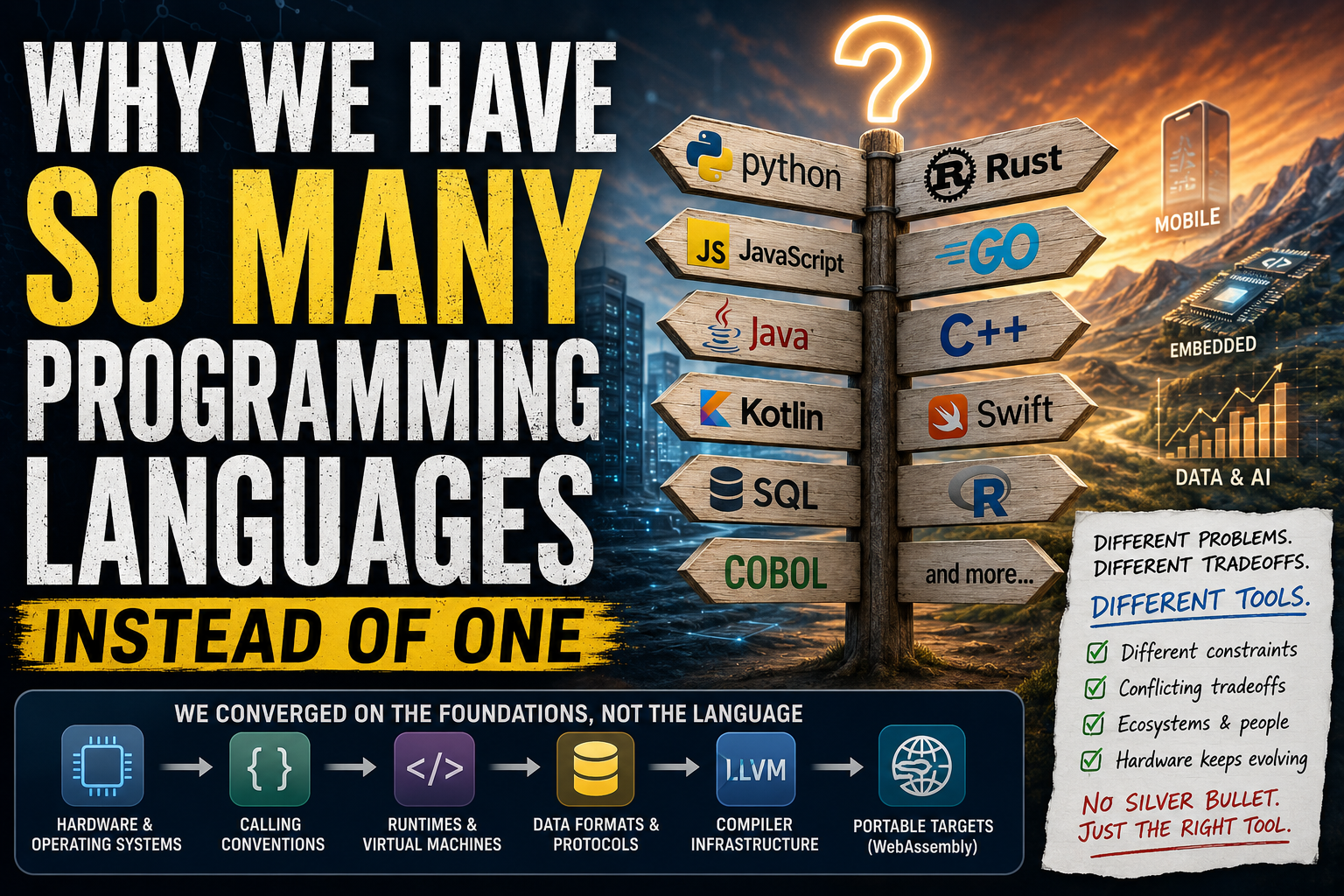
Here is the part that reframes the whole question. The industry has converged. It just did not converge on a single language. It converged on shared foundations that let many languages coexist and work together.
That convergence shows up in several layers:
The operating system and the C calling convention act as a common ground that lets code written in different languages call into each other.
Shared virtual machines host many languages each. The Java Virtual Machine runs Java, Kotlin, Scala, and Clojure. The .NET runtime runs C#, F#, and others.
Shared data formats and protocols, like JSON, HTTP, and gRPC, let services written in completely different languages talk to one another. This is what makes mixed-language systems normal rather than exotic.
Shared compiler infrastructure, especially LLVM and its newer relative MLIR, lets a new language reuse decades of optimization work instead of reinventing it. Rust, Swift, and Mojo all lean on this.
The pattern is consistent. Standardization happened at the layers where it genuinely helps, the runtimes, the interfaces, the protocols, the compiler backends. Diversity remained at the layer where it genuinely helps, the languages themselves. The system is not fragmented by accident. It is specialized on purpose, held together by common plumbing.
WebAssembly: one runtime, many languages
The clearest current example of convergence at the foundation rather than the language is WebAssembly.
It started in 2017 as a way to run near-native-speed code inside the browser. By 2026 it has become something much broader: a portable, sandboxed binary format that runs on servers, at the edge, on devices, and still in the browser, with server-side use now overtaking browser-only use. A companion standard called WASI gives it a common way to talk to the operating system, and a Component Model lets modules written in different languages snap together through typed interfaces. More than thirty languages can compile to it.
The framing people use is telling. WebAssembly is described as finally delivering the portability that Java once promised, compile once and run anywhere, but across languages rather than within one. The founder of Docker famously remarked that if this technology had existed earlier, Docker itself might not have been necessary. The honest status in 2026 is that it is production-ready for edge functions, serverless, and plugin systems, and not yet a replacement for general server applications.
The deeper point is what WebAssembly is, conceptually. It is the opposite of a universal language. It is a universal target that frees you to keep using many languages. The thing the industry is actually building to solve the too-many-languages problem is not one language. It is a shared place for all of them to run.
What about the modern unifiers, like Mojo?
It is fair to ask whether some new language will finally pull everything together. The most ambitious current candidate is worth looking at closely, because it shows the real shape of unification.
Mojo, created by Chris Lattner, who previously designed Swift and the LLVM compiler infrastructure, aims to combine the ease of Python with the performance of systems languages like C++ and Rust. It is designed to become a superset of Python, reached a 1.0 beta in 2026, and posts very large speedups over plain Python on the right workloads. Its headline use is writing fast code for GPUs and CPUs without dropping down to C++ or CUDA.
But notice what Mojo is actually unifying. It bridges two layers, high-level Python and low-level performance code, within one domain, AI and high-performance computing. Even the most ambitious modern attempt is scoped. It is not trying to also be the language for web frontends, mobile apps, embedded controllers, and database queries. And it is not yet a complete Python superset even within its own lane.
So Mojo is not a counterexample to the thesis. It is evidence for it. Unification is happening, but as targeted bridges between adjacent niches, not as a single language for all of computing.
Does AI change the answer?
The newest version of the question is whether AI coding assistants finally make one language unnecessary, by letting anyone work in any language. The honest answer points in two directions at once.
In one direction, AI lowers the friction of using an unfamiliar language. Models can generate, explain, and translate code between languages, which weakens the old lock-in where a developer only really knew one. In principle this makes working across many languages easier, not harder.
In the other direction, these models are best at languages that appear most in their training data, such as Python, JavaScript, and Java, and noticeably weaker on niche or brand-new languages. That creates a rich-get-richer effect that entrenches today's popular languages and raises the barrier for new ones. A side effect is already visible: traditional measures of language popularity, like the volume of public questions developers ask, have dropped sharply because people now ask models privately instead.
Put together, AI is more likely to harden the current distribution of languages than to collapse it into a single one. It changes how developers move between languages. It does not remove the underlying reasons there are many. Some language designers have started shipping machine-readable specifications precisely so that future models can learn their new language and it is not frozen out.
The honest takeaway
There is no one programming language for everything because "best" is not a single point. It is a different point for every combination of domain, constraint, hardware, and team, and a language is a fixed bundle of tradeoffs that cannot be optimal in all of them at once.
On top of that technical reality sit human and economic forces, ecosystems, hiring, legacy code, and plain inertia, that keep even imperfect languages alive for decades. Those forces are strong enough that mandating a single language has failed even when powerful organizations tried it.
And the industry is not failing to unify. It unified the parts that benefit from being unified, the runtimes, the calling conventions, the data protocols, the compiler backends, and now portable targets like WebAssembly. It left diverse the part that benefits from being diverse, the languages themselves.
For anyone building software, that is the practical reading. The goal was never one language. It is knowing which tool fits which job, and relying on shared interfaces to make many tools work together. The long list of programming languages is not a mess waiting to be cleaned up. It is specialization doing exactly what specialization does in every mature field.
Frequently asked questions
Why isn't there one programming language for everything?
Because a language is a fixed set of tradeoffs, and different software has conflicting needs. Code for an embedded chip needs tight memory control and predictable timing, while code for data analysis needs fast iteration and huge libraries. No single design is best for both at once, so different languages specialize in different jobs.
Hasn't anyone tried to build a universal language?
Yes, many times. IBM's PL/I in the 1960s tried to merge scientific and business programming. The US Department of Defense mandated Ada in the 1980s. Java promised "write once, run anywhere" in the 1990s. Each became successful and widely used, but each ended up as one more language rather than the last one.
What is the main technical reason languages differ?
You cannot maximize performance, safety, simplicity, and expressiveness all at the same time, because they trade off against each other. Manual memory control is fast but risky, automatic memory management is safe but slower, a simple language is easy but verbose, and a powerful one is concise but complex. Every language picks a position on these tradeoffs.
Are the reasons only technical?
No, and often the non-technical reasons matter more. Languages survive because of their libraries and tooling, because companies hire for them, because rewriting existing code is expensive, and because a "good enough" option that is everywhere usually beats a better one that is late or niche. These forces keep even imperfect languages alive for decades.
If we cannot have one language, how do different languages work together?
Through shared foundations rather than a shared language. The operating system and the C calling convention let languages call each other, virtual machines like the JVM host several languages each, and formats like JSON and protocols like HTTP let services written in different languages communicate. The industry standardized the plumbing, not the syntax.
Is WebAssembly a universal language?
No, it is closer to the opposite. WebAssembly is a portable runtime that more than thirty languages can compile to, letting them run anywhere from browsers to servers to edge devices. Rather than replacing many languages with one, it gives many languages a single common place to run.
Will AI coding assistants lead to one language?
Probably not. AI makes it easier to work across languages by generating and translating code, but models are strongest at already-popular languages and weaker at niche ones. That tends to reinforce the languages we already use rather than collapse everything into a single one.
Is Mojo going to unify programming?
Mojo is an ambitious attempt to combine Python's ease with systems-level performance, but it is focused on AI and high-performance computing rather than all software. It bridges two layers within one domain, which is a useful kind of unification, but not a single language for web, mobile, embedded, and everything else.
Sources, for fact-checking the current-state claims before publishing (the historical and conceptual parts are standard computer-science background and not cited): the Mojo details are from coverage describing Mojo as created by Chris Lattner to combine Python's usability with C++ and Rust-level performance, approaching its 1.0 release in 2026 and reporting on the 1.0 Beta and its phased open-source roadmap; the WebAssembly figures are from the 2026 State of WebAssembly survey showing 67% production use, up from 47% in 2024, with server-side use overtaking browser use and the Component Model reaching 1.0 and the description of 30-plus languages compiling to Wasm and the Solomon Hykes Docker remark; and the AI section draws on IEEE Spectrum's finding that Stack Exchange question volume in 2025 was just 22% of 2024 as developers shifted to private LLM chats, the research on a Matthew effect where AI assistant accuracy correlates with how common a language is in training data, and the suggestion that new languages ship machine-readable conformance suites so models can learn them.