
Why the First Years of Business Are the Hardest: The Part Nobody Shows You Before the Freedom
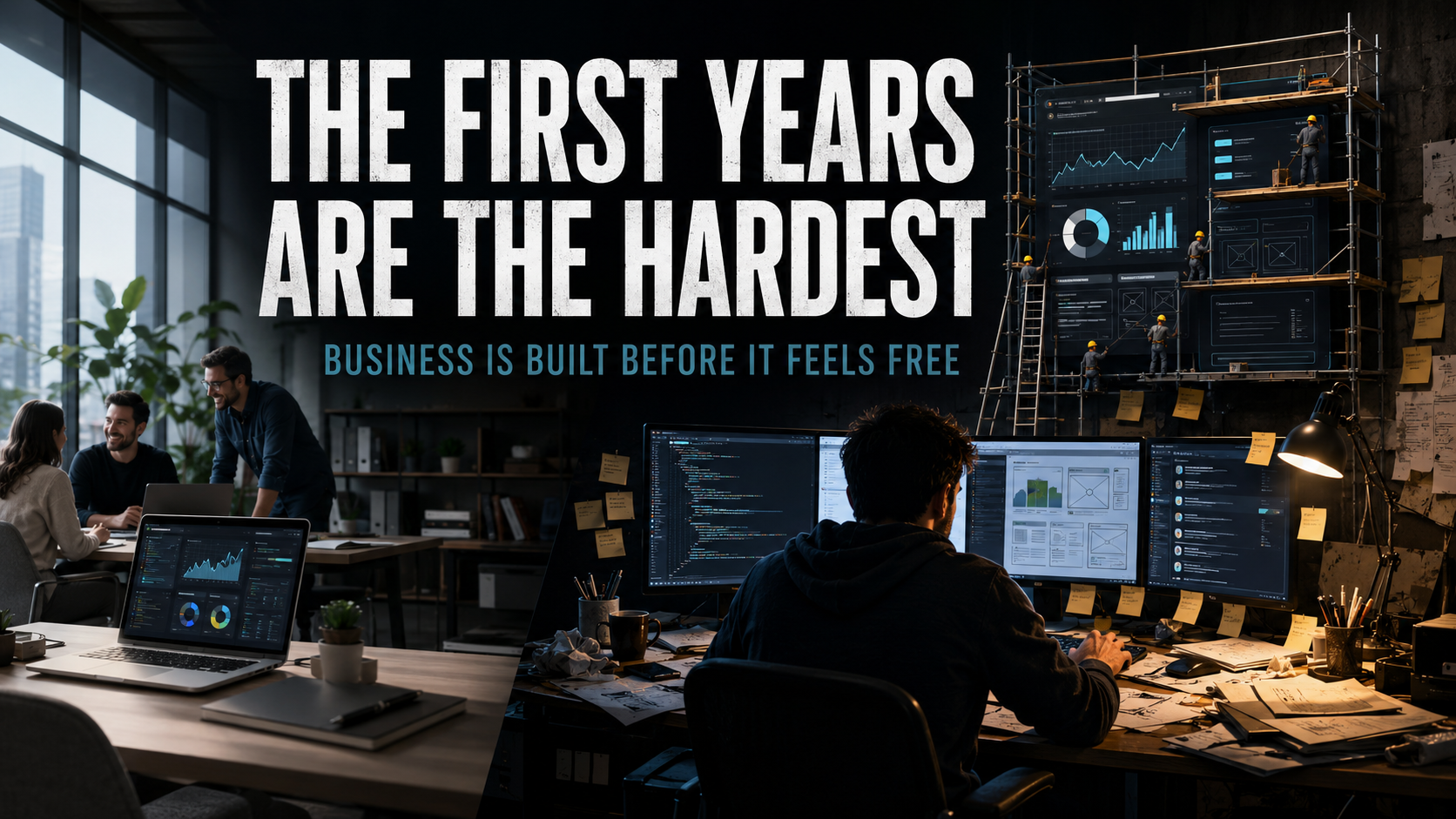
Most people do not want the beginning of a business.
They want the version they see later.
They want the business owner who controls their schedule, works on interesting problems, has a team, chooses clients, makes money while they sleep, takes calls from nice places, and talks about “freedom” like it is a normal Tuesday.
That version is real for some people.
But it is usually not year one.
Year one is often the construction site. The systems are not built. The reputation is not built. The sales process is not built. The product is not finished. The website is not converting. The offer is still unclear. The founder is still learning what customers actually want instead of what they assumed customers wanted.
This is the part many people underestimate.
They compare their 9 to 5 job to somebody else’s year five business.
That is not a fair comparison.
A mature business owner may have recurring revenue, referrals, repeat customers, processes, employees, contractors, automation, a brand, case studies, and years of painful judgment built into the company.
A new business owner usually has energy, ambition, a half-finished system, and a long list of things they did not know they needed to learn.
That does not mean you should avoid starting a business.
It means you should understand what phase you are entering.
The first years of business are not the freedom phase.
They are the construction phase.
The Business Owner Fantasy
The fantasy is easy to understand.
Nobody wants to be told what to do forever. Nobody wants to ask for permission to take a Tuesday afternoon off. Nobody wants their income controlled by one employer, one manager, one promotion cycle, or one HR department.
Business ownership promises a different path.
You can build something. You can choose the direction. You can solve problems your way. You can earn more than a fixed salary. You can make decisions without waiting for approval. You can create an asset instead of only selling your time.
That is powerful.
And for many people, especially builders, developers, designers, marketers, freelancers, and tech founders, the idea is intoxicating.
Why work on someone else’s product when you could build your own?
Why help another company grow when you could grow your own?
Why spend your best hours inside a system you do not own?
There is nothing wrong with that feeling. In fact, it is often the beginning of something good.
But the fantasy usually skips the timeline.
It shows the outcome, not the messy middle.
It shows the founder after the company has momentum, not the founder at 1:00 AM fixing a checkout bug, rewriting the landing page, answering support emails, preparing invoices, chasing leads, and wondering why the thing that looked obvious in their head is not obvious to the market.
That gap between the dream and the beginning is where many people get shocked.
The Famous 80-Hour Joke Is Funny Because It Is True
There is a popular quote often attributed to Lori Greiner:
“Entrepreneurs are willing to work 80 hours a week to avoid working 40 hours a week.”
It is funny because it sounds absurd.
It is also uncomfortably accurate.
Many new business owners leave a structured job because they want freedom, then spend the first years working more than they ever worked as employees.
The difference is not always the number of hours. It is the type of pressure.
In a normal job, you may work 40 hours and then go home. You may be tired, annoyed, underpaid, or bored, but the company is not fully on your shoulders.
In your own business, the work follows you.
If sales are slow, it is your problem.
If the website is broken, it is your problem.
If customers are confused, it is your problem.
If cash flow is tight, it is your problem.
If the product is not good enough, it is your problem.
If the strategy is wrong, it is your problem.
This is the hidden trade.
You remove the boss above you, but you inherit the weight that the boss, the company, the finance department, the sales team, the support team, and the operations team were carrying.
At the start, all of those jobs may become yours.
Why Year One Feels Harder Than a Job
The first year of business is hard because almost nothing is stable yet.
A job has structure already built in.
There is a company name, a product, a customer base, a manager, a process, a salary date, an accounting system, a legal setup, tools, meetings, departments, and someone else making many of the high-risk decisions.
A new business has to build all of that.
Even a simple online business has more moving parts than it appears from the outside.
You need an offer.
You need a target customer.
You need proof.
You need a website or landing page.
You need pricing.
You need a way to get leads.
You need a way to close sales.
You need delivery.
You need customer support.
You need admin.
You need invoices, taxes, contracts, terms, policies, tools, tracking, and follow-up.
You need to decide what to do when things do not work.
That last part is the real work.
The problem is not only that you have many tasks. The problem is that many of those tasks are unclear.
A 9 to 5 gives you work.
A new business gives you fog.
You do not just have to work. You have to decide what work matters.
That is much harder.
The First Years Are a Search Problem
Many people think the beginning of business is an execution problem.
They believe they need to work hard, launch fast, post content, run ads, improve the product, and keep going.
That is true, but incomplete.
The first years are also a search problem.
You are searching for the right customer.
You are searching for the right offer.
You are searching for the right price.
You are searching for the right sales channel.
You are searching for the right positioning.
You are searching for the right delivery model.
You are searching for the right product features.
You are searching for the right systems.
You are searching for the version of the business that can survive.
This is why early business feels so exhausting. You are not walking a known road. You are building the road while trying to drive on it.
That is especially true in tech and online businesses.
A coffee shop owner has hard problems, but the basic business model is understandable. Location, product, foot traffic, repeat customers, costs, staff, service.
A tech founder may not even know if the market wants the product yet.
A SaaS founder may spend months building features only to discover customers do not care about those features.
An agency owner may get clients, then realize delivery depends too much on them personally.
A freelancer may earn good money, then realize they have created another job, not a business.
An ecommerce founder may get sales, then realize margins, returns, ad costs, logistics, and cash flow are harder than the “revenue screenshots” made it look.
The early years are where reality gives feedback.
And reality is not gentle.
The Data Is Not Romantic
The numbers are not there to scare you, but they are useful.
The U.S. Bureau of Labor Statistics has shown that roughly one in five new business establishments do not survive their first year, with one-year survival rates often around the high 70% to low 80% range depending on year and region. That means many businesses survive year one, but many do not.
The harder truth is that survival is not the same as success.
A business can technically survive while the owner is exhausted, underpaid, and doing everything manually.
In tech, the startup failure pattern is even harsher. CB Insights’ 2026 analysis of hundreds of startup post-mortems found that running out of capital was the most common end point, but deeper causes included poor product-market fit, bad timing, and unsustainable unit economics.
That is important.
Many startups do not fail because the founder was lazy.
They fail because the market did not want the product enough, the timing was wrong, the economics did not work, the cost of acquiring customers was too high, or the company ran out of money before the model became repeatable.
This is why the first years are so hard.
You are not only working. You are testing whether the business deserves to exist in the market.
Tech Businesses Are Especially Competitive
Tech and online businesses look easier from the outside because they have low starting costs.
You do not need a factory. You do not need a physical store. You do not need a warehouse for a SaaS product. You can launch a website from a laptop. You can use no-code tools, AI tools, cloud infrastructure, payment processors, templates, analytics, and global platforms.
That is the good news.
It is also the bad news.
Because if it is easier for you to start, it is easier for everyone else to start too.
Low barriers to entry create high competition.
A new SaaS product competes with funded startups, indie hackers, big platforms, open-source tools, free alternatives, AI features built into existing software, and thousands of other founders trying to get attention.
A web agency competes with freelancers, templates, Squarespace, Shopify, Webflow, Wix, AI site builders, overseas teams, local agencies, big agencies, and every developer who says they can do the same thing cheaper.
A marketing business competes with software, AI tools, consultants, agencies, internal teams, and creators giving away free advice.
An online course competes with YouTube, newsletters, books, communities, AI tutors, and people with bigger audiences.
This is why “I can build it” is not enough.
In tech, building is often the easiest part to overestimate and the hardest part to sell.
The market does not reward effort. It rewards useful outcomes.
The Beginning Is Hard Because You Have No Leverage
A mature business has leverage.
Brand is leverage.
Reputation is leverage.
Systems are leverage.
Employees are leverage.
Contractors are leverage.
Recurring revenue is leverage.
Content assets are leverage.
Customer referrals are leverage.
Software automation is leverage.
A strong product is leverage.
A new business usually has very little leverage.
That means the owner must use personal effort to compensate.
You answer every email.
You write every page.
You chase every lead.
You fix every bug.
You do every call.
You create every proposal.
You test every idea.
You handle every complaint.
You make every decision.
This is why the first years can feel heavier than a job. You are not only doing work. You are creating the leverage that future you will use.
That is the construction phase.
When people see a business owner later with more freedom, they are often seeing the result of leverage that was built slowly.
They are not seeing the years when everything depended on one person’s attention.
The Systems Do Not Exist Yet
A real business is not just a product or service.
A real business is a machine that can repeatedly create value, attract customers, deliver the work, collect money, handle problems, and improve over time.
In the beginning, that machine does not exist.
The founder is the machine.
That is dangerous, but normal.
The goal of the early years is to slowly turn founder effort into business systems.
A sales script becomes a sales process.
A repeated client question becomes a FAQ.
A messy delivery becomes a checklist.
A one-off proposal becomes a template.
A repeated bug becomes a better product flow.
A stressful onboarding call becomes an onboarding system.
A manual report becomes automation.
A painful mistake becomes a policy.
A founder’s instinct becomes company knowledge.
That is how the business becomes less chaotic.
But it takes time because you cannot design every system before reality hits. Many systems are built from pain.
You discover the process because something broke.
You write the policy because a client misunderstood.
You improve onboarding because people got confused.
You add payment rules because someone paid late.
You improve support because the same question appeared 20 times.
This is why the first years feel messy. They are supposed to reveal what needs to be systemized.
The Emotional Load Is Different
People talk a lot about workload. They talk less about emotional load.
The first years of business can mess with your identity.
When you have a job, a bad month is unpleasant.
When you own the business, a bad month feels personal.
If nobody buys, you wonder if your idea is bad.
If a client leaves, you wonder if you failed.
If a launch underperforms, you question your judgment.
If competitors grow faster, you compare yourself.
If revenue drops, you feel it in your body.
If you work all week and nothing moves, you start asking whether you are wasting your life.
This is normal, but it is not shown in the entrepreneur fantasy.
Business owners spend a lot of time alone with uncertainty.
They think about pricing while eating.
They think about strategy while walking.
They think about customers before sleeping.
They think about cash flow when they wake up.
They think about the product in the shower.
They think about one email for two days because it might change the month.
This is not always bad. Some people love it.
If you are building something you care about, the thinking can be energizing. Your mind stays engaged because the business is yours. You are not just completing tasks. You are solving a puzzle that could change your life.
But it is still heavy.
Ownership gives meaning to the work.
It also gives weight to the work.
The Fun Parts Are Real Too
A brutally honest article should not pretend that business is only suffering.
There are real fun parts.
Working on your own thing feels different.
Even when the hours are long, the work can feel more alive because you are not only executing someone else’s plan. You are building something that reflects your decisions, your taste, your standards, and your vision.
You learn fast because the market teaches fast.
You learn sales, psychology, money, customers, product, positioning, writing, negotiation, patience, resilience, and self-control.
You learn what you avoid.
You learn how you behave under pressure.
You learn whether you actually want freedom or only wanted escape.
You learn what kind of work gives you energy.
You learn how much uncertainty you can handle.
You learn that motivation is not enough, but neither is discipline without direction.
And when something works, it feels very different from a salary.
The first real customer.
The first payment.
The first repeat buyer.
The first referral.
The first month where revenue comes from something you built.
The first time someone says your product helped them.
The first time you realize the business might actually become real.
Those moments matter.
They are why people keep going.
The early years are hard, but they are not meaningless. They are often some of the most formative years of a person’s professional life.
Outliers Exist, But They Are Not the Rule
Some businesses start fast.
Some founders have the right network.
Some products hit the market at the perfect time.
Some people already have an audience.
Some agencies launch with warm referrals.
Some SaaS products catch a wave.
Some ecommerce stores find a winning ad angle quickly.
Some founders raise money early.
Some people appear to skip the painful years.
Good for them.
But those are not the rule.
And even when the outside looks easy, the inside may not be.
A business can grow fast and still be chaotic. Revenue can rise while operations break. A founder can get customers quickly and still have no systems. A startup can raise money and still be under brutal pressure to grow. A viral launch can create support problems the team is not ready for.
Fast growth is not the same as easy growth.
The mistake is building your expectations around outliers.
You can study them. You can learn from them. But you should not assume your first year will look like their highlight reel.
A healthier expectation is this:
The first years will probably ask more from you than you think.
If they go better, great.
But build your mindset for the normal path, not the exceptional one.
Why Many People Quit Too Early
Some people quit because the business is genuinely not working and quitting is the right decision.
But many quit because they thought the beginning would feel like freedom.
It usually does not.
The beginning often feels like confusion, pressure, and unpaid work.
If someone expects immediate freedom, they interpret difficulty as failure.
If someone expects construction, they interpret difficulty as part of the process.
That mindset difference matters.
A slow first year does not always mean the business is bad.
It may mean the offer needs work.
It may mean the audience is wrong.
It may mean pricing is wrong.
It may mean the website is unclear.
It may mean the product is too complicated.
It may mean the founder is avoiding sales.
It may mean the market needs more education.
It may mean distribution is weak.
It may mean the business needs a smaller, sharper niche.
The first years are full of signals. The job is to read them without lying to yourself.
Persistence is useful only when paired with learning.
Stubbornness without learning is expensive.
The 9 to 5 Is Not the Enemy
There is another important point: a 9 to 5 is not automatically bad.
For many people, a job is the right place to build skills, save money, learn an industry, understand customers, and reduce financial pressure while preparing a business.
The internet often frames jobs as failure and entrepreneurship as courage.
That is childish.
A job can be a smart platform.
A salary can fund your business.
A stable schedule can give you time to test ideas.
A company can teach you how operations work.
A manager can teach you what leadership looks like, or what not to do.
A job can give you exposure to customers, systems, sales, product, support, and team dynamics.
Quitting too early can make the business harder because panic becomes your strategy.
If you need money immediately, you may accept bad clients, underprice, rush launches, overpromise, or quit before the business has time to mature.
There is no shame in building on the side first.
There is no medal for making the game harder than necessary.
What You Should Know Before Starting a Tech Business
If you are thinking about starting a tech or online business, do not only ask whether the idea is exciting.
Ask harder questions.
Who exactly is this for?
What painful problem does it solve?
How are people solving it now?
Why would they switch?
How will they find you?
Why will they trust you?
Can you reach them without spending more than they are worth?
Can you deliver the result repeatedly?
Can the business work if you are not doing everything manually?
What has to be true for this to become profitable?
What system needs to exist in year two that does not exist now?
These questions are not meant to kill the idea.
They are meant to make the idea real.
The earlier you face reality, the less reality will punish you later.
The Construction Phase Has a Purpose
The first years are not just a painful waiting room before the good part.
They are where the business gets shaped.
You build the offer.
You build the product.
You build the customer understanding.
You build the sales process.
You build the delivery process.
You build the support system.
You build the brand.
You build the founder’s judgment.
You build the ability to survive bad weeks without making stupid decisions.
This is why the construction phase matters.
Freedom without systems is chaos.
A business that depends entirely on the founder’s daily force is not freedom. It is a stressful job with unlimited responsibility.
The goal is not to work 80 hours forever.
The goal is to survive and learn long enough to build the systems that make 80 hours unnecessary.
That is the difference between being self-employed and building a business.
Self-employment can be a good life. But if you want a business that gives freedom later, you have to build the machine, not only do the work.
What Realistic Motivation Looks Like
The right mindset is not blind optimism.
Blind optimism says: this will be easy.
Cynicism says: this is impossible.
Realistic motivation says: this will probably be harder than I think, but I can learn, adapt, and build systems over time.
That is the mindset entrepreneurs need.
You do not need to romanticize the struggle. You do not need to pretend every hard day is beautiful. Some days are just hard.
But you also do not need to be scared away by the fact that the first years require work.
Almost anything meaningful has a construction phase.
A career has one.
A skill has one.
A body has one.
A relationship has one.
A company definitely has one.
The problem is not that construction exists.
The problem is expecting the finished building on day one.
Final Thought
Many people want the life of a business owner.
Fewer people want the first years of becoming one.
That is the honest distinction.
The business owner life people admire usually comes after years of building trust, systems, reputation, judgment, customer understanding, and operational leverage.
At the beginning, you may work more than a 9 to 5 employee. You may earn less predictably. You may think about the business constantly. You may feel alone. You may have to learn sales, marketing, product, finance, support, hiring, and strategy at the same time.
That is not a reason to avoid starting.
It is a reason to start with clear eyes.
The first years of business are not the freedom phase.
They are the construction phase.
And if you understand that before you begin, you are already less likely to be destroyed by the shock of it.
Because the goal is not to escape work.
The goal is to build something worth working on, then slowly build the systems that make it bigger than your own daily effort.
That is where the freedom comes from.
Not at the start.
After the construction.
FAQ
Why are the first years of business so hard?
The first years are hard because the business has very little structure. The owner has to build the offer, sales process, product, systems, customer base, brand, and operations at the same time.
Do business owners work more than 9 to 5 employees?
Many do in the early years. A normal employee usually has a defined role, while a new business owner may handle sales, delivery, support, marketing, admin, finance, and strategy alone.
Is starting a tech business harder than a normal business?
It can be, because tech and online businesses often have low barriers to entry, which means more competition. They also change quickly, require constant learning, and often need strong product, marketing, and distribution at the same time.
Does this mean starting a business is a bad idea?
No. It means starting a business should be approached with realistic expectations. The early years are difficult, but they can also be meaningful, exciting, and financially rewarding if the business becomes sustainable.
Why do people misunderstand business ownership?
Many people compare their current job to a mature business owner’s life. They see the freedom of year five or year ten, but not the uncertainty, workload, and system-building required in the first years.
What is the construction phase of business?
The construction phase is the period when the founder builds the foundations of the business: offer, product, sales, customer understanding, operations, systems, and reputation.
What should someone do before quitting their 9 to 5?
They should validate the idea, understand the customer, test sales channels, save money, build early proof, and know what kind of workload they are entering. A job can be a useful platform while building the business on the side.
What is the biggest mistake new business owners make?
One of the biggest mistakes is assuming that building the product or launching the website is the main work. In reality, finding customers, earning trust, creating repeatable systems, and reaching profitability are often much harder.
Sources Consulted
U.S. Bureau of Labor Statistics - Business Employment Dynamics survival rates
CB Insights - The Top Reasons Startups Fail
Investopedia - Top Reasons New Businesses Fail