
Why RAM Prices Exploded in 2026 - and Why Apple Raised Prices Afterwards
For years, computer memory followed a familiar cycle.
Manufacturers produced too much.
Prices collapsed.
Consumers received more RAM and storage for the same money.
Then suppliers reduced production, demand recovered, and prices climbed again.
But the memory price explosion of 2026 is not simply another ordinary semiconductor cycle.
This time, the center of gravity of the entire memory industry has shifted.
The largest memory manufacturers are increasingly directing production capacity toward AI servers, high-bandwidth memory and enterprise data centers. Those products are more profitable than the ordinary memory used in laptops, smartphones, tablets and consumer electronics.
The result is a supply chain in which AI companies and hyperscale data centers can pay more, sign longer contracts and consume far more memory per system than normal consumers.
Less production capacity remains available for conventional RAM and storage.
Prices rise first at the component level.
Manufacturers absorb the increase temporarily.
Then laptop, smartphone and electronics prices begin moving higher.
Apple tried to delay that final step. Its inventory, purchasing power and long-term supplier agreements gave it more protection than most hardware companies.
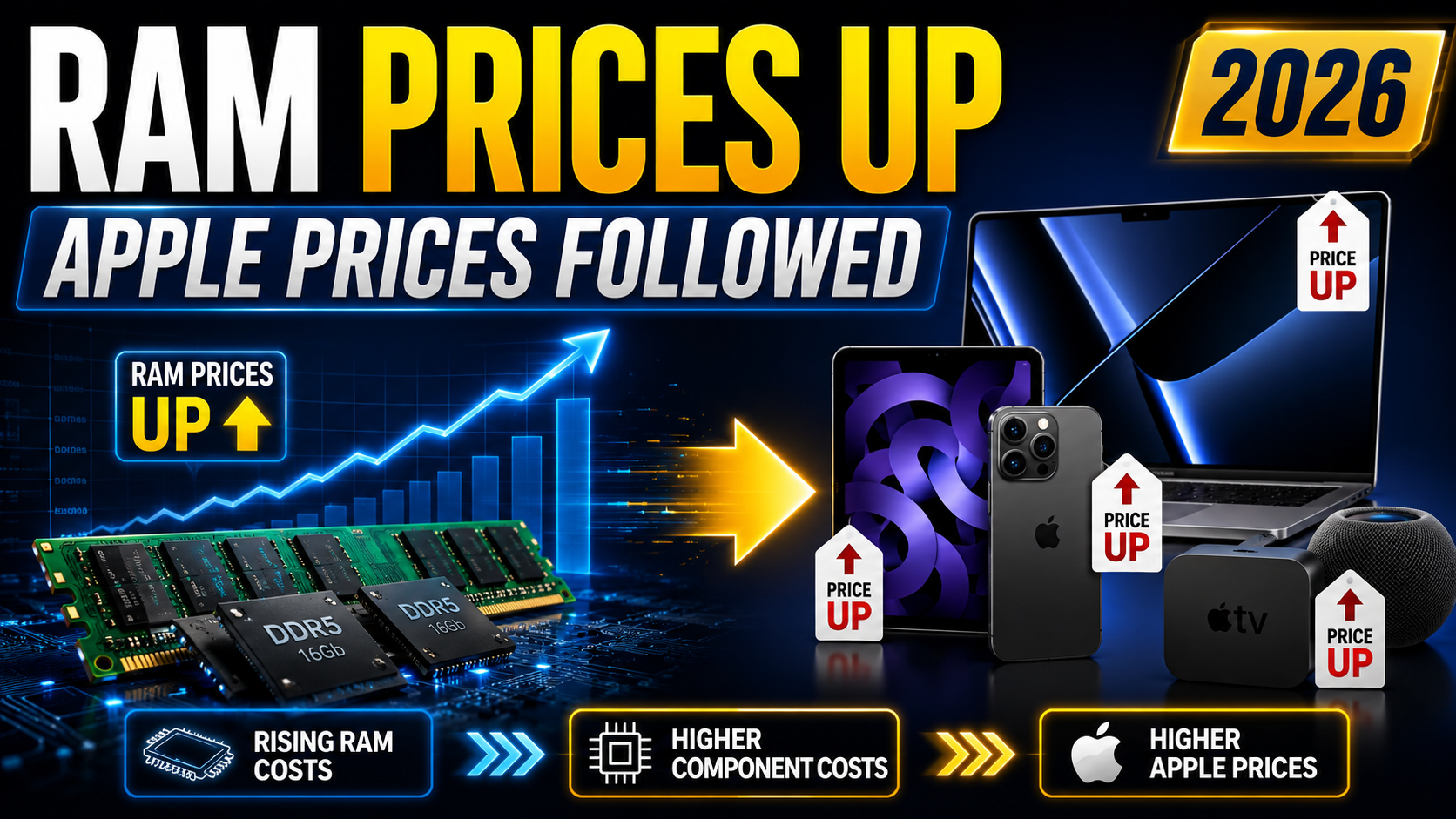
But on June 25, 2026, Apple raised prices across Macs, iPads and several other products, explicitly connecting the decision to rapidly increasing memory and storage costs.
The changes showed how the AI infrastructure boom had finally reached ordinary technology buyers.
The same demand driving investments in Nvidia accelerators, cloud infrastructure and massive AI data centers was now increasing the price of a MacBook, an iPad and even an Apple TV.
This is how that price chain works.
What actually happened to RAM prices in 2026?
The increase was not small.
TrendForce reported that contract prices for conventional DRAM rose approximately 93% to 98% quarter over quarter during the first quarter of 2026.
That means some categories of memory nearly doubled in contract price over a single quarter.
The surge helped increase total DRAM industry revenue by 81% quarter over quarter, reaching approximately $97 billion. TrendForce expected conventional DRAM contract prices to rise by a further 58% to 63% during the second quarter.
By the third quarter, the rate of increase was expected to moderate, but not reverse. TrendForce still forecast another 13% to 18% quarterly increase for conventional DRAM and a 10% to 15% increase for NAND Flash.
That distinction is important.
Prices rising more slowly does not mean memory is becoming cheaper.
It means prices are continuing to rise from an already extremely high base.
The market entered the third quarter with contract prices at record levels, consumer manufacturers reaching their affordability limits and memory suppliers still allocating more production toward server and AI customers.
RAM, storage and HBM are different — but connected
People often describe the situation as a RAM shortage, but several types of memory are involved.
DRAM is the working memory used by computers, smartphones and servers. In consumer products, this becomes system memory such as DDR5 in PCs or LPDDR memory in mobile devices.
NAND Flash is used for persistent storage. It powers SSDs, smartphone storage, tablet storage and other solid-state products.
HBM, or high-bandwidth memory, is a specialized form of memory designed to move enormous amounts of data quickly. It is used alongside advanced AI accelerators from companies such as Nvidia.
HBM is not the same product as the ordinary RAM inside a MacBook or the storage inside an iPhone.
But the different products compete for parts of the same industrial system.
They depend on the same small group of manufacturers.
They require limited cleanroom space, equipment, engineering teams, capital expenditure, packaging capacity and semiconductor wafers.
When Samsung, SK Hynix and Micron prioritize HBM and high-capacity server memory, they cannot expand conventional consumer-memory production at the same speed.
This is why explosive HBM demand can increase the price of ordinary RAM even though consumers are not putting HBM into their laptops.
The connection happens through production capacity.
AI servers use far more memory than consumer computers
An ordinary laptop may contain 16GB or 32GB of memory.
A high-end workstation may contain 64GB, 128GB or more.
An AI server deployment can require vastly larger quantities across every server, accelerator and storage system.
The demand also scales differently.
A consumer normally buys one computer and keeps it for several years.
A hyperscale cloud provider can order thousands of servers at once, continue expanding every quarter and reserve future production years in advance.
AI workloads began with enormous demand for model training, but inference is creating another wave.
Training builds the model.
Inference runs the model every time a user or software system sends it a request.
As AI becomes integrated into search, coding, customer service, office software, advertising, analytics and internal company systems, inference demand can grow continuously.
That requires not only AI accelerators and HBM, but also general-purpose servers, high-capacity DRAM, networking equipment and enterprise storage.
TrendForce reported that the shift from AI training toward AI inference was broadening memory procurement beyond HBM into high-capacity server DRAM and a wider range of RDIMM products.
AI does not consume one isolated category of memory.
It increases pressure across the memory hierarchy.
The three companies controlling most of the market had better customers to serve
The global DRAM market is highly concentrated.
Samsung Electronics, SK Hynix and Micron dominate advanced memory production.
When demand surged, these companies faced a basic economic choice.
They could allocate more capacity to conventional memory sold into price-sensitive consumer products.
Or they could prioritize high-margin server and AI memory purchased by some of the largest and best-funded companies in the world.
The second option was more attractive.
Cloud providers and AI infrastructure companies are often willing to accept price increases because memory represents a critical constraint on data-center expansion.
A laptop manufacturer cannot raise prices indefinitely without losing customers.
A hyperscaler building AI infrastructure may have fewer alternatives. Delaying memory procurement can mean delaying an entire data center, leaving expensive accelerators unused or falling behind competitors.
That gives memory suppliers greater pricing power in the enterprise and AI markets.
TrendForce said suppliers were prioritizing high-capacity RDIMMs for AI servers while inventory remained extremely low. This reduced the product available to PC manufacturers and smartphone vendors.
IDC described the shift as potentially more than a temporary shortage. It called it a strategic reallocation of global wafer capacity away from consumer electronics and toward higher-margin AI memory.
That is why 2026 feels different from a normal RAM cycle.
The industry is not merely waiting for consumer demand and supply to rebalance.
Its most valuable customers have changed.
AI companies did not simply buy all the laptop RAM
The simplest explanation would be that AI data centers purchased so much memory that nothing was left for consumers.
The reality is more indirect.
AI companies are mainly purchasing specialized products, including HBM, server DRAM and enterprise storage.
But manufacturing capacity is not instantly interchangeable or infinitely expandable.
New semiconductor fabrication capacity costs billions of dollars and takes years to plan, build, equip, qualify and ramp.
HBM is also more complex than conventional memory. It requires stacking multiple memory dies, advanced packaging, strict thermal management and close integration with AI accelerators.
Manufacturers therefore redirect their most valuable production resources toward those products.
At the same time, they avoid rapidly overbuilding conventional memory capacity because the industry remembers previous crashes.
Memory manufacturers have repeatedly suffered when aggressive expansion created oversupply and destroyed prices.
In 2026, they had little incentive to flood the market with cheap consumer RAM while AI customers were paying much higher margins.
Long-term contracts protected the largest customers first
Another reason the shortage moved unevenly through the economy is that the most powerful buyers secured supply through long-term agreements.
Large cloud providers and hardware manufacturers can negotiate multi-year contracts that guarantee access to a specific amount of production.
These agreements can limit short-term price increases for the contracted volume.
But they also reduce the supply available to everyone else.
TrendForce reported that several U.S. cloud service providers had entered multi-year memory supply agreements. Buyers without those agreements were expected to face more of the future price increases.
This creates a two-tier market.
The largest customers secure capacity.
Smaller manufacturers and buyers compete for what remains.
Apple is one of the few consumer-electronics companies large enough to operate near the protected side of that market.
Its supplier relationships, purchase volumes and cash position allowed it to secure components earlier and absorb increases longer than most competitors.
But even Apple’s protection had limits.
Why Apple did not raise prices immediately
Component prices can increase months before consumers see the effect.
Large manufacturers do not buy every chip at the spot-market price on the day a product is assembled.
They use contracts, forecasts, existing inventory and negotiated supply arrangements.
Apple may already own or have contractually secured part of the memory required for products that will be sold over the following months.
That inventory acts as a temporary buffer.
When market prices rise, Apple can continue assembling devices using components purchased under older and cheaper terms.
The financial impact arrives later as the company replaces that inventory at higher prices.
This explains the delay between the memory-price explosion and Apple’s retail-price changes.
Apple said in April that existing inventories had helped protect its gross margin. However, the company warned that rising memory expenses would begin affecting the business more heavily by the end of the June quarter.
Tim Cook told investors that Apple expected significantly higher memory costs and that the effect would increase beyond June.
Apple therefore moved through the normal stages of a component shock:
Use inventory purchased at older prices.
Rely on supplier contracts and purchasing power.
Accept some pressure on gross margin.
Adjust product pricing once the pressure becomes too large or persistent.
On June 25, the fourth stage arrived.
What Apple said when it raised prices
Apple did not attempt to hide the reason.
The company said the rapid expansion of AI data centers had created extraordinary demand for memory and storage.
It described the component-price increase as faster and larger than anything it had previously seen and said it had reached the point where it could no longer shield customers from the increases.
Apple then raised prices across Macs, iPads and several home products.
The timing was notable because Apple did not wait for a major new generation of products.
Technology companies often introduce a higher price alongside a redesigned device, faster processor or new feature.
That makes the increase easier to market.
In this case, many existing products became more expensive without receiving new hardware.
That made the supply-chain cause unusually visible.
Which Apple products became more expensive?
The June 25 changes affected a broad section of Apple’s hardware portfolio.
They included:
MacBook Air
MacBook Pro
Other Mac models
iPad models
HomePod and HomePod mini
Apple TV
Apple Vision Pro
Memory and storage upgrade configurations
Reuters reported several clear examples.
A 512GB MacBook Air increased from $1,099 to $1,299.
A MacBook Pro with 1TB of storage increased from $1,699 to $1,999.
The 128GB iPad Air increased from $599 to $749.
Across the larger product range, the increases varied considerably.
TidBITS calculated an average increase of approximately $266 and an average percentage increase of around 21%, although unusually large increases on products such as the M3 Ultra Mac Studio and Apple TV distorted those averages.
Some memory and storage upgrades reportedly increased by 50% to 67%, while certain 64GB and 128GB MacBook Pro memory upgrades doubled in price.
The pattern was not a simple fixed percentage.
Apple appears to have adjusted prices according to a wider combination of component exposure, product margins, sales volume, market positioning and expected replacement schedules.
Why products with more memory were hit harder in dollar terms
A high-end Mac uses more memory and storage than a base-model consumer device.
When the cost per gigabyte increases, configurations containing more memory accumulate a larger absolute cost increase.
A 16GB machine and a 128GB machine are both affected by higher memory prices, but not equally in dollar terms.
High-end machines also use memory packages that may be more difficult to source.
Apple Silicon systems use unified memory integrated closely with the processor package. Customers cannot replace or upgrade that memory later.
Apple must purchase and install the exact configuration during manufacturing.
That means Apple cannot reduce its immediate component exposure by allowing customers to add cheaper third-party RAM after purchase, as is possible with some traditional desktops and workstations.
Storage works similarly across much of Apple’s product lineup.
It is soldered or integrated and selected when the device is ordered.
The component shortage therefore affects both Apple’s manufacturing cost and the already profitable business of selling higher-memory configurations.
Apple did not merely increase the base price of some devices. It also increased the premium customers pay when they configure more RAM and storage.
Was the entire Apple increase really caused by RAM?
Memory and storage were clearly the trigger.
Apple explicitly said so.
But it would be too simplistic to assume that every additional dollar exactly matched Apple’s increased component cost.
Retail pricing does not work like a receipt in which the company adds the new cost of each chip and passes it through unchanged.
Apple sets prices strategically across its entire product ladder.
It considers:
Gross-margin targets
Currency movements
Regional taxes
Import costs and tariffs
Retail and distribution expenses
Product demand
Competitive positioning
Upgrade incentives
Upcoming product launches
Financing and trade-in programs
The relative prices between models
A component shock gives Apple a reason to recalculate the whole ladder.
For example, if the base MacBook Air becomes more expensive, the gap between it and the MacBook Pro may need to change.
If storage upgrades cost more, Apple may adjust multiple configurations to keep customers moving toward the models it wants to sell.
If a product is due for replacement soon, Apple may apply a different increase than it would to a newly launched model.
The shortage explains why Apple needed to act.
It does not necessarily explain the precise increase on every individual product.
Why did Apple initially leave the iPhone alone?
The iPhone was notably absent from the first major round of increases.
That does not mean it was unaffected by memory costs.
Smartphones use both LPDDR memory and NAND storage, and those components represent a meaningful portion of the bill of materials.
IDC estimated that memory can represent approximately 10% to 15% of the bill of materials for a high-end flagship phone and 15% to 20% for a mid-range device.
Apple had strategic reasons to delay an iPhone price change.
The iPhone is the company’s largest product business and one of the most visible price points in consumer technology.
Apple also tends to make major iPhone pricing decisions around the September launch cycle.
Raising the price of an existing iPhone only months before introducing a new generation could create confusion and weaken the launch structure.
Apple may also have secured smartphone memory earlier, allowing existing inventory and contracts to protect the current lineup for longer.
The better interpretation is not that the iPhone escaped.
It is that the iPhone’s pricing decision was deferred.
Reuters reported that analysts expected Apple to increase iPhone prices in the following months.
TrendForce similarly expected smartphone manufacturers to increase retail prices as higher LPDRAM costs moved through the supply chain.
Why Apple Watch was also initially protected
Apple Watch uses memory and storage, but much less than a Mac or iPad.
The absolute component-cost increase per device is therefore smaller.
Apple may have been able to absorb the difference through existing margins, supplier contracts or savings elsewhere in the device.
Pricing psychology also matters.
Wearables compete heavily on upgrade cycles, health features and ecosystem adoption.
A noticeable price increase could discourage upgrades more than the relatively small memory saving would justify.
This again shows why Apple’s pricing response was not a mechanical cost pass-through.
Products were treated differently according to their economics and strategic importance.
Why Apple TV and HomePod were affected
At first glance, a RAM shortage seems more relevant to computers than to home devices.
But Apple TV and HomePod still contain DRAM and NAND storage.
The percentage impact can also be larger on lower-priced products.
A $30 component-and-margin adjustment is small compared with a $3,000 workstation.
It is substantial on a product selling for a few hundred dollars.
Apple TV reportedly received one of the largest percentage increases in Apple’s portfolio, even though its absolute increase was smaller than that of some Macs.
Apple may also have used the shortage as an opportunity to reposition products ahead of future updates.
Once again, the shortage created the pressure, while product strategy determined the final number.
Why the Apple Vision Pro increased despite its already high price
Apple Vision Pro increased from $3,499 to $3,699, a rise of $200.
In percentage terms, that was only around 6%, much smaller than many of Apple’s other increases.
The device contains substantial processing, memory and storage hardware.
Its already high retail price gave Apple more room to absorb component increases without applying a large percentage change.
Vision Pro buyers may also be less sensitive to a $200 increase than buyers considering an entry-level iPad or MacBook.
This is an example of pricing power.
The same component shock does not need to produce the same percentage change across every market segment.
Why Apple was better protected than Windows and Android manufacturers
Apple’s increase was substantial, but weaker manufacturers may face an even harder choice.
Apple controls its hardware, software, chips, retail positioning and a large part of its distribution.
It has enormous purchase volumes and can commit to suppliers years in advance.
It also sells primarily in premium categories with relatively high gross margins.
Many Windows PC and Android smartphone manufacturers operate with thinner margins and more direct price competition.
They have fewer ways to respond.
They can:
Increase prices
Reduce the amount of RAM or storage
Use older or slower components
Delay product launches
Reduce discounts
Accept lower margins
Produce fewer units
IDC warned that manufacturers focused on lower-priced phones could be hit especially hard because memory represents a larger portion of the device’s total cost and those companies have less margin available to absorb the increase.
This may lead to a reversal of a long-running consumer trend.
Instead of receiving more RAM and storage every year at the same price, buyers may pay more for similar specifications.
Why manufacturers cannot simply build more memory factories
When prices rise this sharply, the obvious question is why suppliers do not increase production immediately.
Semiconductor manufacturing does not respond quickly.
A new fabrication plant can take several years from planning to high-volume production.
The facility requires specialized equipment, cleanrooms, water, electricity, experienced staff and extensive qualification.
Even after the factory exists, manufacturing advanced memory with acceptable yields takes time.
Suppliers must also decide what kind of capacity to build.
A factory designed around current HBM demand could become less valuable if AI architectures change.
A large increase in conventional DRAM production could cause another price collapse if demand weakens.
Memory manufacturers therefore prefer disciplined expansion, especially after previous oversupply cycles damaged profitability.
IDC expected DRAM supply to grow only around 16% year over year in 2026 and NAND supply around 17%, below historical levels and insufficient to fully satisfy the new demand structure.
Could Chinese memory manufacturers reduce the shortage?
Chinese manufacturers such as CXMT and YMTC could theoretically add supply and put pressure on global prices.
But geopolitics complicates that route.
Export controls limit access to advanced semiconductor equipment.
Governments are increasingly cautious about depending on Chinese memory for sensitive infrastructure and consumer supply chains.
In July 2026, U.S. lawmakers called for stricter restrictions on Chinese memory manufacturers while reports suggested Apple had explored sourcing DRAM from CXMT amid the shortage.
This creates an uncomfortable tension.
The market needs more supply.
But the most obvious alternative suppliers are caught inside a technology and national-security conflict.
That may keep the market more concentrated and prices higher for longer.
Will RAM prices fall again?
Eventually, supply responses, weaker consumer demand or slower AI investment could reduce the pressure.
But a quick return to the old pricing environment is not guaranteed.
TrendForce expected the DRAM market to remain extremely tight through the third quarter of 2026, with server memory prices continuing to rise quarterly into the second half of 2027.
Several factors could eventually cool the market:
New memory fabrication capacity
Better HBM manufacturing yields
Slower data-center construction
More efficient AI models
Reduced memory requirements per query
Weaker PC and smartphone demand
Increased production from smaller suppliers
Alternative accelerator and memory architectures
But those forces take time.
Higher prices may themselves reduce consumer demand, especially in PCs and smartphones.
TrendForce already reported that consumer buyers were reaching their affordability limit, while IDC modelled scenarios in which higher prices reduce PC and smartphone shipments.
The market may eventually balance because consumers buy fewer devices, not because supply suddenly becomes abundant.
The uncomfortable irony for Apple
Apple is both a victim and a participant in the AI economy driving the shortage.
The company needs more memory for its own products.
Apple Intelligence increases the importance of local RAM because on-device AI models require memory to run effectively.
Apple also operates Private Cloud Compute infrastructure for AI requests that cannot be processed entirely on the device.
So while external AI data centers are increasing Apple’s component costs, Apple is also expanding its own AI capabilities and infrastructure.
The company needs devices with enough memory to support AI features at the exact moment memory is becoming more expensive.
This creates a difficult product trade-off.
Apple can:
Increase RAM to support more on-device AI
Keep memory specifications unchanged
Raise prices
Accept lower margins
Move more processing into the cloud
Optimize models to use less memory
Apple is likely to use a combination of all six.
What this means for consumers
For consumers, the old advice to wait for the next generation may no longer work as reliably.
Technology normally becomes cheaper over time.
A newer model arrives, the old model receives discounts and buyers get more storage or performance for the same price.
During a component shortage, the opposite can happen.
Existing inventory at retailers may be cheaper than newly priced stock.
A current-generation product may cost less than its replacement even before accounting for discounts.
Higher-memory configurations may increase disproportionately.
Entry-level devices may lose specifications or become harder to find.
Consumers considering a Mac, iPad or other memory-heavy device need to compare actual available prices rather than assuming that waiting automatically produces a better deal.
What this means for businesses
Companies buying computers for employees face a larger effect because the increase applies across multiple devices.
A $200 increase is manageable for one laptop.
Across 100 laptops, it becomes $20,000 before accessories, warranties, taxes and support.
Businesses may respond by:
Extending device replacement cycles
Buying refurbished hardware
Standardizing fewer configurations
Purchasing inventory earlier
Negotiating enterprise contracts
Moving some workloads to virtual desktops
Giving high-memory systems only to employees who need them
Reconsidering whether every role requires a premium device
Apple’s increases also arrived as businesses were being encouraged to purchase AI-capable computers with more memory.
The AI industry is therefore creating two opposing forces.
Software vendors want companies to upgrade for AI.
The infrastructure required to build AI is making those upgrades more expensive.
The larger lesson: AI inflation does not stay inside the data center
The memory shortage is one example of a wider economic effect.
AI data centers compete for:
Memory chips
Advanced processors
Semiconductor packaging
Electricity
Cooling equipment
Construction materials
Grid connections
Engineering talent
Networking hardware
When the AI industry consumes more of those resources, prices can rise outside the AI sector.
Consumers may never purchase an AI server.
They can still pay more for a laptop because the server industry consumed the memory capacity.
They can pay more for electricity because data centers increased regional demand.
They can wait longer for hardware because advanced packaging capacity was directed toward AI accelerators.
The cost of the AI buildout does not remain isolated inside Microsoft, Google, Meta, Amazon, OpenAI or Nvidia.
It moves through the industrial economy.
Final thought
Apple did not raise prices because consumers suddenly wanted Macs and iPads 20% more than before.
It raised prices because the economics underneath those products changed.
AI data centers created extraordinary demand for HBM, server DRAM and enterprise storage.
Samsung, SK Hynix and Micron prioritized those higher-margin markets.
Less capacity remained available for conventional RAM and NAND.
Contract prices surged.
Apple used inventory and long-term agreements to delay the impact.
Then the more expensive components reached its product costs and margins.
On June 25, 2026, Apple passed part of that increase to customers.
The sequence was:
AI infrastructure demand → memory capacity reallocation → DRAM and NAND shortages → higher component contracts → depleted low-cost inventory → pressure on Apple’s margins → higher retail prices.
That is the real story.
The RAM shortage is not only a PC-component story.
It is evidence that the AI infrastructure boom has become large enough to change the price of ordinary consumer technology.
And if memory supply remains tight into 2027, Apple’s June increases may not be the final adjustment.