
Elon Musk’s First Principles Thinking Explained: Science, Engineering, Business
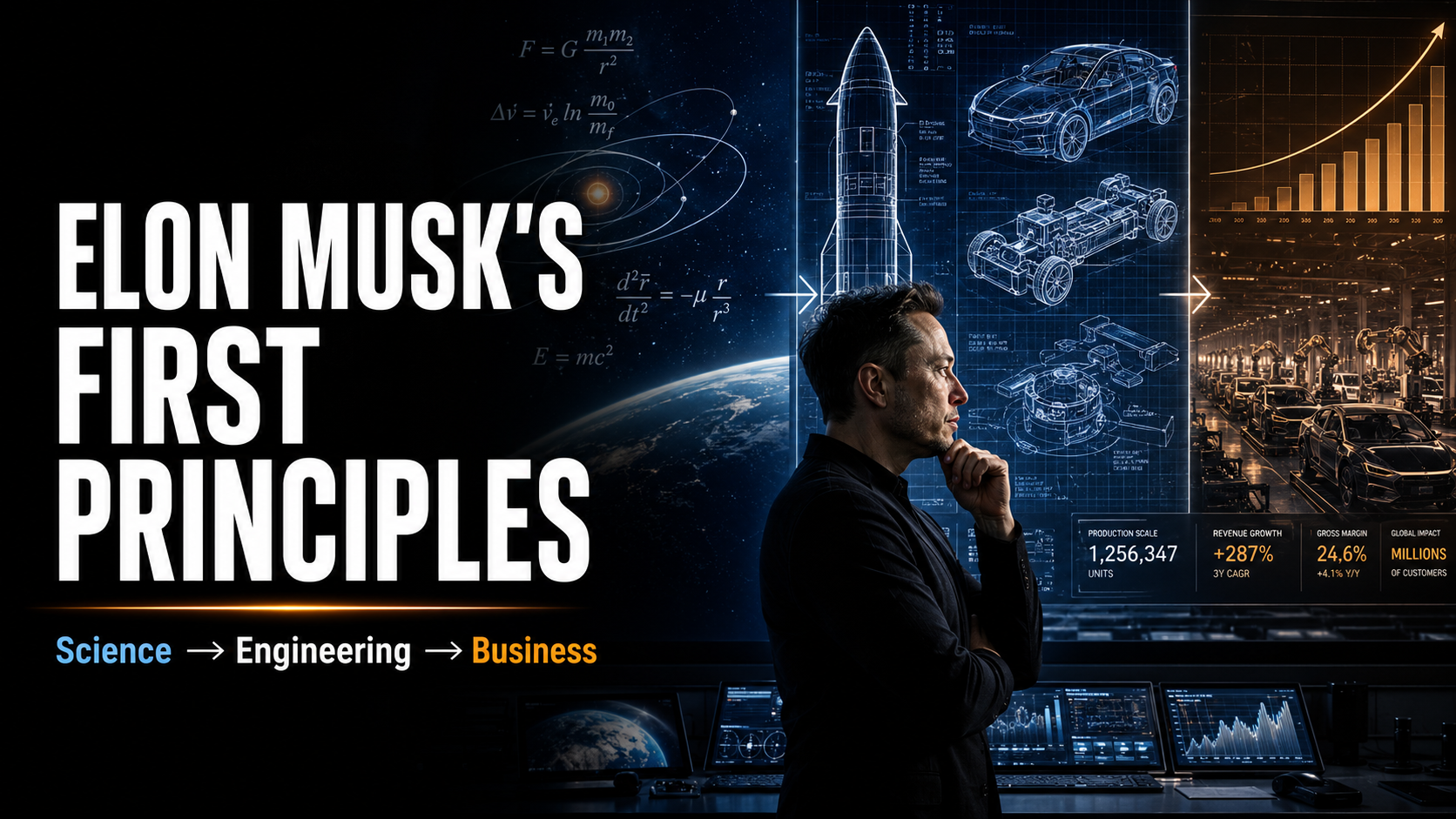
Elon Musk is not the only founder who uses first principles thinking, but he is probably the strongest modern example of what happens when the method is applied at extreme scale.
You can criticize Musk for many things. His communication style, timelines, politics, management intensity, and public behavior are all fair game. But if the question is business impact in the 21st century, it is hard to avoid the obvious: Tesla and SpaceX changed two of the hardest industries on Earth.
Cars and rockets were not small software categories waiting for a clever app. They were capital-heavy, regulation-heavy, physics-heavy industries where failure is expensive and excuses do not matter.
That is what makes Musk’s first principles method interesting.
It is not just a motivational phrase. It is not “think differently” with better branding. At its best, it is a way of moving through reality in the correct order:
Science first.
Engineering second.
Business third.
Most companies do the reverse.
They start with the market, competitors, pricing, branding, and what customers already expect. That can work. In many industries, it is the correct way to build. But it rarely creates a SpaceX or a Tesla.
Musk’s method starts deeper.
What does physics allow?
What is the real constraint?
What is the thing made of?
What should it cost if we strip away assumptions?
Can engineering make it work?
Can manufacturing make it repeatable?
Can the business model make it scale?
That is the interesting part.
First principles thinking is not just about having big ideas. It is about refusing to confuse inherited assumptions with reality.
The Simple Version Of First Principles Thinking
First principles thinking means breaking a problem down to its most basic truths, then reasoning upward from there.
The opposite is reasoning by analogy.
Reasoning by analogy sounds like this:
This is how rockets have always worked.
This is how car companies usually build vehicles.
This is what batteries usually cost.
This is how long development usually takes.
This is what suppliers usually charge.
This is what competitors are doing.
This is how the industry works.
That kind of thinking is not always bad. Analogy is useful. It saves time. It helps people avoid repeating old mistakes.
But analogy also traps people inside the current structure of an industry.
First principles thinking asks a more uncomfortable question:
Is this actually true, or is it just what everyone has accepted?
That question is simple, but it is not easy.
If you ask it seriously, you may discover that the biggest constraint in an industry is not physics. It may be process, bureaucracy, supplier margins, fear, old infrastructure, bad incentives, or people optimizing around rules that no longer make sense.
That is where Musk’s approach becomes powerful.
He does not only ask, “How do we compete inside this industry?”
He asks, “What should this industry look like if we rebuilt it from the underlying physics and economics?”
That is a much more dangerous question.
It can also create much larger outcomes.
Why Musk Is The Best Modern Example
Musk is a useful case study because he did not apply first principles thinking to easy problems.
He applied it to electric cars and reusable rockets.
Both looked unrealistic to many serious people.
Tesla was trying to make electric cars desirable at a time when many people associated EVs with compromise, limited range, weak performance, and niche environmentalism.
SpaceX was trying to lower the cost of access to space in an industry dominated by governments, defense contractors, long timelines, and extremely conservative engineering cultures.
These were not small improvements.
Tesla had to prove that electric cars could be fast, desirable, scalable, and eventually mainstream.
SpaceX had to prove that rockets could be built, launched, landed, reused, and sold commercially at a different cost structure.
That is why the science > engineering > business lens matters.
Musk’s companies did not win only because of branding. Branding helped. Hype helped. Capital markets helped. Timing helped.
But underneath the hype, there was a deeper method:
Find a physical truth.
Engineer around it.
Build a business that compounds the advantage.
Most Businesses Start At The Business Layer
Most business thinking starts at the top layer.
What market is growing?
What competitor is doing well?
What price can we charge?
What segment should we target?
What is the go-to-market strategy?
What is the positioning?
What is the fundraising story?
These are valid questions. A company still needs them.
But when a founder starts only at the business layer, they usually build within existing assumptions.
They ask:
How do we make a slightly better car?
How do we make a cheaper launch service?
How do we position ourselves against competitors?
How do we copy what works?
That can create good businesses. It rarely creates category-changing businesses.
Musk’s more interesting pattern is that he often starts below the market.
He starts with the physical system.
For Tesla, the question was not only “Can we sell an electric car?”
It was closer to:
Can lithium-ion batteries store enough energy?
Can electric motors deliver better performance than combustion engines?
Can the cost curve improve with scale?
Can software make the car better over time?
Can manufacturing eventually drive the cost down?
For SpaceX, the question was not only “Can we sell rocket launches?”
It was closer to:
Why are rockets so expensive?
What are the raw materials actually worth?
How much cost comes from throwing the rocket away?
Can a rocket survive reentry and land?
Can reuse make launch economics fundamentally different?
That is first principles thinking in action.
It starts with reality before it starts with the spreadsheet.
Layer One: Science
The science layer asks what is physically true.
This is where first principles thinking begins.
Not with what competitors believe.
Not with what customers currently expect.
Not with what suppliers quote.
Not with what analysts think.
Science asks:
What are the laws of physics?
What is the energy requirement?
What are the material limits?
What is the efficiency limit?
What is the mass constraint?
What is the thermal constraint?
What is the chemical constraint?
What is the information constraint?
What is actually impossible, and what is merely difficult?
That distinction matters.
Many industries treat “difficult” as “impossible” because the existing business structure cannot handle it.
But physics does not care about industry habits.
If something is physically possible but economically painful, a first principles founder asks whether engineering and scale can close the gap.
That is the Musk pattern.
Tesla At The Science Layer
Tesla’s first principles story starts with energy.
A gasoline car is not magic. It is a machine that converts stored chemical energy into motion, with a lot of waste heat.
An electric car is also not magic. It stores energy in batteries and uses electric motors to convert that energy into motion.
The first principles question is:
Which system is more efficient, and can the energy storage problem be solved well enough?
Electric motors have major advantages. They can deliver instant torque. They are mechanically simpler than combustion engines. They can be controlled precisely with software. They can be highly efficient.
The weak point was energy storage.
For years, the assumption was that batteries were too expensive, too heavy, too limited, and too slow to charge for mass-market cars.
A first principles approach does not accept “batteries are expensive” as the final answer.
It asks:
What are batteries made of?
What do the raw materials cost?
How much of the price is chemistry?
How much is manufacturing?
How much is supply chain?
How much is scale?
How much improvement is possible?
That is the deeper question.
If batteries are expensive because of fundamental material scarcity, that is one kind of problem.
If batteries are expensive because the industry is small, manufacturing is immature, and scale has not arrived yet, that is another kind of problem.
Tesla bet on the second version.
It bet that battery costs could fall, energy density could improve, software could improve the product, and electric cars could move from premium to mainstream over time.
That was not just a business bet.
It was a science and engineering bet.
SpaceX At The Science Layer
SpaceX is an even clearer first principles example.
Rockets are brutally constrained by physics.
You cannot negotiate with gravity.
You cannot fake orbital velocity.
You cannot ignore mass.
You cannot talk your way out of thermodynamics.
That makes rockets a perfect test of first principles thinking.
The old industry assumption was that rockets are extremely expensive because space is hard.
That is partly true.
Space is hard.
But Musk’s deeper question was:
How much of the cost is truly required by physics, and how much comes from the way rockets are designed, built, contracted, and thrown away?
That question changes everything.
A rocket is made of materials: aluminum, steel, carbon composites, engines, electronics, fuel, valves, tanks, plumbing, software, and labor.
If the raw materials are not worth tens or hundreds of millions by themselves, then the cost is coming from design, manufacturing, low production volume, contracting structure, testing processes, and the fact that the vehicle is often discarded after one flight.
The airline comparison is obvious but powerful.
A commercial airplane is expensive, but airlines do not throw away the plane after one trip.
They reuse it thousands of times.
Rockets historically did not work like that.
SpaceX’s first principles question was:
What if the most expensive parts of the rocket could come back and fly again?
That is a physics question before it is a business question.
Can the booster survive?
Can it guide itself back?
Can it land with enough precision?
Can the engines restart?
Can the structure handle flight again?
Can refurbishment become practical?
If the answer is yes, then the economics of launch can change.
That is the core of SpaceX.
Layer Two: Engineering
Science tells you what might be possible.
Engineering decides whether it can become real.
This is where many first principles ideas die.
A founder can say, “Physics allows this,” and still fail completely.
The gap between “possible” and “practical” is enormous.
Engineering has to deal with:
materials
manufacturing
software
safety
testing
failure modes
cost
maintenance
supply chains
quality control
iteration speed
real-world users
regulation
scale
This is where Musk’s companies became interesting.
They did not only have a first principles idea. They built engineering cultures around iteration, vertical integration, aggressive testing, deletion of unnecessary parts, and rapid feedback.
This is also where Musk’s famous engineering algorithm fits.
The simplified version is:
Question the requirements.
Delete the unnecessary part or process.
Simplify and optimize.
Accelerate cycle time.
Automate last.
That order matters.
A lot of companies do the reverse.
They automate a bad process.
They optimize a part that should not exist.
They accelerate work before understanding the real constraint.
They protect old requirements because nobody wants to challenge the person or department that created them.
Musk’s engineering mindset is harsh, but useful:
If the requirement is wrong, everything built on top of it is waste.
If the part is unnecessary, improving it is waste.
If the process should not exist, automating it is waste.
That is first principles thinking translated into engineering management.
Engineering Is The Discipline Of Reality
A first principles founder cannot live only in theory.
Eventually, the rocket must launch.
The car must drive.
The battery must charge.
The factory must produce.
The software must update.
The customer must receive the product.
This is why engineering is the second layer.
Science asks what is true.
Engineering asks what can be made reliable.
That word matters: reliable.
Not just impressive.
Not just possible once.
Not just good in a demo.
Reliable.
For Tesla, that meant turning electric vehicles into products people could actually use: high-performance drivetrains, battery packs, thermal management, charging infrastructure, software systems, manufacturing lines, safety systems, and service.
For SpaceX, it meant engines, avionics, launch operations, landing legs, grid fins, heat protection, guidance software, fueling systems, pad operations, recovery ships, and eventually rapid reuse.
The public sees the launch or the car.
The engineering reality is thousands of decisions underneath.
Every kilogram matters.
Every thermal issue matters.
Every supplier delay matters.
Every manufacturing tolerance matters.
Every software failure matters.
First principles thinking sounds clean in interviews.
In engineering, it becomes dirty, painful, expensive, and repetitive.
That is where the method either becomes real or collapses.
Tesla As Engineering
Tesla did not only ask whether electric cars were possible.
It had to make them emotionally and practically competitive.
That was a major insight.
If the electric car was positioned only as a moral sacrifice, adoption would be limited.
Tesla needed to make the electric car desirable.
That meant speed, design, software, charging, range, status, and user experience.
The first Roadster was not an affordable mass-market car. It was a proof point.
It showed that an electric car could be fast and exciting.
Then Tesla moved through more expensive models before pushing toward broader affordability.
That pattern made business sense, but it also made engineering sense.
Start where customers can pay for the early expensive version.
Use that to improve the technology and manufacturing base.
Move downmarket as costs improve.
This was not random.
It was a staged strategy around an engineering cost curve.
Tesla also treated the car more like a software-enabled machine than a traditional static product.
That changed expectations.
Cars could improve after purchase.
Interfaces could evolve.
Data could matter.
Software became part of the product’s advantage.
Again, this is science > engineering > business.
The physics of electric motors and batteries created the possibility.
Engineering turned it into a product.
Business turned it into a scaling machine.
SpaceX As Engineering
SpaceX’s engineering achievement is not just that it launched rockets.
Many organizations launched rockets before SpaceX.
The key achievement was changing the cost and reuse assumptions.
Landing an orbital-class booster was not a marketing trick. It was an engineering answer to a business problem rooted in physics.
If the rocket is expensive and you throw it away, launches stay expensive.
If the rocket can return and fly again, the cost structure can change.
But that required an enormous number of engineering breakthroughs and operational changes.
The booster had to separate, reorient, survive reentry, restart engines, guide itself, slow down, land, and be inspected for reuse.
Every one of those steps has failure modes.
Every one requires testing.
Every one forces tradeoffs in mass, fuel, structure, software, and mission profile.
This is why SpaceX is such a clean example of first principles thinking.
The business goal was cheaper access to space.
The science constraint was orbital mechanics and rocket physics.
The engineering answer was reusability.
The company did not simply ask, “How do we sell launches cheaper?”
It asked, “What physical and engineering changes would make cheaper launches structurally possible?”
That is much more powerful.
Layer Three: Business
Business comes third, but it still matters.
First principles thinking does not remove the need for a business model.
A beautiful engineering solution can still fail if it cannot attract capital, customers, talent, regulatory permission, manufacturing capacity, and market demand.
Musk’s success is not only that he thinks from physics.
It is that he connects physics to business models.
That is rare.
Some scientists understand the truth but cannot turn it into products.
Some engineers build great products but cannot turn them into companies.
Some business people understand markets but cannot create technical advantage.
Musk’s unusual strength is the connection between all three layers.
Science identifies the deeper possibility.
Engineering builds the machine.
Business scales the machine into an industry.
Tesla As Business
Tesla’s business was not just selling electric cars.
It was changing the meaning of an electric car.
That distinction matters.
Before Tesla, many people thought of EVs as small, slow, limited, and mostly environmental.
Tesla repositioned the EV around performance, technology, design, and status.
That was a business decision built on an engineering truth.
Electric motors can deliver exceptional acceleration.
Battery placement can create a low center of gravity.
Software can improve the ownership experience.
Charging networks can reduce anxiety.
Premium positioning can fund early development.
The business model followed the technical strategy.
Start with a high-end product.
Use that to prove the category.
Move into larger markets.
Build infrastructure.
Expand manufacturing.
Drive down cost.
Increase scale.
This is why Tesla was not just a car company in the traditional sense. It was a technology, energy, software, manufacturing, and brand company wrapped into one.
That complexity is also why Tesla has been controversial and difficult.
First principles strategies are not smooth.
They often look impossible, then reckless, then obvious after they work.
SpaceX As Business
SpaceX’s business is also built around the science and engineering layers.
If reusable rockets reduce launch cost, SpaceX can compete for commercial launches, government launches, crew missions, satellite deployments, and eventually support its own satellite internet business.
That last part matters.
Starlink is not separate from the SpaceX first principles story.
Lower launch cost helps make large satellite constellations more practical.
A large satellite internet business creates demand for launches.
Demand for launches improves operational cadence.
Operational cadence improves the rocket business.
This is a compounding loop.
That is where Musk’s business thinking becomes different from simple disruption talk.
The business does not sit on top of the technology like a marketing layer.
It is connected to the technical engine.
SpaceX uses launch capability to build Starlink.
Starlink creates more reason to launch.
More launches create more data, reuse, cadence, and cost improvements.
That is business built from engineering advantage.
The Real Method: Science To Engineering To Business
The cleanest way to understand Musk’s first principles method is this:
Science asks: What is true?
Engineering asks: What can we build?
Business asks: What can scale?
Most people skip the first question.
Many companies skip the second question.
They start with the third.
They ask what can sell before asking what is fundamentally possible.
That can work for normal businesses.
But if you want to change a hard industry, the order matters.
For Tesla:
Science: Electric motors and batteries can be more efficient than combustion systems.
Engineering: Build desirable EVs, battery systems, software, and charging infrastructure.
Business: Start premium, scale manufacturing, expand adoption, build a global brand.
For SpaceX:
Science: Rockets are expensive partly because they are discarded, not only because physics demands it.
Engineering: Build rockets that can land and refly.
Business: Lower launch costs, increase cadence, win contracts, build Starlink, fund larger ambitions.
That is the pattern.
It is not magic.
It is not just genius.
It is a brutal commitment to asking better questions earlier than competitors.
Why First Principles Thinking Is So Hard
First principles thinking sounds simple, but most people do not actually do it.
There are reasons.
It is uncomfortable.
It forces you to question respected people.
It makes easy answers harder.
It removes excuses.
It exposes fake constraints.
It creates responsibility.
It can make you look foolish before you look right.
In a normal company, analogy is safer.
If everyone in the industry does something one way, you can defend copying it.
If you fail, you can say, “That is the standard.”
First principles thinking gives you less cover.
If you say the industry is wrong, you now have to prove it.
That proof can take years.
It can cost billions.
It can fail publicly.
That is why this method is not for every problem and not for every founder.
Sometimes copying best practices is smart.
Sometimes the industry standard exists for a good reason.
Sometimes a constraint really is a constraint.
First principles thinking does not mean assuming everyone else is stupid.
It means separating what is actually true from what is merely inherited.
That is harder than it sounds.
The Biggest Misunderstanding About Musk’s Method
The biggest misunderstanding is that first principles thinking means ignoring expertise.
That is wrong.
If anything, real first principles thinking requires more expertise, not less.
You cannot reason from physics if you do not understand physics.
You cannot challenge battery assumptions if you do not understand chemistry, manufacturing, supply chains, and cost curves.
You cannot challenge rocket costs if you do not understand engines, materials, orbital mechanics, safety, launch operations, and regulation.
First principles thinking is not “I am smarter than the experts.”
It is closer to:
Let us go back to the underlying reality and see which expert assumptions still hold.
That is very different.
The method requires humility toward reality and aggression toward assumptions.
That balance is rare.
Many people are aggressive toward both reality and assumptions. They become reckless.
Others are humble toward both reality and assumptions. They become trapped.
The first principles thinker tries to respect reality while attacking inherited conclusions.
That is the useful part of Musk’s style.
The Dark Side Of First Principles Thinking
A fair article should also say this: first principles thinking has limits.
It can become arrogance.
It can cause leaders to underestimate human systems.
It can make people dismiss valid experience too quickly.
It can create brutal work cultures.
It can push teams into unnecessary pain.
It can overvalue speed.
It can make every old process look stupid, even when some processes exist because people learned painful lessons.
This is important.
Physics is not the only reality.
People are reality too.
Regulation is reality.
Culture is reality.
Trust is reality.
Execution fatigue is reality.
A company is not a physics equation.
Musk’s method works best when applied to technical and operational constraints that can actually be reduced through better reasoning, engineering, and iteration.
It works less cleanly when applied to human complexity.
That does not weaken the method. It makes it more precise.
Use first principles thinking where the problem can be broken down into real constraints.
Be careful when the problem is mostly social, emotional, political, or cultural.
How Founders Can Apply The Method
You do not need to build rockets to use this thinking.
A founder can apply the same pattern at a smaller scale.
The key is to stop starting with competitors.
Do not only ask:
What are other companies doing?
What features do competitors have?
What is the normal price?
What does the market expect?
Ask deeper questions first.
What is the customer actually trying to achieve?
What is the real bottleneck?
What part of the process creates the most pain?
What is assumed to be expensive?
What is assumed to be slow?
What is assumed to require people?
What is assumed to require software?
What is assumed to be impossible?
What would this look like if we designed it from the ground up today?
Then move through the three layers.
Step One: Find The Science Layer
In a normal startup, “science” may not mean literal physics.
It means the underlying truth of the problem.
For a software product, the science layer might be user behavior.
For an agency, it might be how clients make buying decisions.
For a marketplace, it might be supply and demand.
For a productivity tool, it might be attention, planning, memory, and decision fatigue.
For an ecommerce business, it might be trust, conversion, logistics, and repeat purchase behavior.
The science layer asks:
What is really happening here?
What is the root constraint?
What does the user actually need?
What cannot be avoided?
What is just habit?
Until you answer that, you are probably copying surface patterns.
Step Two: Build The Engineering Layer
Once you understand the real constraint, you need a system.
That is the engineering layer.
It might be actual engineering.
It might be operations.
It might be design.
It might be process.
It might be distribution.
The question is:
What mechanism solves the real problem repeatedly?
Not once.
Repeatedly.
That is the difference between an idea and a company.
A founder using first principles thinking should ask:
What can we remove?
What can we simplify?
What should not exist?
What is being optimized too early?
What creates unnecessary friction?
What breaks when volume increases?
What needs to be tested before we scale it?
This is where Musk’s deletion mindset is useful.
Founders love adding things.
More features.
More funnels.
More tools.
More meetings.
More processes.
More dashboards.
More automation.
But many businesses do not need more.
They need a cleaner machine.
Step Three: Build The Business Layer
Only after that should the business model become the center.
How do we price it?
How do we distribute it?
How do we explain it?
How do we make it profitable?
How do we scale it?
How do we defend it?
How do we keep improving it?
This is where many technical founders struggle.
They understand the science.
They build the product.
Then they assume the market will understand.
It usually will not.
The business layer still matters.
Tesla needed positioning.
SpaceX needed contracts.
Starlink needed customers.
A great technical system still needs a way to reach the market.
First principles thinking does not replace sales, marketing, capital, hiring, operations, or storytelling.
It makes those things stronger because they are attached to something real.
A Practical First Principles Checklist
If you want to use Musk’s method, use this sequence.
First, write down the assumption.
For example:
Customers will not pay for this.
This is too expensive.
This requires a large team.
This cannot be automated.
This must be outsourced.
This must take six months.
This is how the industry works.
Second, ask whether the assumption is physics, economics, regulation, habit, or fear.
Those are very different categories.
Third, break the problem into components.
What is it made of?
What steps are involved?
What does each step cost?
Where does time go?
Where does money go?
Where does quality fail?
Where does the user get stuck?
Fourth, remove everything that is not necessary.
Do not optimize too early.
Do not automate too early.
Do not scale too early.
Remove first.
Fifth, build the simplest working version that tests the real constraint.
Not the prettiest version.
Not the most complete version.
The version that tests whether your understanding of reality is correct.
Sixth, iterate based on feedback from reality.
Not opinions.
Not ego.
Not pitch decks.
Reality.
That is the heart of the method.
Why This Method Creates Outsized Founders
Most founders compete at the surface.
They compete on branding, features, pricing, ads, partnerships, and speed.
Those things matter.
But the biggest founders often compete at a deeper layer.
They change the cost structure.
They change the technical possibility.
They change the user expectation.
They change the distribution model.
They change the supply chain.
They change the infrastructure.
That is why Musk is such an extreme example.
Tesla did not only make another car brand.
It helped force the auto industry toward EVs.
SpaceX did not only become another launch provider.
It changed expectations around rocket reuse and launch economics.
Those are deep changes.
They come from building under the surface.
Science.
Engineering.
Business.
In that order.
Conclusion
Elon Musk’s first principles thinking is often discussed like a personality trait, but the better way to understand it is as an operating sequence.
Start with science.
What is true?
Move to engineering.
What can be built?
Then move to business.
What can scale?
That sequence explains much of Tesla and SpaceX.
Tesla started with the physical advantages of electric motors and the long-term possibility of better batteries, then engineered desirable electric cars and built a business around premium adoption, manufacturing scale, software, and infrastructure.
SpaceX started with the physics and economics of rockets, then engineered reusable boosters and built a business around launch services, contracts, cadence, and Starlink.
The lesson is not that every founder should copy Musk’s intensity or management style.
The lesson is deeper:
Do not confuse the way an industry works today with the way it must work forever.
Some constraints are real.
Some are inherited.
Some are physics.
Some are just process.
Some are impossible.
Some are only expensive because nobody has rebuilt the system yet.
First principles thinking is the discipline of finding the difference.
That is why it is powerful.
And that is why, when it works, it does not just create a better company.
It can change the entire category.
FAQ
What is Elon Musk’s first principles thinking?
Elon Musk’s first principles thinking is the practice of breaking a problem down to its most fundamental truths, then reasoning upward from there instead of copying how others already solve the problem.
What does science > engineering > business mean?
It means starting with what is physically or fundamentally true, then figuring out what can be engineered, and only after that building the business model around the technical reality.
How did Tesla use first principles thinking?
Tesla challenged assumptions about electric cars by focusing on the advantages of electric motors, batteries, software, and long-term cost improvements. It then built desirable premium EVs before scaling toward broader markets.
How did SpaceX use first principles thinking?
SpaceX challenged the assumption that rockets must remain extremely expensive and mostly disposable. It focused on reusability, vertical integration, rapid iteration, and launch cadence to change the economics of space access.
Is first principles thinking only useful in science and engineering?
No. It can be used in business, software, marketing, operations, and product strategy. The key is to identify the real constraint instead of copying inherited assumptions.
Is first principles thinking the same as being contrarian?
No. Being contrarian means disagreeing with the common view. First principles thinking means checking whether the common view is actually true. Sometimes the common view is right.
What is the biggest mistake people make with first principles thinking?
The biggest mistake is using it as an excuse to ignore expertise. Real first principles thinking requires understanding the underlying reality deeply enough to know which assumptions should be challenged.
Can normal founders use Musk’s method?
Yes, but they should adapt it. Most founders do not need rocket-level intensity. They can still use the method by questioning assumptions, removing unnecessary complexity, testing real constraints, and building from reality instead of imitation.