
How Is China Able to Compete With America’s State-of-the-Art AI Models?
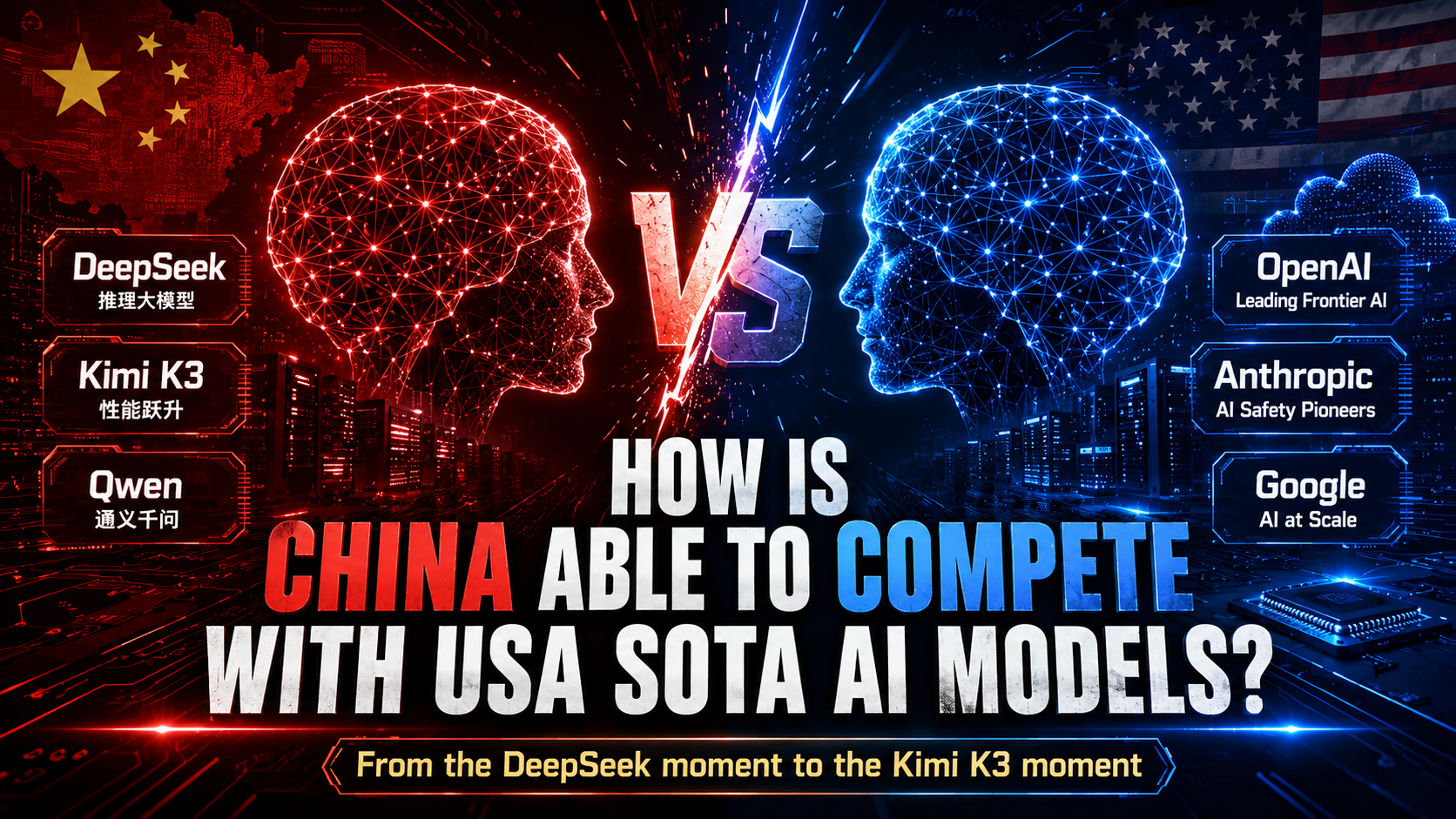
For most of the modern software era, the United States did not have a serious national competitor.
Other countries produced important technology companies. Germany built SAP. Sweden produced Spotify. Japan dominated parts of consumer electronics and gaming. South Korea became indispensable in semiconductors and displays. India built a massive software-services industry.
But the center of the global software industry remained overwhelmingly American.
Microsoft defined desktop computing. Google dominated search and online advertising. Amazon built the largest cloud-computing business. Apple created the most valuable consumer technology ecosystem. Meta controlled several of the world’s largest social platforms. Nvidia became the central hardware supplier for artificial intelligence.
Even when another country created a successful software company, it rarely produced an entire ecosystem capable of repeatedly challenging the strongest American companies at the technological frontier.
China is now changing that.
The DeepSeek moment in January 2025 was the first undeniable warning. A relatively unknown Chinese laboratory released a reasoning model that appeared capable of competing with OpenAI’s best systems while charging far less and releasing its model weights.
Some people initially treated DeepSeek as an isolated event.
Perhaps it was a lucky breakthrough. Perhaps its benchmarks were exaggerated. Perhaps China had copied American models. Perhaps US export controls would eventually prevent Chinese laboratories from keeping up.
Then came Qwen, GLM, MiniMax, newer DeepSeek releases and increasingly capable models from ByteDance.
And in July 2026, Moonshot AI released Kimi K3.
Kimi K3 was not merely another inexpensive Chinese chatbot. It was a 2.8-trillion-parameter Mixture-of-Experts model with 104 billion parameters active during inference, native vision, a one-million-token context window and performance close to the strongest proprietary American models. Its full model weights were released publicly.
Independent testing placed Kimi K3 third on the Artificial Analysis Intelligence Index at launch, comparable to Claude Opus 4.8 and GPT-5.5, although still behind Claude Fable 5 and GPT-5.6 Sol.
That distinction matters.
China does not have to win every benchmark to prove that it has caught up.
It only has to demonstrate that Chinese laboratories can repeatedly produce models within the same frontier capability range as the best American laboratories.
DeepSeek showed that China could do it once.
Kimi K3 showed that DeepSeek was not a one-time accident.
China now has a genuine frontier AI ecosystem.
The Old Assumption: America Invents Software and China Manufactures Hardware
For decades, the simplified technology map looked like this:
The United States invented the software.
American companies owned the platforms.
Taiwan and South Korea manufactured the most advanced semiconductors.
China assembled devices and scaled manufacturing.
The rest of the world consumed the resulting products.
This description was never completely accurate, but it captured the basic structure of the technology economy.
China became the world’s manufacturing center. It developed enormous expertise in supply chains, batteries, telecommunications equipment, solar panels, drones, electric vehicles and consumer electronics.
However, it struggled to produce global software platforms with the influence of Microsoft, Google, Apple, Amazon or Meta.
Chinese companies such as Tencent, Alibaba, Baidu and ByteDance built extraordinary businesses, but much of their dominance remained concentrated inside China or in particular categories.
TikTok became the major exception. ByteDance proved that a Chinese company could build a consumer software product capable of competing globally with the largest American platforms.
Artificial intelligence is now creating a second, much larger exception.
Unlike traditional software, frontier AI does not produce only one application. A state-of-the-art foundation model can become the intelligence layer behind thousands of products:
Coding assistants
Search engines
Customer-service systems
Business automation
Scientific research
Education
Content creation
Robotics
Military systems
Autonomous agents
Enterprise software
Government infrastructure
The country that controls the strongest AI models may influence the next generation of the global software stack.
For the first time, China is not merely manufacturing the hardware underneath an American software revolution.
It is participating directly at the intelligence layer.
What Does “State of the Art” Actually Mean?
State of the art, usually shortened to SOTA, does not refer to one permanent winner.
AI models are tested across many different categories:
Coding
Mathematics
Scientific reasoning
General knowledge
Long-context understanding
Image understanding
Tool use
Web browsing
Agentic execution
Professional knowledge work
Instruction following
Speed
Cost efficiency
One model may be best at autonomous coding but weaker at creative writing. Another may dominate mathematics while being expensive and slow. A smaller model may perform slightly worse but cost one-tenth as much to operate.
This makes the question “Which country has the best AI model?” increasingly difficult to answer.
The more useful question is:
Can a country repeatedly produce models that operate inside the frontier capability range?
By that definition, China has caught up.
Stanford’s 2026 AI Index reported that American and Chinese models had traded the lead multiple times since early 2025. The report also found that the leading US model held only a small performance advantage by March 2026, even though the United States continued to produce more notable models overall.
The United States still has more top laboratories and continues to produce many of the strongest closed models.
But the old situation, in which the frontier belonged almost exclusively to American companies, is over.
The DeepSeek Moment
The first global shock arrived in January 2025.
DeepSeek released DeepSeek-R1, a reasoning model that it said performed comparably to OpenAI’s o1 on several mathematics, coding and reasoning evaluations.
DeepSeek did not simply provide an inexpensive API. It released the model weights and technical report. Its repository and model weights were licensed under the MIT License, allowing commercial use, modification and derivative models.
That decision immediately separated DeepSeek from the dominant American frontier laboratories.
OpenAI and Anthropic provided access to their strongest models primarily through controlled products and paid APIs. DeepSeek gave researchers and companies the ability to download, study, modify and deploy its model independently.
The market reaction was extraordinary.
On January 27, 2025, Nvidia lost approximately $593 billion in market value in one trading day, then the largest single-day market-capitalization loss in Wall Street history. The Nasdaq fell sharply as investors questioned whether the AI industry required as many expensive Nvidia chips as previously assumed.
The market may have overreacted, but the underlying question was legitimate.
American AI development had become associated with ever-larger data centers, ever-more-expensive training runs and hundreds of billions of dollars in infrastructure spending.
DeepSeek suggested that architecture, training methods and systems engineering could matter as much as simply acquiring more GPUs.
The technical work behind DeepSeek supported that argument.
DeepSeek-V3 used a Mixture-of-Experts architecture with 671 billion total parameters but only 37 billion activated for each token. It combined DeepSeekMoE with Multi-head Latent Attention, load-balancing improvements and multi-token prediction. The company reported that its final training run used 2.788 million Nvidia H800 GPU hours.
The widely repeated claim that DeepSeek built its entire model for approximately $5.6 million was misleading. That figure represented an estimate for the final training run and did not include the complete cost of research, failed experiments, data collection, salaries or infrastructure development.
Nevertheless, the broader point remained valid.
DeepSeek had demonstrated that a Chinese laboratory could produce frontier-level performance using hardware that was less advanced than the newest chips available to leading American companies.
It had not defeated the importance of compute.
It had shown that compute could be used much more efficiently.
DeepSeek Was Supposed to Be a One-Time Shock
After the initial market panic, several explanations emerged.
Some argued that DeepSeek had benefited from knowledge produced by American laboratories.
Others claimed the company had access to more advanced GPUs than it publicly acknowledged.
There were allegations that Chinese companies had used model distillation, in which a smaller or newer model is trained using outputs generated by a more capable model.
Some of these concerns may have merit. AI development is not happening in isolated national laboratories. Chinese companies learn from American papers, open-source tools and public model outputs. American companies also learn from research published in China and increasingly evaluate Chinese open-weight models.
But focusing only on whether DeepSeek learned from American systems misses the larger issue.
Every modern AI laboratory builds on prior work.
The Transformer architecture originated in a Google research paper. PyTorch was developed by Meta. CUDA came from Nvidia. Open-source model frameworks, benchmark suites and research papers are shared across borders.
The relevant question is not whether Chinese researchers learned from American technology.
The relevant question is whether they can transform available knowledge into competitive systems.
DeepSeek proved that they could.
More importantly, the Chinese ecosystem kept producing new contenders after the initial DeepSeek release.
By April 2026, DeepSeek had introduced DeepSeek V4 Pro and V4 Flash. DeepSeek described V4 Pro as a 1.6-trillion-parameter model with 49 billion active parameters, one-million-token context support, open weights and competitive reasoning and agentic capabilities.
DeepSeek also continued competing aggressively on price.
As of July 2026, DeepSeek listed V4 Pro at $0.435 per million uncached input tokens and $0.87 per million output tokens. V4 Flash was priced at $0.14 per million uncached input tokens and $0.28 per million output tokens.
These are not small discounts.
They represent a fundamentally different cost structure from the most expensive American frontier models.
The Kimi K3 Moment
The Kimi K3 release on July 16, 2026, was important because it destroyed the argument that DeepSeek was an isolated anomaly.
Moonshot AI introduced Kimi K3 as a 2.8-trillion-parameter Mixture-of-Experts model. Although the model contains 2.8 trillion total parameters, it activates approximately 104 billion parameters during inference.
This allows the model to contain enormous capacity without using every parameter for every token.
Kimi K3 also introduced or refined several architectural and infrastructure techniques:
Kimi Delta Attention
Attention Residuals
Stable LatentMoE
Efficient expert-parallel training
Persistent environments for long-horizon reinforcement learning
A one-million-token context window
Native visual understanding
Moonshot reported that these improvements produced an approximately 2.5-times increase in overall scaling efficiency over Kimi K2. The technical report described frontier-level performance across coding, reasoning, vision, agentic work and long-horizon knowledge tasks.
Moonshot’s own paper acknowledged that Kimi K3 still trailed the strongest proprietary systems, specifically Claude Fable 5 and GPT-5.6 Sol.
That admission makes the release more credible, not less important.
Kimi K3 did not need to be number one.
It was an open-weight Chinese model operating close to the strongest closed American systems.
Independent Artificial Analysis testing ranked it third overall at launch. On the AA-Briefcase benchmark for long-horizon knowledge work, it ranked second behind Claude Fable 5.
The model was strong enough, open enough and affordable enough to force Silicon Valley to pay attention.
Demand was so high that Moonshot temporarily paused new subscriptions after its infrastructure became strained.
That is the second Chinese AI shock.
DeepSeek challenged the assumption that frontier models required unlimited spending.
Kimi K3 challenged the assumption that the strongest open-weight models would remain substantially behind closed American systems.
Kimi K3 Also Competes on Price
Kimi K3 is not as inexpensive as DeepSeek V4, but it is significantly cheaper than the strongest Anthropic model.
Moonshot prices Kimi K3 at:
$0.30 per million cached input tokens
$3 per million uncached input tokens
$15 per million output tokens
The model includes a one-million-token context window.
Anthropic prices Claude Fable 5 at:
$10 per million input tokens
$50 per million output tokens
That makes Kimi K3’s standard input and output prices approximately 70 percent lower than Claude Fable 5’s prices.
This comparison does not mean Kimi K3 is always the better model.
Claude Fable 5 remains stronger on several of the most difficult long-running tasks. Different models also generate different amounts of reasoning tokens, so actual costs depend on the workload.
But the commercial pressure is obvious.
A model does not need to be the absolute benchmark leader to reshape the market.
A model that delivers 90 to 98 percent of the useful capability at a substantially lower cost may be the more attractive option for:
Startups
High-volume SaaS products
Coding tools
Internal company agents
Research pipelines
Customer-support platforms
Companies that need private deployment
Businesses outside the United States
Developers building products with thin margins
Chinese AI companies are attacking both sides of the market.
They are approaching the frontier on capability while aggressively lowering the price of access.
How Did China Catch Up So Quickly?
China’s progress cannot be explained by one factor.
It is the result of talent, research scale, economic pressure, government support, domestic competition, access to published knowledge and engineering decisions shaped by hardware constraints.
1. China Has a Massive AI Research Base
China did not begin developing AI in 2025.
It spent years building universities, research institutes, technology companies and engineering talent.
According to Stanford’s 2026 AI Index, China led the world in AI publication volume, citations and patent grants, while the United States continued to lead in the number of notable frontier models and the impact of its strongest patents. The United States produced 59 notable AI models in 2025, compared with 35 from China, but China’s share of the world’s most-cited AI papers continued increasing.
Patent counts and publication volume do not automatically produce great products.
However, they reveal the depth of the underlying ecosystem.
China has enough researchers to pursue many architectural ideas simultaneously. It has enough engineers to optimize training systems, inference frameworks, data pipelines and distributed computing.
It also has enough companies competing with one another to prevent progress from depending on a single laboratory.
DeepSeek, Moonshot AI, Alibaba, Z.ai, MiniMax, ByteDance, Baidu, Tencent and Huawei are not one centrally managed AI team.
They are competing organizations with different business models, technical strengths and strategic priorities.
This internal competition accelerates progress.
2. AI Research Spreads Faster Than Previous Strategic Technologies
Building an advanced semiconductor manufacturing process requires specialized factories, thousands of suppliers, highly restricted equipment and decades of industrial knowledge.
Building a competitive AI model also requires enormous resources, but the underlying ideas move much faster.
Research papers describe new architectures.
Model weights are published.
Code appears on GitHub.
Benchmarks reveal strengths and weaknesses.
Engineers discuss optimization methods publicly.
Employees move between laboratories.
Developers experiment with models through APIs.
This means one laboratory’s breakthrough can become part of the industry’s shared knowledge within months.
The United States continues to produce many foundational breakthroughs, but it cannot prevent every published idea from being studied and implemented elsewhere.
China has the research capacity to absorb those ideas quickly.
It can then combine them with its own innovations.
DeepSeek’s Multi-head Latent Attention and expert-routing work were not merely copies of an American product. Kimi K3’s Kimi Delta Attention, Attention Residuals and model-training infrastructure were substantial engineering contributions.
The frontier is still moving, but the knowledge required to approach it is no longer contained inside a few American companies.
3. US Chip Restrictions Forced China to Prioritize Efficiency
Since October 2022, the United States has imposed and repeatedly updated restrictions intended to limit China’s access to advanced AI chips and semiconductor-manufacturing technology.
The Bureau of Industry and Security expanded restrictions on advanced computing hardware, entities and potential diversion routes, although parts of the policy changed over time. In January 2026, the US government moved to review certain exports such as Nvidia H200 and AMD MI325X chips on a case-by-case basis rather than applying a universal prohibition.
These restrictions created real problems for Chinese laboratories.
China still does not have the same easy access to the newest Nvidia hardware as American companies. Its domestic chip ecosystem remains behind the cutting edge in several important areas.
But the restrictions also changed Chinese engineering incentives.
American laboratories with access to enormous clusters could pursue capability by scaling compute aggressively.
Chinese laboratories had stronger reasons to ask:
How can we reduce memory requirements?
How can we activate fewer parameters per token?
How can we compress attention states?
How can we train with lower numerical precision?
How can we improve communication between GPUs?
How can we reduce inference costs?
How can we reuse cached context more efficiently?
How can reinforcement learning replace some expensive supervised data?
This does not mean restrictions helped China more than they hurt it.
Without those restrictions, Chinese laboratories might be progressing even faster.
But scarcity can produce a particular kind of innovation.
The United States has often optimized for the highest possible capability.
China has been forced to optimize for the highest capability obtainable from constrained resources.
That discipline is now visible in DeepSeek’s architectures and pricing.
4. Mixture-of-Experts Changed the Economics of Large Models
Several leading Chinese models use Mixture-of-Experts architectures.
A traditional dense model activates most or all of its parameters for every token. A Mixture-of-Experts model contains many specialized parameter groups but routes each token through only a limited selection.
This allows a model to have enormous total capacity without paying the full computational cost on every request.
DeepSeek-V3 had 671 billion total parameters but activated 37 billion per token.
DeepSeek V4 Pro expanded to 1.6 trillion total parameters with 49 billion active.
Kimi K3 contains 2.8 trillion total parameters but activates approximately 104 billion.
Qwen has also released major Mixture-of-Experts models, including the open-weight Qwen3-235B-A22B, which contains 235 billion total parameters but activates approximately 22 billion.
Mixture-of-Experts is not a Chinese invention, and American laboratories also use it.
What Chinese laboratories have done particularly well is combine sparse models with aggressive systems optimization and commercially disruptive pricing.
The advantage does not come from one secret algorithm.
It comes from hundreds of decisions across architecture, data, training, memory, networking, inference and deployment.
5. China Has Turned Open Weights Into a Competitive Weapon
American frontier laboratories generally protect their strongest systems.
Users can interact with models such as Claude or GPT through a product or an API, but they cannot download the complete model and operate it independently.
China has taken a different route.
DeepSeek released R1 under the MIT License.
Alibaba released multiple Qwen3 models under Apache 2.0.
MiniMax released model weights for systems such as M2 and M2.5.
Z.ai released GLM model weights.
Moonshot released the full Kimi K3 weights.
This strategy creates several advantages.
Developers can inspect the model.
Companies can host it inside their own infrastructure.
Researchers can fine-tune it.
Governments can deploy it without sending sensitive data to an American API.
Cloud providers can offer it.
Startups can build specialized versions.
Universities can study it.
Independent developers can optimize it for different hardware.
Open weights turn every external user into a potential contributor to the model’s ecosystem.
This is especially powerful in markets that are uncomfortable becoming completely dependent on a small number of American companies.
A European company, Middle Eastern government or Asian cloud provider may not want its entire AI infrastructure controlled by OpenAI, Anthropic, Google or Microsoft.
Chinese open-weight models provide an alternative.
Open Source and Open Weight Are Not Exactly the Same
The AI industry often uses “open source” loosely.
A genuinely open-source AI project would ideally publish:
Model weights
Training code
Inference code
Architecture details
Training datasets or detailed dataset documentation
Evaluation methods
Licensing terms that permit modification and redistribution
Many so-called open-source models publish their weights but do not provide the complete training data or every part of the training pipeline.
The more precise term is often open weight.
This means developers can download and run the trained model, even though they cannot reproduce the entire training process from beginning to end.
Kimi K3, DeepSeek, Qwen and several other Chinese model families are therefore frequently better described as open-weight systems.
That is still strategically significant.
The weights are the expensive result of the training process. Releasing them allows companies to deploy, modify and study a model without recreating the original multibillion-parameter training run.
6. China Competes With a Portfolio, Not One National Champion
One of China’s greatest advantages is the number of laboratories capable of producing serious models.
DeepSeek
DeepSeek became globally famous through V3 and R1. Its strengths include reasoning, efficient architectures, extremely low API pricing and open releases.
Moonshot AI and Kimi
Moonshot focuses heavily on long context, coding, agentic work and general knowledge tasks. Kimi K2 established the company as a major open-model laboratory, while Kimi K3 moved it close to the absolute frontier.
Alibaba and Qwen
Qwen may have the broadest Chinese open-model ecosystem.
Alibaba has released models across many sizes and categories, including general language models, coding models, vision-language systems, mathematics models and image generation.
Qwen3 included eight open-weight models under Apache 2.0, ranging from compact dense systems to the 235-billion-parameter Mixture-of-Experts flagship.
This range makes Qwen useful not only for benchmark competition but also for practical deployment on different types of hardware.
Z.ai and GLM
Z.ai, previously associated with the Zhipu AI name, has developed the GLM family.
GLM-5 and GLM-5.2 have focused strongly on agentic engineering, coding and long-horizon task execution. Z.ai describes GLM-5.2 as an open model designed for one-million-token workflows and extended autonomous tasks.
MiniMax
MiniMax has developed models spanning language, coding, speech, music and video.
Its M2.5 model weights were released publicly for local deployment and fine-tuning, with the company positioning the model around coding and real-world agent productivity.
ByteDance and Doubao
ByteDance brings something different: enormous product distribution.
Its Seed model family powers products such as Doubao, giving the company access to real usage from hundreds of millions of users. The Seed team develops language, reasoning, vision, voice, music and video models.
The importance of this portfolio is difficult to overstate.
If DeepSeek slows down, Qwen may advance.
If Qwen misses a major architectural shift, Moonshot may discover it.
If Moonshot has infrastructure problems, ByteDance or Alibaba can use their cloud resources and consumer distribution.
China is no longer dependent on one laboratory producing one surprising model.
It has a competitive model industry.
7. China Has a Massive Domestic Market for Testing AI
Frontier models improve through more than pretraining.
They need feedback from real products and real workflows.
China has:
More than one billion internet users
Major e-commerce ecosystems
Enormous payment platforms
Large cloud providers
Advanced logistics networks
Large manufacturing operations
Popular social and video platforms
A highly competitive mobile-app market
Significant government and enterprise demand
These environments create countless opportunities to test AI systems.
Alibaba can integrate Qwen into commerce and cloud products.
ByteDance can connect its models to content, recommendation and creative tools.
Tencent can apply AI to social platforms, gaming and enterprise services.
Baidu can combine models with search and autonomous-driving research.
Huawei can connect AI models with chips, devices, telecommunications and enterprise infrastructure.
American companies still hold powerful advantages in global cloud distribution and enterprise relationships.
However, China has enough domestic scale to support its own AI ecosystem even before a model becomes globally successful.
8. China Is Willing to Sacrifice Margin to Gain Adoption
American AI companies face pressure to justify extraordinary valuations and infrastructure spending.
OpenAI, Anthropic, Google and Microsoft must eventually show that advanced AI can produce enormous revenue.
Chinese companies operate under pressure too, but many are willing to compete aggressively on price to acquire developers and market share.
DeepSeek V4 Pro’s listed price of $0.435 per million uncached input tokens and $0.87 per million output tokens is a small fraction of Claude Fable 5’s $10 input and $50 output pricing.
Such pricing may not produce strong margins immediately.
It may even prove difficult to sustain.
But it changes customer expectations.
Once developers experience capable models costing cents rather than several dollars per million tokens, premium American providers must explain why their additional intelligence is worth ten, twenty or fifty times the price.
For the most difficult tasks, it may be worth it.
For the majority of routine AI requests, it may not be.
9. Government Support Matters, but It Is Not the Whole Explanation
The Chinese state has supported AI development through research funding, infrastructure, education, industrial policy and procurement.
Local governments have also offered support to technology companies, computing centers and semiconductor projects.
This gives China the ability to treat AI as national infrastructure rather than only as a venture-capital market.
However, government support alone does not explain Chinese model quality.
Many countries subsidize technology projects without producing globally competitive systems.
The models still have to work.
DeepSeek still needed to invent and implement efficient architectures.
Moonshot still needed to train a 2.8-trillion-parameter model.
Alibaba still needed to build the Qwen ecosystem.
Engineers still needed to solve thousands of technical problems.
China’s progress comes from the interaction between policy support and fierce commercial competition.
Government support provides resources and direction.
Competition forces companies to turn those resources into usable products.
Why Has No Other Country Challenged American Software Like This?
Europe has excellent universities, wealthy markets and successful technology companies.
Japan has world-class engineering and major corporations.
South Korea dominates several advanced manufacturing industries.
India has millions of software developers.
The Middle East has capital and growing AI ambitions.
Yet none has produced the same concentration of frontier model laboratories now emerging from China.
There are several reasons.
First, China has scale.
Its population, domestic market, engineering workforce and industrial economy allow it to support an entire alternative technology stack.
Second, China has large native platform companies.
Alibaba, Tencent, ByteDance, Baidu and Huawei can fund research, distribute products and provide infrastructure.
Third, China is willing to coordinate technology development as a national strategic priority.
Fourth, Chinese companies face unusually intense domestic competition. They cannot rely only on protection from American competitors because they must also compete against one another.
Finally, China has experience scaling complex technology while reducing costs.
The pattern has appeared in solar panels, batteries, electric vehicles, drones and telecommunications equipment.
Artificial intelligence is different from manufacturing, but the competitive instinct is similar:
Enter a strategically important industry.
Learn rapidly from existing leaders.
Build domestic capacity.
Improve the production process.
reduce prices.
Scale aggressively.
Export the resulting technology.
American companies should recognize this pattern.
China is not satisfied with producing a local alternative to ChatGPT.
Its model companies want to become global infrastructure providers.
Has China Really Caught Up?
Yes, but the statement needs a clear definition.
China has caught up in the sense that:
Multiple Chinese laboratories produce frontier-level models.
Chinese models can compete with leading US models on coding, reasoning and agentic tasks.
China frequently leads the open-weight model ecosystem.
Chinese API prices are often dramatically lower.
Chinese models are increasingly credible options for global developers.
The quality gap is now small enough to change purchasing decisions.
China can repeatedly produce new contenders rather than depending on one release.
China has not caught up in every dimension.
The United States still has major advantages:
Access to the most advanced Nvidia hardware
More hyperscale cloud capacity
Greater private AI investment
Stronger global enterprise software distribution
More frontier laboratories at the absolute top
Leadership in semiconductor-design tools
Stronger relationships with major global corporations
Many of the world’s most influential AI researchers
Control over important software and hardware platforms
The strongest American models also continue to lead many difficult evaluations.
Kimi K3’s own researchers stated that it remained behind Claude Fable 5 and GPT-5.6 Sol overall.
But this no longer represents an overwhelming national lead.
The gap has narrowed from a technological generation to a competitive model-release cycle.
A Chinese model may trail the American leader today and surpass it in one category three months later.
That is what catching up looks like in a rapidly moving field.
The American Advantage Has Shifted From Monopoly to Depth
The United States is not losing the AI race.
It is losing its uncontested ownership of the race.
That is an important difference.
America still has OpenAI, Anthropic, Google, Meta, xAI, Microsoft, Amazon, Nvidia and a deep network of startups, universities and investors.
No other country has an equally broad collection of frontier AI assets.
But China now has enough laboratories, talent, capital, infrastructure and domestic demand to form a second center of gravity.
The AI world is becoming bipolar.
The United States leads through:
Frontier closed models
Advanced chips
Cloud infrastructure
Global enterprise relationships
Capital
Foundational software platforms
China competes through:
Efficient architecture
Low-cost inference
Open-weight releases
Large domestic distribution
Rapid iteration
Engineering scale
Aggressive pricing
Government-backed strategic commitment
The winner may not be the country with the single smartest model.
It may be the country whose models become embedded in the greatest number of products, companies, governments and developer workflows.
Open Weights May Be China’s Most Powerful Strategic Move
The United States currently has an unusual strategic contradiction.
Its strongest models are closed, but many of its companies and developers depend on open ecosystems.
Closed models allow companies to control safety, distribution, pricing and intellectual property.
Open-weight models spread more rapidly.
China has recognized that it may not need to defeat every American model directly.
It can compete by becoming the default provider of strong, customizable and affordable intelligence.
A company choosing between two models may see:
The American model is slightly stronger.
The Chinese model costs much less.
The Chinese model can be hosted privately.
The Chinese model can be modified.
The Chinese model does not require permanent dependence on one API.
The Chinese model can run through multiple cloud providers.
The Chinese model has a permissive license.
That is a powerful commercial proposition.
Open weights can convert a small benchmark disadvantage into a distribution advantage.
They also create pressure inside the United States.
Meta remains an important open-model developer, but the strongest American systems are still largely proprietary.
If Chinese laboratories continue releasing models close to the frontier, American policymakers and companies will have to decide whether protecting model weights is worth surrendering much of the open ecosystem.
The Risks Behind China’s Strategy
China’s approach is not without problems.
Running enormous models locally still requires expensive hardware.
Kimi K3 may be open weight, but its 2.8-trillion-parameter size makes independent deployment difficult for ordinary companies.
Chinese providers may struggle to maintain extremely low prices while paying for chips, energy, data centers and engineering talent.
There are also concerns involving:
Data privacy
Political censorship
Model safety
Intellectual-property disputes
Distillation from proprietary models
Security vulnerabilities
Dependence on Chinese infrastructure
Government access to data
Restrictions on politically sensitive outputs
Long-term financial sustainability
Open weights introduce additional safety questions because users can modify or deploy models with fewer controls.
These concerns should not be dismissed.
But they do not erase the underlying technical achievement.
A model can be strategically controversial and technologically competitive at the same time.
What This Means for Developers and Businesses
For developers, the arrival of competitive Chinese models is mostly positive.
It creates more choice.
A company no longer has to build its entire AI product around one American provider.
Developers can route different tasks to different models:
A premium American model for the hardest reasoning
DeepSeek for inexpensive high-volume requests
Kimi for long-context coding and knowledge work
Qwen for private deployment
MiniMax for agentic or multimodal use cases
GLM for coding workflows
Local smaller models for sensitive data
This model-routing approach may become standard.
Companies will stop asking which single model is best.
They will ask which model is best for each task at a given price, latency and privacy requirement.
Competition will also push prices lower.
American providers will need to improve efficiency, reduce costs or demonstrate that their premium capabilities generate measurably better business results.
For startups, this can dramatically lower the cost of building AI products.
For established software companies, it reduces dependency on one supplier.
For cloud providers, it creates demand for hosting open-weight Chinese models.
For governments, it creates both an opportunity and a geopolitical dilemma.
What This Means for the United States
The wrong American response would be to dismiss Chinese models as copies.
The second-worst response would be to assume that export controls alone can preserve US dominance.
Chip restrictions can slow Chinese development.
They cannot prevent research papers from spreading, engineers from optimizing systems or Chinese companies from building domestic hardware.
The stronger response would combine:
Continued investment in frontier research
More competitive inference pricing
Strong American open-weight models
Faster energy and data-center development
Semiconductor leadership
Immigration policies that attract technical talent
Better commercialization of university research
AI adoption across ordinary businesses
Security rules based on measurable risks rather than nationality alone
The United States still has extraordinary advantages.
But it must now compete.
That may ultimately make American AI companies stronger.
DeepSeek forced them to discuss efficiency.
Kimi K3 is forcing them to discuss open weights.
Chinese pricing is forcing them to justify premium API costs.
A real challenger removes complacency.
The Larger Historical Shift
This competition is about more than chatbots.
Software was one of the few major strategic industries in which American dominance appeared almost permanent.
Europe regulated American platforms.
Asia manufactured devices for American platforms.
The rest of the world built businesses on American clouds, operating systems, app stores and social networks.
China was powerful in hardware and manufacturing, but it had not broken the central position of American software.
Frontier AI may be the first major exception.
China now has models that developers outside China genuinely want to use.
Not because they are forced to use them.
Not because they are the only models available.
Not because they are protected inside the Chinese market.
Developers are considering them because they are capable, inexpensive and open weight.
That is what makes the current moment historic.
China is no longer only trying to create domestic substitutes for American software.
It is producing technology that can compete for global adoption on its own merits.
Conclusion: DeepSeek Was the Warning. Kimi K3 Is the Confirmation.
DeepSeek was the moment the world discovered that China could build a frontier reasoning model.
Kimi K3 is the moment it became clear that China could do it repeatedly.
Between those releases, Qwen, GLM, MiniMax, ByteDance and newer DeepSeek systems continued advancing.
The conclusion is no longer avoidable.
China has caught up sufficiently to become the first true national challenger to American software dominance in the modern era.
The United States still has the deepest AI ecosystem and many of the strongest models. It continues to lead in advanced chips, capital, cloud infrastructure and the absolute frontier.
But the frontier is no longer exclusively American.
China has found a different route into the race:
Work around hardware constraints.
Optimize architecture and infrastructure.
Compete aggressively on price.
Release model weights.
Build multiple rival laboratories.
Use an enormous domestic market.
Convert engineering scale into global distribution.
DeepSeek proved that American AI could be challenged on efficiency.
Kimi K3 proved that open Chinese models could operate near the absolute frontier.
The next phase will not be America teaching and China following.
It will be two competing AI ecosystems pushing one another forward.
For the first time in the software era, the United States has a true challenger.
Frequently Asked Questions
Has China really caught up with the United States in AI?
China has caught up in the sense that multiple Chinese laboratories can now produce models within the same broad frontier capability range as leading American systems.
The United States still produces more top-tier models and retains advantages in advanced chips, cloud infrastructure, capital and global enterprise distribution. However, the quality gap is no longer large enough to treat Chinese models as second-tier alternatives.
What was the DeepSeek moment?
The DeepSeek moment occurred in January 2025 when DeepSeek-R1 attracted global attention for delivering reasoning performance comparable to leading American models while offering open weights and much lower API prices.
The release caused a major technology-stock selloff and forced the industry to reconsider assumptions about the amount of compute and spending required to build powerful AI.
What is the Kimi K3 moment?
The Kimi K3 moment began with Moonshot AI’s July 2026 release of a 2.8-trillion-parameter open-weight model designed for long-horizon coding, reasoning, vision and professional knowledge work.
Independent evaluations placed it close to the strongest American proprietary models. Its release showed that DeepSeek was not a one-time Chinese breakthrough.
Is Kimi K3 better than the best American AI models?
Kimi K3 performs competitively with many leading American models and has achieved frontier-level results in coding, agentic work and long-horizon knowledge tasks.
However, Moonshot’s technical report and independent testing indicate that Claude Fable 5 and GPT-5.6 Sol remain stronger overall.
Kimi K3’s importance comes from combining near-frontier capability with released model weights and lower pricing.
Why are Chinese AI models cheaper?
Chinese laboratories frequently use sparse Mixture-of-Experts architectures, efficient attention mechanisms, aggressive caching, infrastructure optimization and lower-margin pricing strategies.
They may also accept weaker short-term profitability to increase adoption and developer market share.
Are Chinese AI models genuinely open source?
Some Chinese model releases include permissive licenses, code and model weights. However, many do not release the complete training datasets and every component required to reproduce the model.
For that reason, open weight is often a more accurate description than fully open source.
What are the most important Chinese AI model families?
The leading Chinese model families include:
DeepSeek
Kimi from Moonshot AI
Qwen from Alibaba
GLM from Z.ai
MiniMax
Doubao and Seed from ByteDance
ERNIE from Baidu
Hunyuan from Tencent
DeepSeek, Kimi, Qwen, GLM and MiniMax are particularly important in the open-weight and developer-model ecosystem.
Did US chip restrictions fail?
The restrictions have made it more difficult and expensive for Chinese companies to acquire advanced AI hardware.
However, they have not prevented China from developing competitive models. Chinese laboratories responded by improving model efficiency, using sparse architectures, optimizing memory and networking, stockpiling available hardware and expanding domestic semiconductor development.
The restrictions may slow China, but they have not eliminated it from the frontier.
Is China now leading the AI race?
China leads in some areas, particularly open-weight model availability, API pricing, research volume and patent quantity.
The United States continues to lead in the overall depth of the frontier-model ecosystem, advanced AI chips, cloud infrastructure, private investment and many of the strongest proprietary systems.
The most accurate description is that the AI industry now has two major national centers of gravity.
Why is AI different from previous software markets?
Traditional software platforms benefited from powerful network effects, ecosystems and distribution advantages that made American dominance difficult to challenge.
AI models are different because research travels quickly, models can be evaluated through public benchmarks, open weights can be distributed globally and developers can switch providers through compatible APIs.
This makes it easier for a technically capable competitor to narrow the gap rapidly.
What does Chinese AI competition mean for businesses?
Businesses will gain more model choices, lower prices and greater flexibility.
Companies can use premium American models for their most difficult tasks while using Chinese or locally hosted open-weight models for high-volume, lower-cost and privacy-sensitive workloads.
The result will likely be a multi-model market rather than one provider controlling every AI application.