
Why AI Is So Good at Coding: How Software Development Entered the Agentic Era
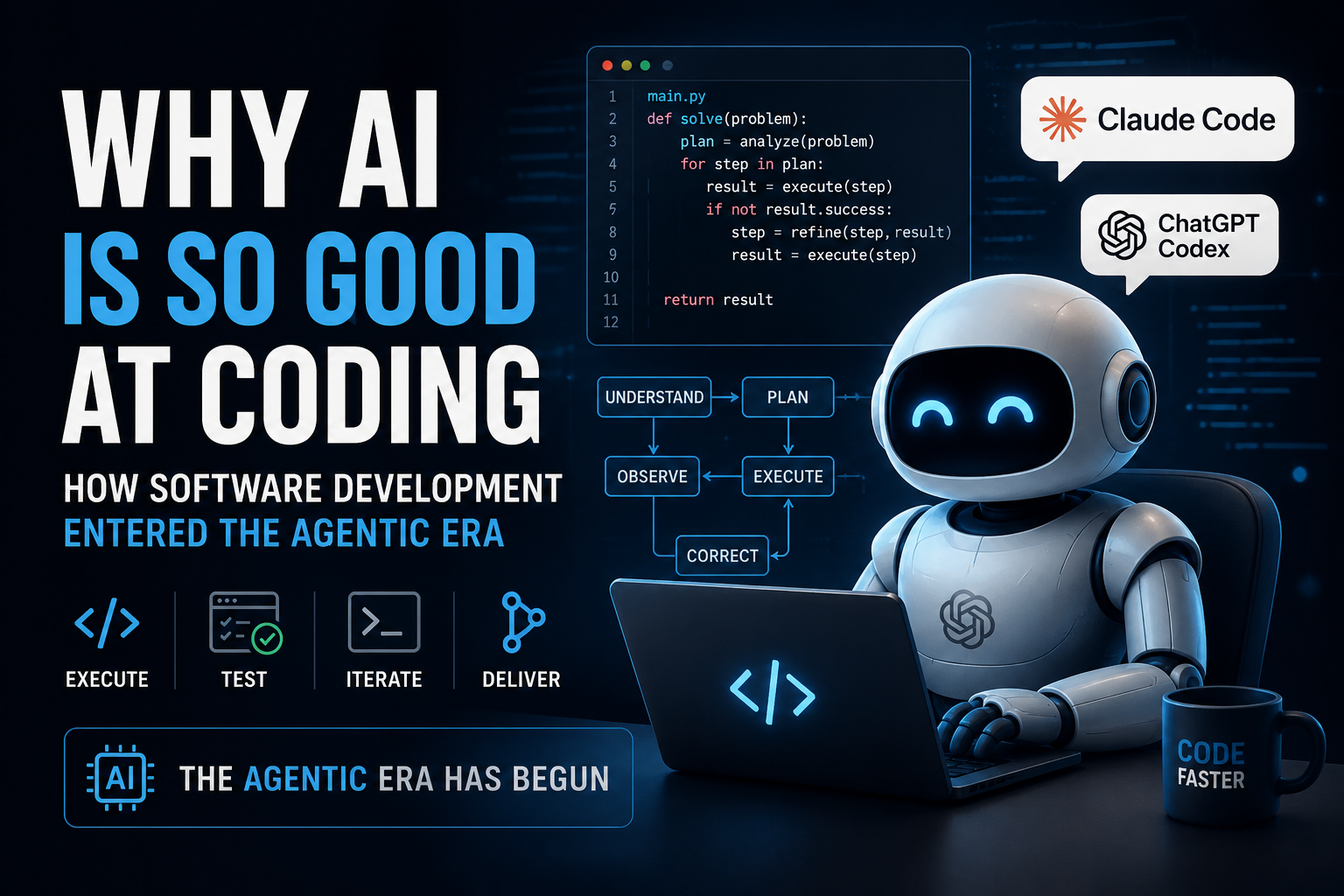
Artificial intelligence can write emails, summarize documents, generate images, analyze data, and answer questions about almost any subject.
But coding is where AI appears to be advancing unusually fast.
A few years ago, an AI coding tool mostly suggested the next line. Then developers started using chatbots to generate functions, explain errors, and write tests. Now tools such as Claude Code and OpenAI Codex can inspect an entire repository, modify multiple files, run commands, execute tests, diagnose failures, and continue working until they have a result ready for human review.
This is a much bigger change than better autocomplete.
It is the beginning of agentic software development.
In the autocomplete era, the developer wrote the software while AI suggested pieces of code.
In the chatbot era, the developer asked questions and manually transferred the answers into the project.
In the agentic era, the developer increasingly defines the objective, gives the agent access to the development environment, and supervises the work.
The instruction is no longer only:
“Write a function that validates an email address.”
It is becoming:
“Investigate why customer verification fails in production, find the relevant code, implement the smallest safe fix, update the tests, run the test suite, and prepare the change for review.”
That is a fundamentally different relationship between people and software.
Why did coding reach this stage so quickly?
Why are AI coding agents improving faster than agents for many other professions?
And what does this mean for developers, technology companies, and businesses that depend on software?
The answer is not simply that AI models have memorized a large amount of code.
AI is good at coding because software development provides something almost no other form of knowledge work can offer: a structured digital environment where an AI can act, observe the result, detect failure, and try again.
That feedback loop is what turns a chatbot into an agent.
What Is Agentic Coding?
Agentic coding is a form of software development in which an AI system can perform a sequence of actions toward an engineering objective with a degree of autonomy.
Instead of responding to one isolated prompt with one block of code, an agent can:
Read the task.
Inspect the repository.
Search for relevant files.
Understand existing patterns.
Plan an implementation.
Edit multiple files.
Run the application or tests.
Read errors and logs.
Revise its approach.
Present the completed work for review.
Anthropic describes Claude Code as an agentic coding system that can read a codebase, make changes across files, run tests, and deliver committed code. OpenAI describes Codex as a software engineering agent that can build features, fix bugs, perform refactors, run tests, and prepare review-ready changes.
The important word is not “coding.”
It is “agentic.”
A chatbot generates a response.
An agent pursues a result.
The agent may use a language model for reasoning, but it is also connected to tools. It can interact with files, terminals, test runners, package managers, browsers, version control systems, documentation, databases, and cloud environments.
This gives it the ability to move between thinking and doing.
That loop can look like this:
Understand → act → execute → observe → correct → repeat
Coding is one of the best environments for this loop because almost every stage can happen digitally.
The Three Eras of AI Coding
The evolution of AI coding can be divided into three broad stages.
Era One: Autocomplete
The first widely adopted AI coding experiences looked like advanced autocomplete.
The developer opened an editor, started writing code, and the AI predicted what might come next.
It could complete a line, generate a common function, repeat an existing pattern, or suggest a block based on the surrounding code.
This was useful, but the developer remained responsible for the entire process.
The human decided which file to open.
The human decided what needed to change.
The human integrated the suggestion.
The human ran the code.
The human found the errors.
The human brought the information back to the tool.
AI accelerated typing, but it did not own the task.
GitHub’s early Copilot research focused heavily on this model of AI assistance: suggestions appearing inside the editor while developers remained in the normal coding workflow.
Era Two: Conversational Coding
The launch and rapid improvement of general-purpose AI chatbots created the second era.
Developers could paste an error and ask what it meant.
They could request a React component, SQL query, API endpoint, regular expression, test suite, migration script, or explanation of unfamiliar code.
The interaction was more powerful because it was conversational.
A developer could ask follow-up questions, provide additional context, reject a solution, and request another approach.
But there was still a large gap between the conversation and the actual software environment.
The AI might produce a correct-looking answer, but the developer had to:
identify the relevant files;
copy the answer into the repository;
adapt it to local conventions;
install dependencies;
run the project;
collect the errors;
paste those errors back into the chat;
repeat the process.
The AI could reason about code, but it could not reliably operate the complete development workflow.
Era Three: Agentic Coding
The third era connects the model directly to the engineering environment.
The agent can now inspect the project rather than depending entirely on the developer to describe it.
It can search the codebase.
It can open configuration files.
It can read tests.
It can inspect package versions.
It can make coordinated changes across the repository.
It can run commands and interpret the results.
It can use version control to show exactly what changed.
OpenAI’s original Codex release in May 2025 described a cloud-based software engineering agent that could work on multiple tasks in parallel, with each task running inside an isolated environment containing the user’s repository. The system was designed to iteratively run tests until it obtained a passing result.
By 2026, both OpenAI and Anthropic were describing software development less as individual code generation and more as task delegation, orchestration, and review. OpenAI’s Codex application was explicitly designed to let developers manage multiple agents working in parallel.
That is the agentic shift.
The developer no longer needs to manually carry every piece of information between the model and the software.
The agent can enter the loop itself.
Why Is AI So Good at Coding?
There is no single reason.
AI coding is advancing quickly because software development combines several properties that are unusually favorable to artificial intelligence.
1. Code Has Formal Rules
Natural language is flexible.
A sentence can be technically correct but misleading. An argument can sound confident but be weak. A marketing campaign can be creative but ineffective. A business strategy can look intelligent while being based on the wrong assumptions.
There is rarely one immediate signal that tells an AI whether the output is correct.
Code is different.
Programming languages have syntax.
Compilers enforce rules.
Type systems identify inconsistencies.
Functions receive inputs and produce outputs.
Interfaces define contracts.
Databases enforce schemas.
Linters identify violations.
Tests describe expected behavior.
This does not make software simple. Real software is full of ambiguity, incomplete requirements, hidden dependencies, and business-specific logic.
But it gives AI more structure than most knowledge work.
If an AI writes an invalid sentence in a strategy document, the document still opens.
If it writes invalid TypeScript, the compiler can reject it immediately.
That distinction is enormously valuable.
2. Code Can Be Executed
Code is not merely text.
It is text that becomes behavior.
When a model generates prose, it can inspect the words it wrote, but it cannot automatically determine whether the ideas are useful, original, ethical, persuasive, or commercially effective.
When a model generates code, it can often run that code.
It can observe whether:
the program starts;
the build succeeds;
the endpoint responds;
the test passes;
the page renders;
the database migration completes;
the expected value is returned;
the error still occurs.
The output produces new evidence.
That evidence can be passed back into the model.
This makes software development a natural environment for iterative AI reasoning.
The model does not need to be right on the first attempt if it can detect that it was wrong, understand the error, and make another attempt.
3. Coding Has Powerful Feedback Systems
Professional software development already contains a large collection of automated feedback tools.
These tools were originally created for human developers, but they also function as sensors for AI agents.
An agent can receive feedback from:
compilers;
automated tests;
static analysis;
type checking;
linters;
build systems;
application logs;
browser consoles;
monitoring systems;
security scanners;
continuous integration pipelines;
code review systems.
Every one of these tools can produce a signal.
The agent can use those signals to narrow the problem.
A failed test may show which behavior is incorrect.
A stack trace may identify the execution path.
A type error may reveal an invalid assumption.
A lint warning may expose a local convention.
A browser screenshot may show that the implementation is visually wrong.
Most professions do not have this much automatic feedback.
A legal agent cannot instantly run a lawsuit to see whether its strategy works.
A marketing agent cannot launch a company, wait five years, and immediately discover whether its positioning was correct.
A medical agent cannot safely test every possible treatment on a real patient.
A coding agent can run a test suite hundreds of times inside a controlled environment.
That ability to experiment cheaply and repeatedly is one of the biggest reasons coding agents are progressing so quickly.
4. Software Is Already Digital
AI agents are most effective when the work environment is accessible through software.
Coding is completely native to that environment.
The repository is digital.
The documentation is digital.
The issue tracker is digital.
The terminal is digital.
The tests are digital.
The deployment system is digital.
The logs are digital.
The completed result is digital.
An AI coding agent does not need a robotic arm to interact with the work.
It does not need to travel to a location, hold a physical object, speak to a customer, inspect a building, or operate machinery.
It can access almost the entire workflow through tools.
This greatly reduces the gap between intelligence and action.
An AI model may understand how a construction project should be managed, but it cannot physically inspect concrete without a separate robotic and sensor system.
A coding agent can inspect the software directly because the work and the agent exist in the same digital world.
5. Repositories Create a Bounded Environment
General knowledge work often has unclear boundaries.
If someone asks, “How should we grow this business?” the relevant context might include the company’s finances, customers, competitors, team, market, reputation, history, culture, and thousands of informal decisions.
Much of that context may not be documented anywhere.
A software repository is not perfectly self-contained, but it is far more bounded.
The agent can inspect:
source files;
configuration;
dependencies;
tests;
documentation;
schemas;
commit history;
coding conventions;
infrastructure files;
continuous integration rules.
The repository creates a defined environment in which the agent can search for evidence.
Instead of asking the human to explain every internal detail, the agent can investigate.
This is why repository-level understanding is more important than isolated code generation.
A code snippet may show how one function works.
A repository shows how the system is organized.
Modern coding agents are improving partly because they can work at that larger level.
6. Software Tasks Can Be Decomposed
Many coding tasks naturally break into smaller steps.
Consider a bug report:
“Customers cannot apply discount codes when purchasing an annual subscription.”
A coding agent can decompose that into a process:
Find the subscription checkout flow.
Find the discount validation logic.
Reproduce the problem.
Compare monthly and annual behavior.
Identify where the plans diverge.
Modify the relevant implementation.
Add a regression test.
Run the affected tests.
Run broader validation.
Review the final diff.
The model does not need to solve the entire problem in one generation.
It can solve a series of smaller problems.
This is well suited to tool-using agents because every step can generate information for the next one.
Planning, searching, editing, testing, and revising form a natural chain.
7. AI Has Access to Enormous Amounts of Technical Knowledge
Software development leaves behind a huge amount of public material.
Open-source repositories contain real implementations.
Technical documentation explains APIs and frameworks.
Developer forums contain questions, errors, and solutions.
Package repositories show dependencies and examples.
Public issue trackers contain bug reports and discussions.
Pull requests show how code changed and why.
Standards and specifications describe expected behavior.
This does not mean an AI model simply retrieves and copies the correct answer.
Real repositories contain unique architecture, custom business logic, unusual dependencies, and undocumented constraints.
But broad technical exposure gives AI models a strong foundation.
They can recognize common patterns.
They can understand widely used frameworks.
They can propose familiar implementations.
They can connect error messages to likely causes.
They can interpret the language developers use to describe software problems.
Code is also unusually repetitive.
Authentication, pagination, validation, caching, forms, database queries, error handling, tests, and API integrations appear across millions of projects.
The exact implementation differs, but many structural patterns repeat.
8. Coding Performance Can Be Measured
AI progress accelerates when researchers can measure it.
Software engineering provides benchmarks that test whether an agent can solve real problems.
SWE-bench, introduced by researchers from Princeton and Stanford, collected 2,294 engineering tasks from real GitHub issues and pull requests. An AI system receives an issue and a repository, modifies the code, and is evaluated by whether the relevant tests pass.
When SWE-bench was introduced in 2023, its strongest evaluated model solved only 1.96% of the original tasks. Later agent systems performed far better on newer and filtered versions of the benchmark, although differences between datasets and evaluation harnesses mean the numbers should not be compared as if they were identical tests.
The broader point is that coding creates measurable targets.
Researchers can see where agents fail.
Model developers can train against those failure patterns.
Tool builders can improve how agents browse repositories, manage context, edit files, and execute tests.
Evaluation does not solve the problem, but it creates a visible path for improvement.
9. Coding Agents Can Learn Through Execution
Traditional language models are trained to predict likely text.
Agentic coding systems add another important dimension: interaction with an environment.
The agent generates an action.
The environment returns a result.
The agent interprets that result.
It then chooses the next action.
This is especially useful during reinforcement learning, where models can be rewarded for completing tasks successfully rather than merely producing code that looks plausible.
OpenAI said the original Codex model was optimized on real-world software engineering tasks and trained to follow instructions, match common pull-request preferences, and run tests iteratively until obtaining a passing result.
The distinction between plausible code and working code is critical.
A language model can generate something that resembles a correct solution.
An agent can attempt to prove that the solution works.
10. The Economic Incentive Is Enormous
Software is expensive to create and maintain.
Companies frequently have more engineering work than their teams can complete.
Backlogs grow.
Legacy systems need modernization.
Tests are missing.
Dependencies become outdated.
Security issues need attention.
Products require integrations, migrations, bug fixes, documentation, analytics, internal tooling, and continuous improvements.
At the same time, experienced software engineers are highly paid because good engineering requires deep technical knowledge, judgment, and responsibility.
This creates a powerful economic incentive.
Even a moderate improvement in engineering productivity can be valuable.
A tool that saves a few hours per developer each week can justify significant investment.
A tool that allows a small team to complete work that previously required a much larger team can change a company’s economics.
That is why AI laboratories, cloud providers, developer platforms, startups, and large enterprises are investing so heavily in coding agents.
The market wants more software than the existing development workforce can comfortably produce.
Why Coding May Be the First Truly Agentic Profession
Coding is not necessarily the easiest intellectual activity.
Professional software development can require deep reasoning, system design, security knowledge, performance optimization, product understanding, and years of experience.
But it may be the profession most compatible with agents.
The work is digital.
The environment is accessible.
The actions are reversible.
The output is executable.
The results are measurable.
The feedback is immediate.
The agent can experiment inside a sandbox.
The human can inspect the final changes before releasing them.
This combination is rare.
In many professions, an AI can advise but cannot act.
In coding, the AI can increasingly do both.
That is why software development may become the first major profession in which agentic workflows become normal.
Claude Code and Codex Show the Direction
Claude Code and Codex are two prominent examples of this transition.
They are not simply chat interfaces with a code theme.
They are designed to operate within software development workflows.
Claude Code can inspect a codebase, plan changes, edit files, run tests, and respond to failures. Anthropic distinguishes this explicitly from code completion, where the tool only predicts the next line or function.
Codex similarly works across the terminal, editor, cloud environments, and ChatGPT. OpenAI positions it around end-to-end engineering tasks such as feature development, complex refactoring, migrations, debugging, testing, and code review.
The newer direction is multi-agent development.
Instead of asking one agent to do one thing while the developer waits, multiple agents can work on separate tasks or separate branches in parallel.
One agent might investigate a bug.
Another might improve test coverage.
Another might prepare a migration.
Another might review the first agent’s changes.
The human begins to act less like the person typing every line and more like the person coordinating a small digital engineering team.
This does not mean the agents are equivalent to independent senior engineers.
It means the workflow is beginning to resemble delegation rather than autocomplete.
Human Expertise Still Matters
The rise of coding agents does not mean technical knowledge has become worthless.
Early evidence suggests the opposite.
Anthropic analyzed approximately 400,000 Claude Code sessions involving about 235,000 people between October 2025 and April 2026. Its researchers found that people typically made most of the planning decisions while Claude made most of the execution decisions. More experienced users tended to generate longer chains of productive agent activity from each instruction, and domain expertise was associated with better outcomes.
That finding makes intuitive sense.
An expert is better at describing the real problem.
An expert knows which constraints matter.
An expert can identify a dangerous shortcut.
An expert can distinguish a local fix from an architectural mistake.
An expert understands what the tests do not cover.
An expert knows when a passing build is not enough.
AI may reduce the amount of manual implementation required, but it can increase the leverage of judgment.
The developer’s value moves toward:
defining the problem;
selecting the architecture;
establishing constraints;
designing reliable tests;
reviewing security implications;
validating business behavior;
coordinating agents;
deciding what should ship.
In that sense, AI coding may change what it means to be a strong developer without eliminating the need for strong developers.
Why Non-Developers Can Build More, But Still Need Caution
Agentic coding also lowers the barrier for people outside traditional engineering roles.
A founder can describe an internal tool.
A marketer can automate a reporting workflow.
An analyst can build a data-processing application.
A product manager can create a prototype.
A researcher can generate and execute analysis code.
Anthropic’s 2026 research into Claude Code usage found substantial use outside conventional software occupations. It also found that domain knowledge could help users direct agents effectively, even when they were not professional software engineers.
This is important because many business problems require small, specialized software solutions that previously were not worth assigning to a full engineering team.
Agentic coding can make those projects economical.
But there is a major difference between creating a working prototype and operating dependable production software.
Production systems need:
security;
authentication;
authorization;
privacy controls;
backups;
monitoring;
performance;
accessibility;
maintainability;
compliance;
reliable deployment;
recovery procedures.
A non-developer may be able to build more than before.
That does not mean every generated application is safe to release.
What AI Coding Agents Still Get Wrong
The progress is real, but autonomous software engineering is not solved.
They Can Misunderstand Requirements
Software requirements are often incomplete.
A request that sounds simple may hide dozens of business rules.
“Allow customers to cancel a subscription” raises questions:
Does cancellation happen immediately or at the end of the billing period?
Are refunds allowed?
What happens to stored data?
Can administrators reverse it?
What happens to team members?
Which emails are sent?
How is revenue reported?
An agent may implement the most obvious interpretation without realizing that the business expects something else.
The code can be technically correct and commercially wrong.
Passing Tests Do Not Prove the Entire System Is Correct
Tests are powerful, but they only validate what they cover.
A generated change may pass the existing test suite while introducing:
an untested security vulnerability;
a performance regression;
an accessibility issue;
an incorrect edge case;
a broken integration;
a poor user experience;
an architectural inconsistency.
A coding agent can use tests as feedback, but it may also optimize toward those tests.
If the test suite is weak, passing it provides weak evidence.
Agents Can Damage Architecture
A local solution can create a global problem.
An agent may duplicate logic instead of using an existing abstraction.
It may add a dependency for something the project already supports.
It may fix a symptom instead of the underlying cause.
It may make several individually reasonable changes that collectively reduce maintainability.
Architecture requires a long-term view of how a system should evolve.
Current agents can reason about architecture, but they do not always understand the organization’s history, future plans, operational constraints, or appetite for complexity.
Long-Horizon Work Remains Difficult
The longer a task runs, the more opportunities there are for the agent to lose context, follow a wrong assumption, accumulate technical debt, or make an irreversible decision.
Research benchmarks continue to show that harder, enterprise-style software work remains challenging.
SWE-Bench Pro, introduced in 2025, included more complex tasks that could require professional engineers hours or days to complete. Under its reported evaluation, the strongest tested models still solved fewer than one-quarter of tasks on the first attempt.
Newer research such as SWE-Cycle also argues that many benchmarks simplify the real development process by providing preconfigured environments and focusing on only part of the issue-resolution lifecycle. Real engineering includes environment setup, reproduction, implementation, testing, review, and iteration.
AI coding is advancing rapidly, but a benchmark result does not equal complete autonomy in a real company.
Security Risks Increase With Autonomy
A tool that only suggests text has limited power.
A tool that can run shell commands, modify files, access credentials, use the internet, connect to databases, or deploy software has a much larger potential impact.
The same capabilities that make an agent useful also create risk.
A coding agent could:
delete important files;
expose a secret;
install a malicious package;
execute untrusted instructions;
modify infrastructure;
damage production data;
introduce vulnerable code.
This is why coding-agent systems use sandboxes, permission boundaries, approval steps, isolated branches, and human review.
Anthropic’s research on agent autonomy found that longer autonomous sessions were becoming more common, increasing the importance of understanding how much control users grant agents and what kinds of actions they can perform.
The agentic era requires better security practices, not fewer.
Developers Do Not Fully Trust AI Output
Adoption and trust are not the same thing.
Stack Overflow’s 2025 Developer Survey reported that 84% of respondents used or planned to use AI tools in their development process, while 46% said they did not trust the accuracy of AI-generated output.
That combination captures the current moment well.
Developers see real value.
They also see real mistakes.
AI coding tools can be impressive enough to use every day and unreliable enough to require careful review.
Both statements can be true.
How the Developer’s Role May Change
The most likely near-term future is not software without developers.
It is software development with a different division of labor.
Developers may spend less time manually writing routine implementation and more time on:
system design;
product decisions;
architecture;
requirements;
validation;
testing strategy;
security;
observability;
agent coordination;
code review.
Writing code will remain important, especially when the developer needs to understand a system deeply.
But typing every line may become less central.
The developer increasingly becomes the person who defines the environment in which agents can succeed.
That includes creating:
clear repository documentation;
reliable test suites;
consistent architecture;
reusable development commands;
explicit coding standards;
safe permissions;
observable systems;
review procedures.
OpenAI has described this as “harness engineering”: structuring repositories, tools, and workflows so agents can work effectively while humans enforce architecture, quality, and taste.
The better the engineering environment, the more work an agent can complete safely.
What This Means for Businesses
The agentic coding era matters far beyond software companies.
Almost every modern company depends on software, even if it does not sell software directly.
AI coding can affect how businesses:
launch products;
automate operations;
integrate systems;
analyze data;
build internal tools;
maintain websites;
modernize legacy applications;
test new ideas.
Smaller Teams May Build Larger Products
If each experienced developer can supervise more implementation work, a small team may be able to maintain a larger product.
This does not mean every company should reduce its engineering team.
It means the same team may be able to address more of its roadmap.
Work that was previously postponed may become economical.
Internal tools that were never important enough to justify a dedicated developer may finally be built.
The Cost of Experimentation May Fall
Many business ideas fail before they are tested because software development is expensive.
A founder may have to spend months building a product before learning whether anyone wants it.
Agentic coding can reduce the cost of reaching the first useful version.
More companies may be able to create:
prototypes;
proof-of-concept integrations;
customer portals;
reporting tools;
workflow automations;
specialized applications.
This could increase the number of software experiments dramatically.
But cheaper development does not guarantee demand.
When building becomes easier, knowing what to build becomes more important.
Product Judgment Becomes More Valuable
If ten competitors can build similar features quickly, the advantage shifts away from implementation alone.
The harder questions become:
Which customer should we serve?
Which problem matters most?
What should the product avoid?
What makes the experience better?
Why should customers trust us?
How will the product reach the market?
Which features create real value?
AI may make software production cheaper while making product strategy, distribution, and customer understanding more valuable.
Technical Debt Could Improve or Explode
Coding agents can help maintain software.
They can add tests, update dependencies, improve documentation, perform migrations, and identify repeated patterns.
But they can also generate a larger amount of mediocre code faster than teams can review it.
The result depends on how the tools are managed.
A disciplined company may use agents to improve quality.
An undisciplined company may use them to multiply complexity.
Higher development speed requires stronger standards.
The Bottleneck Moves Upward
For decades, many business ideas were limited by implementation capacity.
In the agentic era, the bottleneck may move toward:
clear specifications;
architecture;
data quality;
customer access;
product decisions;
security;
organizational coordination;
distribution.
The ability to generate software does not automatically create a successful business.
It only removes one part of the difficulty.
Why AI Coding Is Advancing Faster Than Other AI Agents
AI coding has a rare combination of advantages:
The work is fully digital.
The environment is accessible through tools.
Code follows formal rules.
The output can be executed.
Tests provide objective feedback.
Changes can be isolated in a sandbox.
Mistakes are often reversible.
Repositories provide rich context.
Tasks can be decomposed.
Progress can be benchmarked.
The economic incentive is enormous.
Other professions may eventually develop similar agentic workflows.
But many lack one or more of these ingredients.
That is why coding is not merely another AI use case.
It is the first large-scale demonstration of what happens when a capable language model gains the tools, environment, feedback, and permissions required to perform real work.
Final Thought
AI is good at coding for a deeper reason than code generation.
Software gives AI a complete learning and execution loop.
It can read the objective.
It can inspect the environment.
It can take action.
It can run the result.
It can observe failure.
It can correct itself.
It can repeat the process.
That loop is what makes coding agents different from chatbots.
Claude Code, Codex, and similar systems represent the transition from AI that advises developers to AI that performs parts of software development under supervision.
This does not make software engineering easy.
It does not eliminate the need for experience.
It does not guarantee that generated software is secure, maintainable, or useful.
But it changes the amount of implementation work one person can direct.
The future developer may write less code manually while becoming more responsible for defining problems, designing systems, supervising agents, reviewing decisions, and determining what deserves to be built.
Coding may become the first truly agentic profession not because developers are easy to replace, but because software gives AI the ideal environment to act intelligently.
The agentic era has started with code.
It probably will not end there.
FAQ
Why is AI so good at coding?
AI is good at coding because code has formal rules, repeatable patterns, and objective feedback systems. An AI agent can generate code, execute it, inspect errors, run tests, revise the implementation, and repeat the process until it reaches a better result.
What is agentic coding?
Agentic coding is software development in which an AI system can independently perform a sequence of engineering actions toward a goal. It may inspect a repository, plan changes, edit files, run tests, diagnose failures, and prepare the completed work for human review.
How is an AI coding agent different from autocomplete?
Autocomplete predicts the next line or function while a developer types. An AI coding agent operates at the task or project level. It can search the codebase, modify several files, run commands, test the result, and iterate without the developer manually directing every step.
What are Claude Code and OpenAI Codex?
Claude Code is Anthropic’s agentic coding system. Codex is OpenAI’s software engineering agent. Both are designed to work with real codebases, use development tools, make coordinated changes, execute tests, and help prepare software for review.
Why did coding enter the agentic era before other professions?
Coding is fully digital, executable, measurable, and highly structured. AI agents can access the work environment directly, receive immediate feedback from tools, and test their actions safely inside sandboxes. Many other professions lack this combination.
Can AI coding agents build complete applications?
They can build substantial parts of applications and sometimes complete smaller applications end to end. However, production software still requires careful decisions about architecture, security, privacy, business rules, performance, accessibility, maintenance, and deployment.
Will AI coding agents replace software developers?
AI agents are likely to automate more implementation work, but current evidence still shows strong value from human expertise. Developers remain responsible for defining goals, making architectural decisions, reviewing code, validating business requirements, and deciding what is safe to release.
Can non-developers use AI coding agents?
Yes. Founders, analysts, researchers, marketers, and product managers can use coding agents to create prototypes, internal tools, automations, and data workflows. However, releasing production software without technical review can create security, reliability, and maintenance risks.
Are AI-generated tests reliable?
AI can generate useful tests, but those tests may reflect the same incorrect assumptions as the generated implementation. Human developers should review whether the tests cover the right business behavior, edge cases, integrations, and security requirements.
What are the biggest risks of agentic coding?
The main risks include misunderstood requirements, insecure code, incomplete testing, architectural degradation, accidental file or data changes, unsafe command execution, dependency risks, and excessive trust in a result that only appears correct.
Why do experienced developers often get better results from coding agents?
Experienced developers tend to give clearer instructions, recognize hidden constraints, design better tests, detect architectural problems, and recover from incorrect agent assumptions. AI increases the leverage of expertise because experts can delegate more execution without surrendering judgment.
What does AI coding mean for businesses?
AI coding can lower the cost of software experimentation, help smaller teams build more, accelerate internal automation, and reduce the time required for maintenance and migration work. It also makes product strategy, security, review, and customer understanding more important.
Will AI make software cheaper?
It will probably reduce the cost of many implementation tasks, especially routine coding, testing, documentation, refactoring, and prototyping. Total software costs may not fall equally because companies may choose to build more software and invest more in security, infrastructure, review, and product development.
What skills will developers need in the agentic era?
Developers will need strong problem definition, architecture, debugging, testing, security, product thinking, code review, communication, and agent-orchestration skills. Understanding how systems work remains important even when agents write more of the code.
Is agentic coding already reliable enough for production?
It can contribute to production software, but it should be used with safeguards. Important changes still need tests, code review, controlled permissions, security checks, monitoring, and human approval before deployment.