
How China Built the Industrial Foundation for the Largest Economic Rise in History
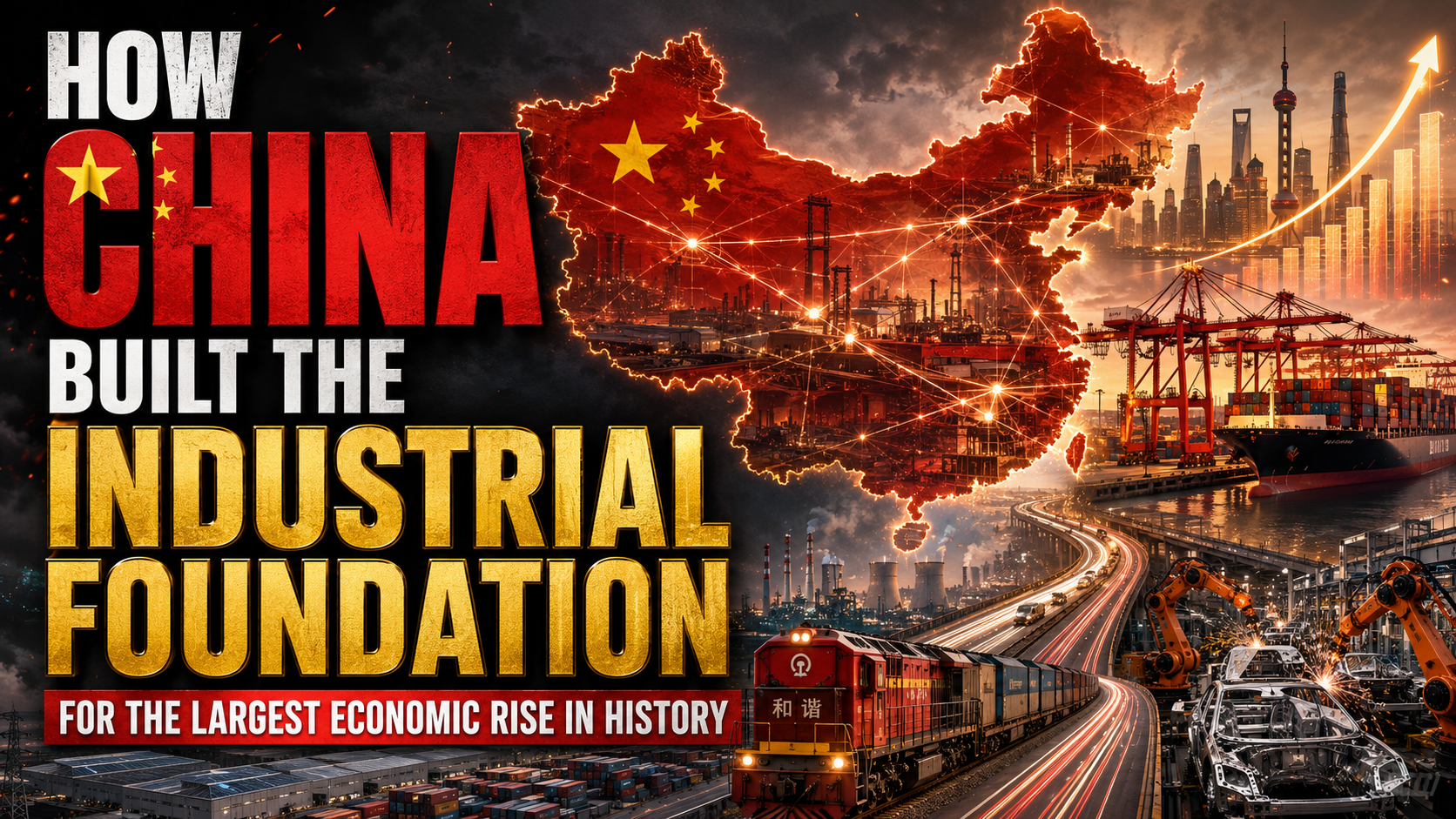
In 1978, China was still a predominantly rural, low-income country emerging from decades of political and economic disruption.
Less than one-fifth of its population lived in cities. Most Chinese workers remained connected to agriculture. The country played a limited role in world trade, lacked modern infrastructure across much of its territory and was nowhere near the center of the global economy.
Over the following four decades, China achieved an economic transformation of a scale that is difficult to compare with anything else in modern history.
Since economic reforms began in 1978, China’s economy has grown by more than 9 percent per year on average. Nearly 800 million people were lifted out of extreme poverty, accounting for more than three-quarters of the reduction in global extreme poverty over that period.
The transformation was not based primarily on financial speculation, natural-resource wealth or a temporary commodity boom.
China built things.
It manufactured clothing, furniture, toys, machinery, chemicals, steel, appliances, electronics, telecommunications equipment, solar panels, batteries, ships, drones and electric vehicles.
It became the place where the global economy went when it needed almost anything produced at enormous scale.
By 2023, China accounted for approximately 31.8 percent of global manufacturing value added. One country was responsible for almost one-third of the value created by the world’s manufacturing sector.
That did not happen simply because Chinese workers were inexpensive.
Many countries had lower wages.
Many countries wanted foreign investment.
Many countries created industrial parks, offered tax incentives and tried to attract multinational corporations.
But no other country constructed such a complete manufacturing ecosystem.
China became the world’s factory because it built the foundation that factories need:
Reliable power
Industrial land
Ports
Highways
Railways
Telecommunications
Technical workers
Supplier networks
Access to capital
Export infrastructure
Large domestic markets
Government institutions capable of coordinating development
Cheap labor helped China win some of the first manufacturing orders.
The industrial foundation made those orders difficult to move elsewhere.
China’s Rise Was Not a Miracle
China’s economic expansion is often described as an economic miracle.
That word makes the transformation sound sudden, mysterious or accidental.
It was none of those things.
The rise took decades. It involved experimentation, foreign investment, domestic entrepreneurship, state planning, urban migration, technological learning and the reinvestment of an unusually large share of national income.
There were also enormous mistakes, social costs and policy failures.
China’s development was not a perfectly designed master plan executed without interruption. The country frequently changed direction, corrected failed policies, tolerated contradictions and allowed different economic systems to exist beside one another.
State-owned companies operated alongside private businesses.
Central planning existed alongside market competition.
Foreign corporations were welcomed while strategic domestic industries were protected.
Local governments competed against one another even while operating inside a centralized political system.
This ability to combine apparently conflicting approaches became one of China’s greatest advantages.
Instead of waiting until the entire country could be reformed, China changed individual parts of the economy, observed the results and expanded the policies that worked.
China did not begin by creating the finished system.
It built the system through controlled experimentation.
The First Foundation Was Agricultural Reform
China’s industrial rise began in the countryside.
This may seem contradictory. Factories, cities and exports appear to have little to do with farming.
But a poor agricultural economy cannot industrialize easily when most of its workers are needed simply to produce enough food.
Before large numbers of people could move into factories, agricultural productivity had to improve.
The reforms that began in 1978 gradually replaced collective agricultural production with the household responsibility system. Rural households received greater control over production decisions and were allowed to benefit more directly from what they produced.
This created stronger incentives, increased agricultural efficiency and freed workers who were no longer required on farms.
China’s reforms initially developed gradually through agriculture, township and village enterprises, trade opening, state-owned enterprise reform and financial changes rather than through one immediate national privatization program.
The economic importance was larger than food production.
Higher agricultural productivity created surplus labor.
Millions of people could leave farming without causing agricultural output to collapse.
Those workers became the labor force for rural businesses, construction projects and eventually the rapidly expanding factories of China’s coastal cities.
Between 1979 and 1997, the transfer of labor from agriculture into non-farm activity is estimated to have contributed roughly one-fifth of China’s GDP growth.
The first step toward becoming the world’s factory was therefore not building a factory.
It was making agriculture productive enough that hundreds of millions of people could eventually do something else.
Township and Village Enterprises Created an Industrial Bridge
China did not move directly from collective agriculture to modern multinational factories.
Between those stages came township and village enterprises, commonly known as TVEs.
These businesses operated in rural areas and smaller towns. Some were collectively owned, some were effectively private and others existed in a legally ambiguous space between government and private entrepreneurship.
That ambiguity was useful.
Private business remained politically sensitive, but local authorities needed employment and revenue. They therefore supported companies that operated commercially while maintaining some form of collective or local-government connection.
TVEs produced construction materials, machinery, textiles, food products, chemicals, metal goods and countless other manufactured products.
They gave rural workers industrial experience before those workers moved to the largest cities.
They created domestic suppliers.
They taught local officials how to support production.
They also demonstrated that economic activity outside the traditional state-owned sector could create employment, tax revenue and higher incomes.
World Bank research identifies rural non-state industry as one of the most important economic transformations following agricultural decollectivization, while other studies describe TVEs as the most dynamic part of Chinese manufacturing during the 1980s and early 1990s.
This stage is often overlooked because the largest Chinese companies today are technology platforms, industrial giants and state-owned enterprises.
But China’s industrial system did not appear fully formed.
It grew through layers.
Agricultural reform released workers.
Township enterprises introduced industrial production.
Coastal export zones connected that production capability to the world.
China Reformed Through Experiments, Not One National Shock
Several former socialist economies attempted rapid transitions toward market capitalism.
China followed a different path.
Rather than dismantling the previous economic system all at once, China introduced market mechanisms gradually and geographically.
One region might receive permission to accept foreign investment.
Another might experiment with land leasing.
A city could introduce different tax rules.
An industrial zone could operate under simplified customs procedures.
If an experiment succeeded, it could be reproduced elsewhere.
If it failed, the damage was easier to contain.
This approach is closely associated with the idea of crossing a river by feeling for the stones.
The destination may be known, but each step is tested before the next is taken.
This gradualism allowed China to preserve political stability while introducing increasingly powerful market incentives.
It also created something that a purely centralized system normally lacks: competition between locations.
Cities and provinces competed to attract factories.
Local officials wanted companies, jobs, exports and tax revenue.
Industrial zones competed through infrastructure, land availability, administrative speed and access to workers.
The central government set the direction, but thousands of local decisions shaped the final result.
China’s size and decentralized administrative implementation encouraged competition, trial and error in areas such as port development and industrial policy.
This combination of central direction and local experimentation became a recurring feature of Chinese development.
Special Economic Zones Opened Controlled Windows to Capitalism
Special economic zones were among the most important experiments.
In 1980, China established its first major special economic zones in Shenzhen, Zhuhai, Shantou and Xiamen. Hainan later received similar status.
These locations were not selected randomly.
They were concentrated near the coast and close to economically important Chinese communities outside mainland China.
Shenzhen sat beside Hong Kong.
Zhuhai was close to Macau.
Xiamen was positioned across the Taiwan Strait.
This geography made it easier to attract capital, management experience, technology and commercial relationships from Hong Kong, Taiwan and the broader Chinese diaspora.
Inside the zones, investors received advantages that were not yet available throughout the country:
More flexible business rules
Preferential taxes
Simplified import and export procedures
Greater access to foreign capital
Infrastructure designed around industrial activity
More freedom to hire workers and organize production
Better integration with ports and international markets
The zones were not simply tax shelters.
They were testing grounds for a different economic system.
World Bank research concluded that China’s early special economic zones tested market institutions and provided models that were later expanded across the coastal region and into the interior.
China avoided an all-or-nothing decision.
It did not ask whether the entire country should immediately become a market economy.
It asked whether a specific city could be allowed to operate differently.
Shenzhen became the most famous answer.
Shenzhen Was Built as a Proof of Concept
Before becoming a global technology and manufacturing center, Shenzhen was a relatively small border settlement beside Hong Kong.
Its location allowed China to observe one of the world’s most commercially active economies from a short distance.
Hong Kong had capital, international banking relationships, export experience, logistics companies and entrepreneurs familiar with Western markets.
Mainland China had land, workers and a government eager to learn.
Shenzhen connected the two systems.
Factories could operate on the mainland while using Hong Kong for finance, management, trade and contact with international customers.
As the experiment succeeded, Shenzhen received more investment.
More investment justified better infrastructure.
Better infrastructure attracted more manufacturers.
More manufacturers created a supplier ecosystem.
The supplier ecosystem attracted companies making increasingly complex products.
This was the beginning of an industrial flywheel.
Shenzhen eventually became much more than a location for inexpensive assembly.
It developed into one of the world’s most important centers for electronics, telecommunications, hardware startups, electric vehicles, batteries and advanced manufacturing.
The lesson was not that every country needed its own Shenzhen.
The lesson was that economic reform could be concentrated geographically until it produced enough momentum to spread.
Foreign Investment Supplied More Than Money
China did not build its manufacturing system alone.
Foreign companies played a central role.
During the 1980s and 1990s, much of the early investment came from Hong Kong and Taiwan. Manufacturers from these economies were searching for lower-cost production locations while remaining close to existing commercial networks.
Later, companies from Japan, South Korea, the United States and Europe expanded their operations in China.
Foreign direct investment provided factories and capital, but the larger contribution was knowledge.
International companies brought:
Production methods
Quality-control procedures
Machinery
Product designs
Management systems
Supplier requirements
Export relationships
Technical standards
Inventory systems
Customer expectations
Chinese workers learned how global production operated.
Chinese managers learned how to meet international deadlines and specifications.
Domestic suppliers learned what multinational corporations required.
Local authorities learned which infrastructure manufacturers valued.
Research into China’s globalization found that investment from Hong Kong and Taiwan dominated much of the early export-oriented foreign investment, while OECD analysis concluded that foreign investment was at the core of China’s rapid trade expansion.
This relationship benefited both sides.
Foreign companies gained access to lower production costs and a future consumer market.
China gained jobs, foreign currency, technology and industrial knowledge.
For decades, Western corporations and Chinese industrial policy reinforced one another.
Global companies helped build the Chinese manufacturing system because that system increased their profits.
Cheap Labor Was the Invitation, Not the Permanent Advantage
China’s large labor force mattered enormously.
Factories could hire large numbers of workers, expand production quickly and produce goods at prices that were difficult for manufacturers in wealthier countries to match.
But labor cost alone does not explain China’s rise.
If the cheapest workforce automatically became the global manufacturing center, production would have moved continuously toward whichever country had the lowest wages.
It did not.
A company cares about the total cost of delivering a finished product, not only the hourly wage of the person assembling it.
A lower-wage country may still be more expensive when it has:
Unreliable electricity
Slow ports
Weak roads
Limited industrial land
Few local suppliers
Complicated customs procedures
Shortages of trained managers
Poor access to finance
Long delays for replacement components
China reduced many of these surrounding costs.
Its advantage became systemic.
A worker might not always be the cheapest in the world, but the complete Chinese production process could remain faster, more predictable and less expensive.
That distinction is essential.
China stopped competing only through labor and began competing through the ecosystem around labor.
China Built Infrastructure Before the Returns Were Obvious
Factories cannot operate on ambition.
They need electricity.
They need roads capable of carrying materials and finished goods.
They need ports that can load enormous quantities of cargo reliably.
They need telecommunications, water systems, industrial land, warehouses and housing for workers.
China invested heavily in all of them.
World Bank research estimates that China spent more than 5 percent of GDP on infrastructure over several decades, reducing transportation costs and connecting production centers to domestic and international customers.
This spending created short-term economic activity through construction, steel, cement and machinery.
More importantly, it reduced the long-term cost of doing business.
A new highway made an inland supplier more useful to a coastal factory.
A better port made export schedules more reliable.
A power station allowed an industrial area to expand.
A railway connected workers, materials and markets.
A telecommunications network improved coordination across the supply chain.
Infrastructure should not be romanticized. Some Chinese projects were wasteful, politically motivated or built far ahead of realistic demand.
But much of the core infrastructure created genuine productive capacity.
China was willing to build the industrial environment before every private investor had arrived.
Once the infrastructure existed, private investment became easier to attract.
Ports Connected Chinese Factories to the World
China’s coastal geography provided a major advantage, but geography alone was not enough.
Ports must be expanded, connected and managed.
China developed huge port systems around manufacturing regions such as:
The Pearl River Delta
The Yangtze River Delta
The Bohai Economic Rim
The Fujian coast
Factories were connected to ports through expressways, railways, inland waterways, logistics parks and customs systems.
This produced a powerful relationship between industrial clusters and maritime trade.
Manufacturers could import components, assemble products and export finished goods through highly developed logistics systems.
As trade volumes increased, port investment became less risky.
As port capacity improved, manufacturing became more competitive.
World Bank analysis of Chinese port development describes this reinforcing cycle, in which trade generated demand for port capacity while competition and experimentation among Chinese ports accelerated development.
China did not merely build factories.
It built the machinery that connected those factories to customers thousands of kilometers away.
Urbanization Moved Labor Toward Productivity
China’s factory system required one of the largest internal migrations in history.
In 1978, less than one-fifth of China’s population lived in urban areas. Over the following three decades, approximately half a billion people moved from rural areas into cities, frequently seeking work in manufacturing and services.
This migration changed both geography and productivity.
A worker engaged in low-productivity agricultural activity could produce much more economic value in a factory, construction company, logistics operation or urban service business.
The movement of workers therefore increased output even before considering improvements in technology.
Urban concentration also created economies of scale.
Companies could hire from larger labor markets.
Workers could move between employers.
Suppliers could serve multiple customers.
Specialized knowledge spread more quickly.
Infrastructure could support dense concentrations of economic activity.
The World Bank describes agglomeration, specialization and mobility as important forces behind China’s industrial upgrading and economic growth.
Urbanization was not merely a consequence of China’s growth.
It was one of its engines.
The Hukou System Made Industrialization Cheaper, but Unequal
China’s household registration system, known as hukou, divided access to many public services according to a person’s registered place of residence.
Millions of rural migrants worked in cities without receiving the same access to education, healthcare, housing and social benefits as officially registered urban residents.
This arrangement allowed cities and factories to use migrant labor without immediately paying the full social cost of permanently integrating every worker and family.
From a narrow industrial perspective, that reduced costs.
From a human perspective, it created a divided urban society.
Workers could spend years in a city while their children remained in their home province.
Families were separated.
Migrant workers contributed to urban prosperity without always sharing equally in its services and protections.
World Bank research has identified hukou restrictions as a barrier to labor mobility, wage convergence and more inclusive urbanization.
China’s manufacturing rise created extraordinary opportunity.
It also depended partly on a labor system that transferred a significant share of the social burden to migrant families.
Industrial Clusters Became China’s Most Defensible Advantage
A factory is relatively easy to copy.
An industrial cluster is not.
China developed regions in which hundreds or thousands of related companies operated near one another.
One city might specialize in lighting products.
Another might specialize in textiles.
Another might become known for furniture, machinery, toys, household appliances or electronics.
The Pearl River Delta became one of the world’s most important electronics and consumer-product manufacturing regions.
The Yangtze River Delta became a vast network of automotive, chemical, electronics, machinery and advanced manufacturing businesses.
Within these clusters, a manufacturer could find nearby companies producing:
Screws
Plastic molds
Circuit boards
Batteries
Displays
Motors
Cables
Packaging
Metal parts
Chemicals
Tools
Labels
Testing equipment
This proximity reduced time and uncertainty.
A company developing a product could visit suppliers in person.
A failed component could be replaced quickly.
A design could be modified without waiting weeks for a supplier on another continent.
Production volumes could expand through networks of subcontractors.
Workers carried knowledge from one company to another.
Factories learned from competitors.
The advantage was not only lower cost.
It was speed.
China could often move from an idea to a physical product faster than countries with more fragmented supply chains.
World Bank research on Chinese industrial clusters emphasizes how special economic zones bundled public services, concentrated infrastructure and supported agglomeration among related industries.
Once a cluster reached sufficient scale, it became self-reinforcing.
Suppliers attracted manufacturers.
Manufacturers attracted more suppliers.
Both attracted workers, logistics providers, banks and technical services.
This is why replacing Chinese manufacturing has proved so difficult.
Moving one assembly line is possible.
Moving an entire ecosystem is much harder.
China Created a Manufacturing Flywheel
China’s industrial rise can be understood as a compounding loop.
Low costs and government incentives attracted initial factories.
Factories created jobs and export revenue.
Export revenue and domestic savings financed infrastructure.
Infrastructure attracted more factories.
More factories created demand for domestic suppliers.
Suppliers reduced dependence on imported components.
Local competition improved speed and cost.
Better capabilities attracted more complex products.
Complex products required more skilled workers and technology.
Higher capabilities made China attractive even as wages increased.
Each stage strengthened the next.
China’s advantage therefore became larger over time rather than disappearing when salaries began to rise.
The country no longer needed to be the cheapest location for every individual operation.
Its accumulated capability became valuable.
A customer was not only buying labor.
The customer was buying access to the flywheel.
China Saved and Reinvested Instead of Consuming Everything
China’s development model relied heavily on saving and investment.
Households saved large portions of their income.
State-owned banks directed capital toward infrastructure, property, industrial companies and strategic sectors.
Local governments used land development and borrowing to finance construction.
Companies reinvested in additional capacity.
During the first decade of the 2000s, investment is estimated to have contributed approximately half of China’s GDP growth, with an especially large increase following the infrastructure-heavy response to the 2008 global financial crisis.
This model had a clear strength.
China could build productive assets rapidly.
Instead of consuming all the income generated by growth, the economy repeatedly converted income into:
Factories
Machinery
Power systems
Roads
Ports
Railways
Industrial parks
Urban development
That increased future production capacity.
But the model also created a weakness.
When investment becomes the default answer to every slowdown, the economy can build more infrastructure, housing and factory capacity than it can use productively.
The same system that created China’s industrial foundation eventually contributed to debt, property problems and overcapacity.
The foundation was powerful.
It was not cost-free.
WTO Membership Opened the Global Valve
China officially joined the World Trade Organization on December 11, 2001, after approximately 15 years of negotiations. It became the WTO’s 143rd member.
WTO accession did not create Chinese manufacturing.
By 2001, the country had already spent more than two decades reforming agriculture, developing special economic zones, attracting foreign investment, building factories and expanding trade.
But WTO membership transformed expectations.
International companies gained greater confidence that China would operate within a recognizable global trade framework.
Tariffs and trade barriers became more predictable.
Foreign companies accelerated investments.
Global corporations moved additional production into China.
Chinese exporters gained better access to major markets.
The effect was an enormous acceleration of a machine that had already been constructed.
The plumbing existed.
WTO membership opened the valve.
China’s GDP was approximately $1.3 trillion when it entered the WTO in 2001. By 2020, it had reached about $14.7 trillion, while China had become the world’s largest manufacturing producer and merchandise exporter.
WTO accession was therefore not the beginning of China’s rise.
It was the moment China’s industrial foundation became fully integrated into the global economy.
Western Companies Did Not Merely Witness China’s Rise
They participated in it.
American and European companies wanted lower production costs.
Retailers wanted cheaper goods.
Investors wanted higher margins.
Consumers wanted affordable electronics, clothing, furniture and household products.
Moving production to China satisfied all of them.
Corporate executives could reduce manufacturing expenses without rebuilding supply chains themselves.
Chinese partners and local governments provided workers, land, suppliers and infrastructure.
The resulting products flowed back into wealthy consumer markets.
For many years, the arrangement appeared overwhelmingly beneficial.
Western companies increased profits.
Consumers paid lower prices.
China gained jobs, knowledge and investment.
But a long-term transfer was taking place.
Every production contract gave Chinese workers more experience.
Every factory trained managers.
Every supplier relationship strengthened domestic capabilities.
Every new product increased the sophistication of the ecosystem.
Western companies often believed they were renting China’s low-cost labor.
In reality, they were helping finance China’s industrial education.
China Increased the Domestic Content of Its Exports
Early Chinese export manufacturing depended heavily on imported components.
A factory might import sophisticated parts from Japan, South Korea, Taiwan or the United States, perform final assembly in China and then export the finished product.
China received the manufacturing jobs, but much of the product’s value was created elsewhere.
Over time, that changed.
Chinese companies began producing more of the components domestically.
Local suppliers improved.
Domestic machinery companies emerged.
Materials that once needed to be imported became available inside China.
The country moved from simple assembly toward deeper control of supply chains.
World Bank research notes that China increased the domestic content of its exports by substituting domestically produced materials and components for imports.
This transition was crucial.
Assembly work can move quickly when wages rise.
An integrated supply chain is more defensible.
The greater the domestic content, the more economic value remains inside the country.
The more value that remains inside the country, the more capital and knowledge are available for the next stage of development.
China Climbed the Manufacturing Ladder
China’s early export identity was built around inexpensive goods:
Clothing
Shoes
Toys
Furniture
Basic electronics
Household products
Had China remained at that stage, rising wages would eventually have destroyed much of its advantage.
Instead, it moved upward.
China expanded into:
Industrial machinery
Telecommunications equipment
Computers
Smartphones
Shipbuilding
High-speed rail
Solar panels
Batteries
Electric vehicles
Drones
Advanced chemicals
Industrial robotics
This movement was neither complete nor uniform.
China continues to depend on foreign technology in areas such as the most advanced semiconductor manufacturing equipment, certain high-end components and specialized industrial software.
But the direction is clear.
China did not accept a permanent position as the low-value assembly floor of the global economy.
OECD research found that China’s export basket moved rapidly toward technology-intensive products, supported by foreign investment, imported capital equipment and integration into international production networks.
The manufacturing foundation created a ladder.
China used lower-value production to build the capabilities needed for higher-value production.
Scale Became a Form of Technology
Scale is often treated as the result of competitiveness.
In China, scale also became a source of competitiveness.
A manufacturer producing enormous volumes can spread fixed costs across more products.
A supplier serving hundreds of factories can justify better machinery.
A port processing huge quantities of cargo can invest in automation and capacity.
A large domestic market allows companies to test products before exporting them.
Scale also generates data and experience.
A factory producing ten million units encounters more problems than a factory producing ten thousand.
But it also learns how to solve more problems.
Those lessons improve future production.
China’s manufacturing system accumulated billions of small improvements in:
Quality control
Scheduling
Tooling
Packaging
Logistics
Materials
Automation
Supplier management
Waste reduction
No single improvement explains China’s dominance.
The accumulated effect does.
China learned how to manufacture by manufacturing more than anyone else.
Why Other Low-Cost Countries Did Not Become the World’s Factory
Countries such as India, Vietnam, Bangladesh, Indonesia and Mexico have attracted major manufacturing investment.
Some have lower wages than China.
Some are closer to the United States or Europe.
Some have younger populations.
Yet none has fully replaced China.
The reason is that cheap labor is only one input.
To reproduce China’s position, a country would need to reproduce many conditions simultaneously:
A very large labor force
Political continuity
Industrial infrastructure
Efficient ports
Reliable electricity
Supplier density
Technical education
Access to capital
Large domestic demand
Export-oriented institutions
Capable local governments
Decades of accumulated production knowledge
A new factory in Vietnam may still purchase machinery, components or materials from China.
A product assembled in Mexico may contain Chinese electronics.
An Indian manufacturer may depend on Chinese chemical inputs or industrial equipment.
Production can move outside China while the surrounding supply chain remains connected to China.
That is why the current diversification strategy is often called China plus one rather than China replacement.
Companies add another manufacturing location.
They rarely remove China from the system entirely.
China’s Government Could Think in Decades
Democratic governments can build effective long-term policy, but election cycles often make continuity difficult.
China’s political system gave the state the ability to maintain strategic priorities over long periods.
Plans could extend beyond a single government term.
Infrastructure could be built before immediate demand existed.
Industries could receive support for years.
Local governments could be evaluated partly through economic development.
National priorities could influence land allocation, bank lending, education and procurement.
This capacity contributed to China’s speed.
It also created serious risks.
When political goals are wrong, centralized authority can scale mistakes as effectively as it scales success.
Local governments can overinvest to meet targets.
State banks can continue financing unproductive businesses.
Officials can suppress information that challenges policy.
Resources can be directed toward politically favored sectors rather than the most productive uses.
China’s advantage was not simply that the government controlled the economy.
Many controlled economies failed.
The distinctive feature was that state direction operated alongside market competition, local experimentation, private entrepreneurship and foreign investment.
China’s rise came from the interaction between the state and the market, not from either one alone.
The Price of Becoming the World’s Factory
China’s industrial transformation improved living standards on an extraordinary scale.
It also imposed heavy costs.
Rapid industrialization contributed to severe air, water and soil pollution.
Workers endured long hours, dangerous conditions and weak bargaining power.
Migrant families were separated by hukou restrictions.
Coastal provinces became much wealthier than many inland regions.
Local governments displaced residents to obtain land for development.
Factories and infrastructure consumed enormous quantities of coal, steel, cement and water.
China’s rapid transformation produced major environmental damage, resource pressure and social division alongside its economic gains.
These costs were not minor side effects.
They were part of the development model.
Low prices in global stores did not reflect only high Chinese efficiency.
They sometimes reflected environmental damage and social costs that were not included in the final price.
Western consumers benefited from inexpensive products.
Chinese communities often absorbed a disproportionate share of the pollution and disruption required to make them.
China’s Industrial Model Eventually Created Overcapacity
A system designed to build capacity will continue trying to build capacity.
Local governments want factories because factories create jobs, tax revenue and measurable economic activity.
Banks prefer lending to companies with physical assets.
National policy frequently identifies strategic industries for expansion.
The result can be too many companies building the same products.
China has faced concerns about excess capacity in property, steel, cement, solar panels, batteries, electric vehicles and other industries.
From China’s perspective, intense competition can improve technology and lower prices.
From the perspective of foreign producers, subsidized Chinese capacity can make fair competition difficult.
Both interpretations can be true.
China’s industrial policy has created globally competitive companies.
It has also encouraged investment beyond what domestic demand can absorb.
The surplus is then exported, creating trade tensions with countries whose manufacturers struggle to compete with Chinese scale and pricing.
The manufacturing machine that powered China’s growth has therefore become one of the largest sources of international economic conflict.
The Old Growth Model Is Reaching Its Limits
China can no longer repeat the first forty years of reform.
The country has already moved hundreds of millions of workers from agriculture into industry and services.
Its population is aging.
Its workforce is no longer expanding as it once did.
Wages are higher.
Property development cannot grow indefinitely.
Some infrastructure has reached diminishing returns.
Debt has increased.
Household consumption remains weak relative to the size of the economy.
The International Monetary Fund has warned that China’s historic dependence on investment, state direction and external demand now faces problems including weak domestic demand, deflationary pressure and financial vulnerability.
The challenge is no longer simply to build more.
It is to make each unit of capital, labor and technology more productive.
China must shift from:
Investment toward consumption
Construction toward productivity
Low-cost manufacturing toward innovation
Imported technology toward domestic capability
Export dependence toward stronger household demand
Quantity of growth toward quality of growth
This is a more difficult transition.
A country can direct banks to finance a highway.
It cannot as easily command households to feel financially secure and consume more.
It can subsidize a factory.
It cannot guarantee that the factory will produce genuine innovation.
The next stage requires stronger productivity growth, better social protection, more efficient capital allocation and greater confidence among households and private businesses.
The Foundation Still Matters
China’s growth is slowing, but slowing growth does not erase accumulated capacity.
The country still possesses:
The world’s largest manufacturing base
Dense supplier networks
Major ports
Huge electricity and transport systems
Large numbers of engineers
Deep experience scaling production
Powerful domestic technology companies
A vast internal market
Strong positions in strategic industrial sectors
This foundation allows China to enter new industries rapidly.
The pattern can be seen in solar energy, electric vehicles, batteries, drones and increasingly artificial intelligence.
Once China identifies a strategic technology, it can connect research to an existing industrial system.
A battery breakthrough can be connected to chemical suppliers, machinery companies, vehicle manufacturers and ports.
An electric-vehicle company can source most of what it needs domestically.
A robotics company can work with electronics, motor and sensor suppliers.
An AI company can draw on a large engineering base, domestic cloud infrastructure and a government treating the technology as strategically important.
China’s current technological challenge to the United States did not appear separately from its manufacturing rise.
The industrial foundation made the technological challenge possible.
China Is Now Trying to Turn Manufacturing Power Into Technological Power
For decades, the dominant model was straightforward:
American, European or Japanese companies designed products.
China manufactured them.
That relationship is changing.
Chinese companies increasingly design the products, own the brands, control the supply chains and develop the underlying technology.
Huawei is not simply assembling telecommunications equipment designed elsewhere.
BYD is not merely manufacturing vehicles for a Western car company.
DJI is not producing generic drones under another brand.
CATL is not only assembling imported battery designs.
These companies emerged from an environment built through decades of manufacturing experience, supplier development and state-supported industrial expansion.
China is now attempting the same movement in:
Semiconductors
Artificial intelligence
Robotics
Aerospace
Biotechnology
Industrial software
Advanced materials
Success is not guaranteed.
The frontier of scientific and technological innovation is different from scaling an established manufacturing process.
It requires basic research, intellectual freedom, risk-taking and the ability to tolerate failure.
But China is entering this competition with a physical and technical foundation that no previous challenger to the United States possessed.
The World Helped Build a Competitor It Now Struggles to Replace
China’s industrial rise is often presented as something China did to the global economy.
The reality is more uncomfortable.
The global economy helped build China.
Western companies transferred production.
Investors provided capital.
Retailers demanded lower prices.
Consumers rewarded companies that outsourced manufacturing.
Governments accepted growing trade imbalances because inexpensive imports reduced inflation and corporate profits increased.
For years, each individual decision appeared rational.
A company that kept manufacturing domestically risked being underpriced by a competitor producing in China.
Once enough companies moved, suppliers followed.
As suppliers disappeared from Western countries, producing locally became even more difficult.
China’s ecosystem strengthened while competing industrial ecosystems weakened.
The result was not created by one agreement, one president or one corporation.
It emerged from millions of decisions made across several decades.
The world did not wake up one morning and choose China as its factory.
It chose China one contract at a time.
The Deepest Lesson Is About Foundations
China’s economic rise offers a lesson larger than manufacturing.
Large outcomes are frequently produced by foundations that appear unremarkable when they are first built.
A port does not create a global manufacturing industry by itself.
Neither does a technical school, highway, power station, industrial park or customs reform.
But when these systems are built together, they create possibilities that did not exist before.
China’s growth came from compounding.
Agricultural reform released workers.
Rural enterprises introduced industrial activity.
Special economic zones attracted capital.
Foreign companies transferred knowledge.
Infrastructure reduced transportation costs.
Urbanization concentrated labor.
Industrial clusters increased speed.
Exports created revenue.
Revenue financed further investment.
Scale produced learning.
Learning allowed China to move into more advanced industries.
There was no single secret.
The strength was the interaction between all the parts.
Conclusion: China Built the Factory Before It Became Rich
China did not become the world’s factory because it was already wealthy.
It became wealthy partly because it built the world’s most complete manufacturing system.
It did not wait for perfect institutions, high incomes or advanced technology.
It began with the resources it had:
A huge population
Low wages
A unified state
Coastal access
Nearby capital from Hong Kong and Taiwan
A government willing to experiment
A population eager for better economic opportunities
China then spent decades turning those starting advantages into structural power.
It built ports before every exporter needed them.
It built industrial zones before every investor had committed.
It trained workers through increasingly complex production.
It allowed foreign companies to bring technology while helping domestic suppliers learn from them.
It reinvested the proceeds of growth into greater production capacity.
Cheap labor may have opened the door.
Infrastructure kept it open.
Industrial clusters widened it.
WTO membership sent the global economy through it.
Scale eventually made the system almost impossible to reproduce elsewhere.
The result was not only higher GDP.
China changed how the entire world manufactures, trades and consumes.
It lifted hundreds of millions of people from poverty, created the largest industrial base on Earth and became the first country capable of challenging American technological leadership across multiple strategic industries.
The model also produced pollution, inequality, debt, overcapacity and a dangerous dependence on investment and exports.
China’s next transformation may prove harder than the first.
But the first transformation has already changed history.
China built the industrial foundation.
The global economy built on top of it.
And by the time the rest of the world understood how valuable that foundation had become, China was no longer merely participating in global manufacturing.
It was the center of it.
Frequently Asked Questions
Why did China become known as the world’s factory?
China became the world’s factory because it combined a large workforce with infrastructure, efficient ports, industrial clusters, foreign investment, government support and extensive supplier networks.
Low wages attracted early manufacturing, but China’s complete production ecosystem made the country difficult to replace.
Did China become the world’s factory only because of cheap labor?
No.
Cheap labor was important during the early stages, but many countries had lower wages.
China’s greater advantage was the complete system surrounding its workers, including reliable infrastructure, suppliers, logistics, access to capital, industrial land and government coordination.
When did China begin its major economic reforms?
China’s major reform and opening period began in 1978 under Deng Xiaoping.
The first reforms focused on agriculture before gradually expanding into rural industry, special economic zones, foreign investment, private business and international trade.
What role did Shenzhen play in China’s economic rise?
Shenzhen became one of China’s first special economic zones.
Its location beside Hong Kong made it an ideal place to attract foreign investment, experiment with market-oriented rules and develop export manufacturing.
Its success became a model for other Chinese cities and industrial zones.
How did foreign companies contribute to China’s rise?
Foreign companies contributed capital, machinery, production knowledge, management systems, technical standards and access to global customers.
In return, they gained lower manufacturing costs and access to China’s expanding market.
These relationships helped Chinese workers, managers and suppliers develop industrial capabilities.
Why was joining the World Trade Organization important for China?
China’s entry into the WTO in 2001 gave foreign companies greater confidence in China’s access to international markets and its participation in global trade rules.
It accelerated investment and exports, although China had already spent more than two decades building its industrial foundation.
What are industrial clusters?
Industrial clusters are geographic concentrations of manufacturers, suppliers, workers and supporting businesses operating in related industries.
They reduce costs, improve access to components and make it easier to develop and manufacture products quickly.
China’s dense industrial clusters are among its most difficult advantages for competitors to reproduce.
How did infrastructure help China’s manufacturing sector?
Roads, railways, ports, power stations and telecommunications reduced the cost of moving materials, coordinating production and delivering products to customers.
China invested heavily in these systems before and during its manufacturing expansion.
How did manufacturing increase China’s GDP?
Manufacturing moved workers from lower-productivity agriculture into higher-productivity industrial jobs.
It attracted foreign investment, generated exports, created domestic suppliers, financed infrastructure and encouraged urbanization.
These processes increased productivity and national output.
How much of global manufacturing does China control?
According to UNIDO data, China accounted for approximately 31.8 percent of global manufacturing value added in 2023.
This means that almost one-third of the value generated by world manufacturing originated in China.
Can India, Vietnam or Mexico replace China?
These countries can attract substantial portions of global manufacturing, and companies are increasingly diversifying production.
However, replacing China completely would require reproducing its infrastructure, supplier density, logistics networks, workforce experience and industrial scale.
In many cases, factories outside China still depend on Chinese machinery, materials or components.
What does China plus one mean?
China plus one is a supply-chain strategy in which a company maintains operations in China while adding production in another country.
The goal is to reduce dependence on one location without abandoning China’s manufacturing ecosystem entirely.
What were the negative effects of China’s industrial growth?
The negative effects included pollution, dangerous working conditions, regional inequality, migrant-worker disadvantages, debt, property overdevelopment and excess industrial capacity.
China’s growth produced enormous benefits, but the costs were significant.
Is China’s old economic model still sustainable?
Not in its original form.
China can no longer rely indefinitely on infrastructure construction, property development, exports and a growing labor force.
Its next stage will require stronger household consumption, higher productivity, technological innovation and more efficient investment.
How is China’s manufacturing foundation connected to its AI progress?
China’s manufacturing rise created engineering talent, infrastructure, domestic technology companies and experience scaling complex systems.
Those capabilities now support Chinese development in artificial intelligence, robotics, electric vehicles, batteries and other advanced industries.