
10 Categories of AI-First Business Small Founders Are Actually Building in 2026
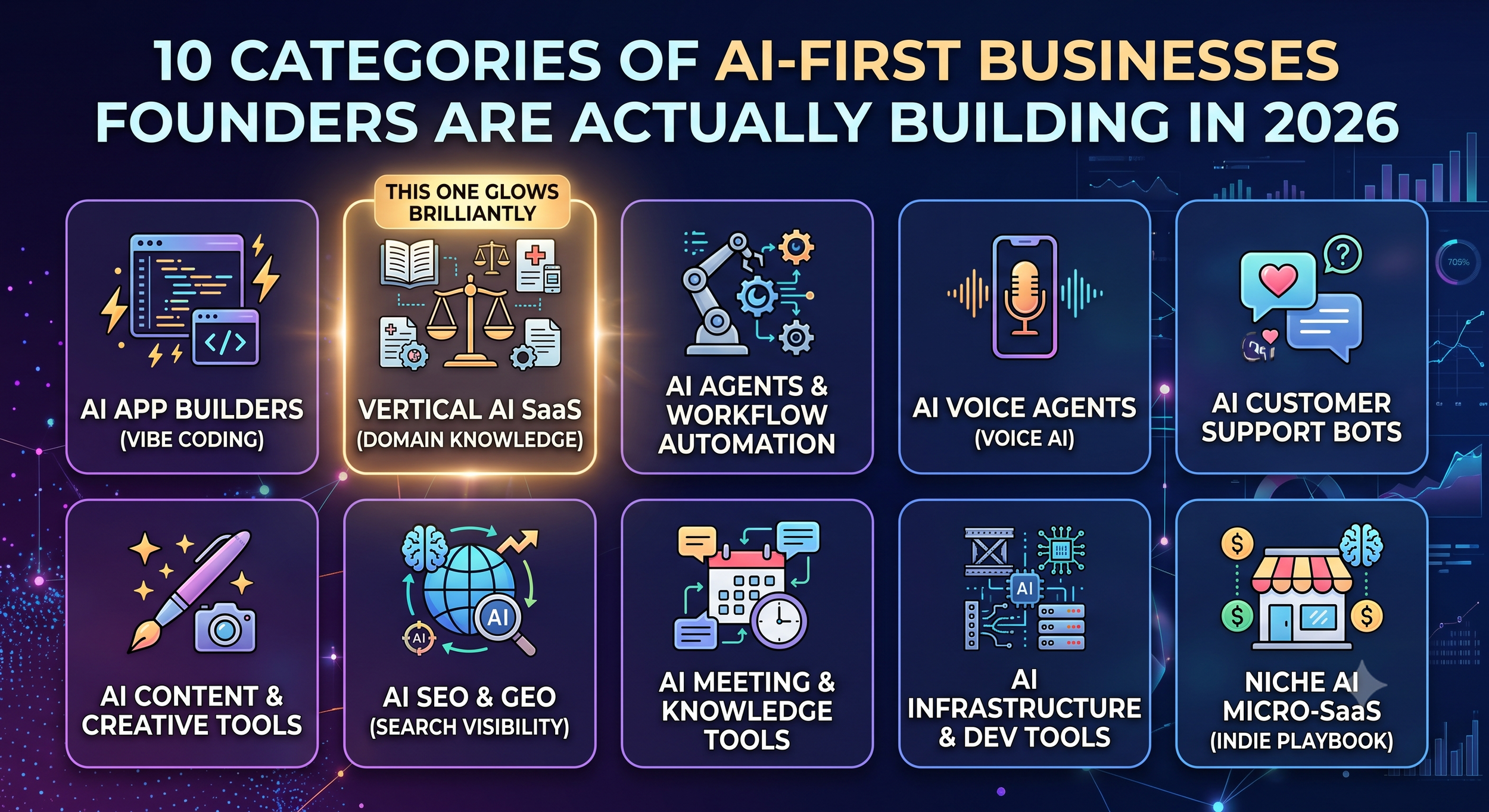
1. AI app builders, the vibe-coding layer
The first category is the one that powers most of the others: tools that turn a plain-language description into a working application.
The traction is staggering. Lovable, a text-to-app platform out of Stockholm, went from open beta in late 2024 to around $400 million in annualized revenue and a $6.6 billion valuation, reportedly at over $2 million of revenue per employee. Replit grew its annualized revenue from about $2.8 million to $150 million in under a year and raised at a $9 billion valuation, pushing into autonomous app-building with its agent. Alongside them sit Cursor, Bolt, and others reshaping how software gets made.
Why it matters for small founders is less about competing with these platforms and more about using them. They are the reason a non-technical founder can now ship a product at all, and they are the toolchain underneath most of the other nine categories.
The honest catch: the consumer end is crowded, the tools themselves are capital-intensive to build, and "I made an app in a weekend" is a starting line, not a business. The value is in what you build with them, not in launching another general-purpose builder.
2. Vertical AI SaaS, the domain-knowledge play
If there is one category purpose-built for small founders, it is vertical AI: software that does one job for one industry, where understanding the work is half the product.
The category turned real in 2026. Harvey, building AI for law firms, reached a reported $200 million-plus in annualized revenue at an $11 billion valuation, and Legora's rise to a $5.55 billion valuation suggested legal AI is a category rather than a one-company market. Narrower players proved the model too, like EvenUp automating demand letters for personal injury law. In healthcare, Hippocratic AI raised over $400 million building patient-communication agents with HIPAA compliance and clinical safety built in.
The reason this suits small builders is that a general-purpose model cannot easily replicate deep knowledge of a specific industry's workflows, regulations, and language. A founder who has worked in dental practices, freight brokerage, or property management knows exactly which painful, repetitive, text-heavy task is worth automating, and that knowledge is the moat. The opportunities are unglamorous on purpose: healthcare admin, legal ops, recruiting coordination, logistics back office, compliance documentation.
The honest catch: you actually need the domain expertise. Without it, a vertical tool is just a thin wrapper that a customer who knows the field can see through immediately.
3. AI agents and workflow automation
The shift defining 2026 is AI moving from answering questions to doing work, executing multi-step tasks and taking actions in real systems. This is the agent category, and it is the fastest-growing software market right now.
The numbers reflect the hype. The AI agent market grew from about $5.25 billion in 2024 to $7.84 billion in 2025, with projections near $52.62 billion by 2030, and Sierra, building customer-experience agents, hit $100 million in annualized revenue in seven quarters on its way to a reported valuation above $15 billion. For smaller builders, the accessible version is agent-building and automation platforms, the tools that let you wire up an agent for a specific business process without a research team.
The honest catch is important here, and the industry says it openly. Getting an agent from an impressive demo to production-grade reliability, the 99%-plus accuracy a business will actually trust, is exponentially harder than the demo, and the first major agent security incident is widely expected to reshape the category. The last mile is where most agent startups will die.
4. AI voice agents
A specific slice of the agent wave deserves its own category, because the economics are so clean: AI that makes and takes phone calls, acting as a receptionist, support line, or sales qualifier.
Voice AI established itself as core infrastructure in 2026. ElevenLabs tripled its valuation to $11 billion on a $500 million Series D, with annualized revenue climbing from $330 million to $500 million in months, becoming the default voice layer for a generation of products. On top of infrastructure like that, smaller builders ship voice agents using platforms such as Vapi, Bland, and Retell. The demand signal shows up at the indie end too: tools like Dialora, positioned as an always-on AI receptionist and sales-qualification agent for small businesses wanting voice AI without per-minute developer rates, were among the trending AI deals on AppSumo in 2026.
The reason this works is unambiguous ROI: a voice agent replaces expensive, hard-to-staff phone labor, and the value is obvious to any business that misses calls. The honest catch is that voice-quality expectations rise fast, so a tool that feels cutting-edge today can feel dated within a year.
5. AI customer support
Customer support is the category where, in the words of one agent-market analysis, the ROI math is the least ambiguous of all, which is why both well-funded and indie builders are piling in.
At the top, customer-service agents command the richest valuations in the agent space, with the category trading at extreme revenue multiples, led by Decagon, Sierra, and incumbent Intercom's Fin. At the indie end, the model scales down cleanly: Chatbase, which lets users build an AI chatbot from a URL or documents, reached roughly $50,000 in monthly recurring revenue within months, and SiteGPT was built by a solo developer doing the same thing for businesses on their own data.
The reason it suits small founders is that "train a chatbot on a specific company's content and resolve its tickets" is a well-defined, repeatable product. The honest catch is consolidation: enterprises are moving from testing many tools to picking one or two winners per category, so the window to establish a niche is narrowing.
6. AI content and creative tools
This is the largest and most visible category, covering AI writing, image, video, design, and presentations, and it contains both the most inspiring lean-team story and the most crowded market.
The inspiring one is Midjourney, mentioned above, doing hundreds of millions in revenue with about 40 people and no outside funding. The model also shows up in newer winners: Gamma, an AI presentation tool, reached $100 million in annualized revenue having raised only $23 million, pulling around 4 million organic visits a month as a standalone destination people return to by name. Video and design tools like HeyGen, Captions, and Krea round out the field. On AppSumo, AI writing, video, and design tools dominate the AI category.
The honest catch is the harshest in this list. Generic content generation is the most commoditized thing AI does, prices race to the bottom, and AI content features are becoming standard inside larger platforms. The survivors are specialized: a specific brand voice, a specific vertical, a specific workflow, not "another AI writer."
7. AI search visibility and GEO tools
An entirely new category appeared in 2026, created by the shift of search itself toward AI answers: tools that help brands get cited inside ChatGPT, Perplexity, and Google's AI results. This is the new SEO, sometimes called generative engine optimization.
The category is young but funding and demand are real, with players like Profound, Goodie, and QuickSEO building visibility-tracking and optimization tools. The demand reaches the indie end fast: AppSumo deals like ClickRank pitch SEO automation explicitly built to optimize content for AI search engines including ChatGPT, Claude, Perplexity, and Gemini, not just Google.
The reason this is a strong small-founder bet is timing. A genuinely new category has very little entrenched competition, and businesses are actively budgeting for AI visibility because they can see their search traffic changing. The honest catch is that the optimization science is still emergent and partly speculative, so the tooling has to stay credible rather than promising guaranteed AI rankings nobody can yet deliver.
8. AI meeting and knowledge tools
Hybrid work created durable demand for tools that capture, summarize, and make sense of conversations and documents, the so-called second-brain category.
The breakout shows the trajectory clearly. Granola, an AI meeting-notes app that started as a Mac-only product in 2023 with a no-bot approach, raised a $125 million Series C at a $1.5 billion valuation in March 2026 after 250% revenue growth in a single quarter. Fathom won the broadest individual adoption with an unusually generous free tier and the highest rating in its category from thousands of reviews, while Fireflies anchored the team-and-CRM use case. Smaller plays exist too, like the indie analytics tool Notionlytics clearing tens of thousands in monthly revenue.
The reason small founders can win is that the category is shifting from transcription, now a commodity, toward the layer that turns conversations into actions and queryable memory. The honest catch is that platform giants like Zoom, Microsoft, and Google are bundling the basic version for free, so a standalone tool has to be meaningfully better at the part that comes after the transcript.
9. AI infrastructure and developer tools, the picks and shovels
Every gold rush rewards the people selling shovels, and in 2026 that means tools built for the AI builders themselves.
The category spans inference and deployment, like Baseten, which raised a $300 million round at a $5 billion valuation solving the problem of running models fast and cheaply enough for production, and the emerging web-infrastructure-for-agents layer, with companies like Browserbase, Exa, and Parallel building search and browsing systems designed for AI agents rather than humans. At a more accessible scale sit tools like the AI code reviewer CodeRabbit, solving one clear pain for a clear buyer.
The reason this suits a certain kind of small founder, usually a technical one, is that the demand is durable and the customers are sticky: as everyone races to build AI products, the tools that make building easier sell themselves. The honest catch is that it is more technical and more competitive at the infrastructure end, so the realistic indie entry point is a single sharp developer tool, not a platform.
10. Niche AI micro-SaaS, the indie playbook
The tenth category is less a vertical than a method: the solo-founder micro-SaaS, a small, focused AI product solving one painful problem for one narrow audience.
This is where the cost collapse shows up most directly. The micro-SaaS market is growing roughly 30% a year, from about $15.7 billion in 2024 toward a projected $59.6 billion by 2030, and AI tooling has cut build time enough that a solo founder can ship in weeks on infrastructure costing $30 to $100 a month. The examples run from the focused, like the chatbot tools above, to the prolific: the indie hacker Nick Dobos reportedly built BoredHumans to around $733,000 a month by launching more than 100 small AI tools on a single domain, a volume-and-distribution play rather than a single flagship product.
The honest catch is the most important number in this entire article, and the next section is built around it.
What the winners have in common
Step back from the ten categories and a consistent pattern separates the businesses that work from the ones that stall.
The first is specificity. The recurring lesson across the data is that horizontal, general-purpose AI tools are crowded and commoditizing, while narrow tools aimed at one industry, role, or moment of use still have room. The winners build surgical instruments, not Swiss Army knives.
The second is that distribution and domain expertise beat novelty. The fastest growth shows up when the founder already has an audience or deep knowledge of the field, not when they have the cleverest technology. An AI feature is not a moat when every competitor can add the same one; what the customer cannot easily replicate is the founder's understanding of their problem and their access to the right buyers.
The third is selling outcomes, not access. Across the agent and automation categories, outcome-based pricing, charging for results rather than seats, is gaining traction because it aligns with the value AI actually delivers.
The fourth is pricing discipline around AI costs, and this is where the market is visibly maturing. Lifetime-deal platforms are moving away from unlimited-access offers toward structured, credit-based tiers, precisely so founders can stay sustainable when every action a user takes carries a real inference cost. Uncapped AI pricing is a quiet way to lose money on your best customers.
The honest reality check
None of this is easy, and the data is clear that most of these businesses do not make it. The single most important figure to internalize before building anything here is the base rate.
An analysis of more than a thousand micro-SaaS businesses found that 70% generate under $1,000 a month, and only 1 to 2% ever exceed $50,000 a month. Building is cheap now, which means everyone is building, which means the bottleneck has moved from making the product to getting anyone to notice and pay for it.
Margins are a second trap specific to AI businesses. Because each use of an AI product carries an inference cost, some indie AI tools run on thin margins, with one example operating at just 25% while heavier categories enjoy 70 to 90%. A tool that looks profitable on signups can quietly bleed on usage if the pricing does not account for model costs. This is the structural reason behind the move to capped and credit-based pricing.
Defensibility is the third. As AI features become standard inside larger platforms, a product whose only advantage is "it has AI" has no durable edge. The moat has to be the niche, the data, the workflow, or the distribution, not the model, which everyone can access through the same handful of APIs.
And the AppSumo signal, useful as it is, comes with its own caution. Lifetime-deal buyers are often deal hunters who buy impulsively and underuse tools, some products shut down within two to three years, and founders frequently struggle to convert one-time buyers into long-term users. A launch there validates demand and brings cash, but it is a starting signal, not a sustainable business on its own.
The opportunity in 2026 is genuinely real: the tools, the costs, and the demand have never been more favorable for a small team building an AI-first product. But the same forces that make it easy for you make it easy for everyone, and the winners are the ones who pair the cheap building with something that is still hard, which is knowing a specific audience deeply and reaching them better than anyone else.
Frequently asked questions
What kinds of AI businesses are small founders building in 2026?
The most active categories are AI app builders, vertical AI tools for specific industries, AI agents and workflow automation, voice agents, customer support bots, content and design tools, AI search visibility tools, meeting and knowledge assistants, developer infrastructure, and niche single-purpose micro-SaaS. Vertical tools and niche micro-SaaS are generally the most accessible to solo founders.
Can you really build an AI business as a solo founder now?
Yes, more than ever, because AI cut build time substantially and infrastructure can cost as little as $30 to $100 a month at the start. The lean-team economics are real, with companies like Cursor reaching roughly $40 million of revenue per employee and Midjourney building a large business with no outside funding. The hard part is no longer building but getting noticed and reaching profitability.
Which AI business category is best for someone with industry experience?
Vertical AI SaaS. A general AI model cannot easily replicate deep knowledge of a specific industry's workflows, regulations, and terminology, so a founder who knows a field like legal, healthcare admin, logistics, or property management has a real and defensible advantage. Domain expertise is the strongest moat available to a small founder.
Are AI tools on AppSumo a good signal of what's working?
They are a useful demand signal, since AI is the fastest-growing category there and the trending tools mirror the broader market, including chatbots, voice agents, AI SEO, and content tools. But it is only a signal. Lifetime-deal buyers often underuse what they buy, and a launch validates interest rather than guaranteeing a sustainable business.
Why are so many AI products moving to credit-based pricing?
Because every action in an AI product carries a real inference cost, so unlimited or flat pricing can lose money on the most active users. Capped and credit-based tiers let founders keep margins sustainable, which is why both subscription products and lifetime-deal platforms have been shifting toward them.
What's the biggest risk in building an AI micro-SaaS?
The base rate of failure and thin margins. Most micro-SaaS products make under $1,000 a month, only a small fraction exceed $50,000, and AI inference costs can squeeze profitability further. On top of that, AI features are becoming standard in larger tools, so a product needs a moat beyond simply having AI.
Do you need venture funding to build in these categories?
No. Many of the most instructive examples, like Midjourney and a range of indie micro-SaaS tools, are bootstrapped and profitable. Funding helps in capital-intensive categories like foundation infrastructure or app builders, but vertical tools, niche micro-SaaS, and content or support products are routinely built without it.