
The Rise Nobody Saw: How Anthropic Out-Earned and Out-Valued OpenAI in 2026
The crossover, in numbers
Start with the revenue trajectory, because it reads like a typo.
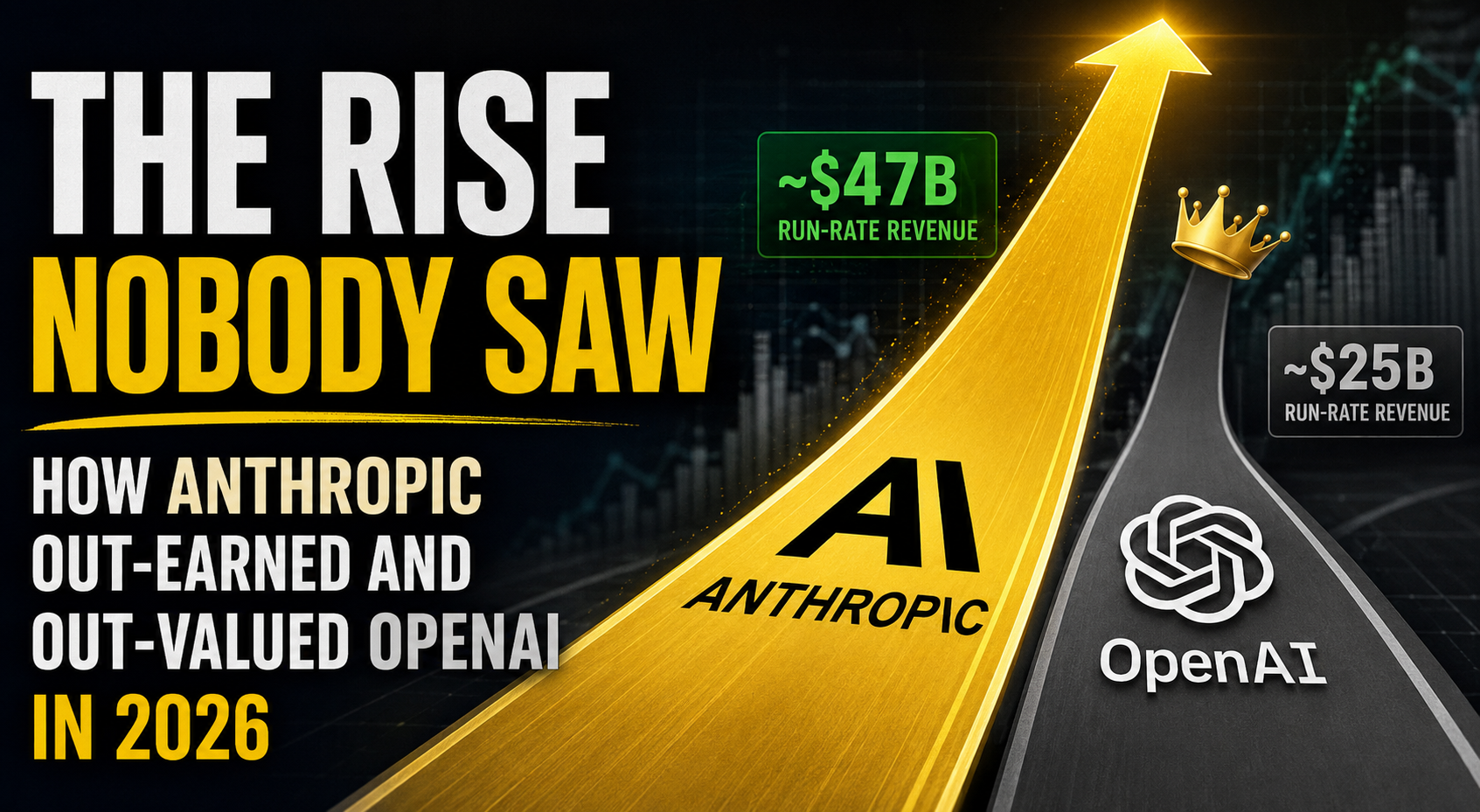
In January 2024, Anthropic's annualized run rate was around 87 million dollars. By December 2024 it was about 1 billion. By the end of 2025 it had reached roughly 9 billion. Then the curve went vertical: about 14 billion in February 2026, 19 billion in March, and roughly 30 billion by early April. By late May, the company reported its run rate had crossed 47 billion. It also expected nearly 11 billion dollars in second-quarter revenue, more than double the prior quarter, and was on pace for its first profitable quarter.
That is roughly thirty times growth in fifteen months. Anthropic's chief executive said the company saw something like eighty times growth in annualized revenue and usage in the first quarter alone.
OpenAI was not standing still during this period. It went from about 2 billion in run-rate revenue in 2023 to 6 billion in 2024 to more than 20 billion by the end of 2025, reaching roughly 24 to 25 billion by April 2026, which the company confirmed as about 2 billion dollars a month. That is excellent growth by any normal standard. It was simply slower than Anthropic's.
The crossover happened in April 2026, when Anthropic's roughly 30 billion run rate moved ahead of OpenAI's 25 billion. For perspective on the pace, Salesforce took about two decades to reach 30 billion in annual revenue. Anthropic reached that run rate in under three years from a standing start.
The valuation that flipped the order
The revenue lead was followed quickly by a valuation lead, which is the part I would have told you was impossible a few months ago.
In February 2026, Anthropic raised its Series G at a 380 billion dollar valuation. On May 28, it announced a 65 billion dollar Series H at a 965 billion dollar post-money valuation. That nearly tripled its price in a single quarter, and it moved Anthropic past OpenAI, which had been valued at 852 billion in late March after a record 122 billion dollar round. For the moment, that makes Anthropic the most valuable AI startup in the world.
It is worth keeping the scale honest. This is the most valuable pure-play AI lab, not the most valuable AI company overall, since Elon Musk's merged SpaceX and AI operation is in a different valuation bracket. But measured against the rival it spun out of, Anthropic now carries both the higher run-rate revenue and the higher valuation, and both companies are now racing toward public listings.
But "passed" needs an asterisk
Before going further, the honest caveats, because they are what separate analysis from a press release. They also reframe the rest of the story in a useful way.
Run-rate revenue is not the same as audited annual revenue. A run rate annualizes the most recent month, so it captures momentum but can swing sharply if growth accelerates or stalls. On trailing first-quarter revenue, the actual money booked in the quarter, OpenAI was reportedly still ahead, roughly 5.7 billion to Anthropic's 4.7 billion. By that measure, OpenAI still had the bigger business at the moment of the run-rate crossover.
The figures themselves are contested. OpenAI reportedly drafted internal memos questioning Anthropic's accounting, and under a stricter framing Anthropic's number could be read closer to 22 billion. Confusingly, other reporting suggested Anthropic's real run rate was actually higher than the 30 billion it announced, closer to 40 billion. The lesson is to treat these as company disclosures and informed estimates, not audited results, and to attribute them rather than state them as fact.
Even the surprise has an asterisk. One forecaster, Epoch AI, actually modeled this crossover months in advance, projecting it for around the middle of 2026 based on the two companies' growth rates. So "nobody saw it coming" is slightly too strong. What is true is that the broad market consensus genuinely believed OpenAI's lead was untouchable, and that consensus was wrong.
And none of this means OpenAI is collapsing. It grew through the same period, just more slowly, and it remains an enormous business with a dominant brand. The durable story here is not a single-month revenue crossover. It is the growth-rate gap and the strategy that produced it.
How it happened: a different bet
The reason Anthropic could pass a competitor with more than ten times its consumer users comes down to one strategic choice made early.
Anthropic never really had a consumer phase. From the start, it built around enterprise contracts, API usage, and developers, the companies that embed Claude into their own products and workflows. OpenAI did the opposite, building the largest consumer product in tech and then working to convert free users into paying ones.
The difference shows up in revenue density. A casual consumer user pays nothing. A subscriber to a 20-dollar monthly plan pays, well, 20 dollars a month. But a company running Claude for software engineering, automation, and API workloads can spend six or seven figures a year. OpenAI optimized for reach. Anthropic optimized for the density of revenue per user, and at this stage density is winning.
That bet rested on four things working together.
Claude Code: the accelerant
The single clearest driver was Claude Code, the company's coding agent. It launched publicly in May 2025, reached a 500 million dollar run rate by that August, crossed 1 billion within six months of launch, and passed 2.5 billion by February 2026. By one estimate it was authoring around 4 percent of all public commits on GitHub.
Coding turned out to be the breakout enterprise use case for AI. It has measurable return on investment, it is sticky once a team adopts it, and usage expands naturally across an engineering organization. A newer product, an agent for broader knowledge work, extends the same idea beyond code. This is also why developers and agencies could feel the shift in real time even while most consumers noticed nothing. The action moved to where software gets built.
Enterprise concentration
Underneath the coding product sat a fast-thickening base of enterprise customers. By late 2025, Anthropic reported more than 300,000 business customers. Roughly 80 percent of its revenue came from business rather than consumer use. The number of customers spending more than 1 million dollars a year passed 1,000 by April 2026, having doubled in under two months, and eight of the Fortune 10 became customers. Large accounts grew several times over year on year, one consulting firm rolled Claude out to roughly 470,000 of its people, and more than 100,000 businesses were running Claude through Amazon's cloud.
This kind of revenue behaves differently from consumer subscriptions. It retains better, expands inside the account over time, and churns less, which means it compounds. The shift even showed up in independent spending data: by April 2026, one widely cited index of US business AI spending put Anthropic narrowly ahead of OpenAI for the first time, after Anthropic roughly quadrupled its business adoption in a year while OpenAI's stayed nearly flat, and after Anthropic began winning a majority of head-to-head deals among first-time buyers.
The efficiency edge
The least-discussed factor may be the most important one. Anthropic has been running its models at a meaningfully lower cost than OpenAI. Reporting on both companies' confidential financials suggested Anthropic spends roughly four times less on training, with OpenAI heading toward something like 125 billion dollars a year in training costs by 2030 against Anthropic's projected 30 billion.
That gap flows straight to the bottom line. OpenAI has projected a loss in the range of 14 billion for 2026, burns cash heavily, and has pushed its breakeven target out toward the end of the decade. Anthropic, by contrast, was on pace for its first profitable quarter in mid-2026. If the real race is to reach durable economics, then higher-value enterprise revenue combined with lower cost is a strong place to be standing.
The honest counterpoint is that Anthropic also burns enormous amounts of cash and has raised tens of billions to fund its compute. Both companies are making the same underlying bet, that the cost of intelligence keeps falling and revenue keeps compounding faster than spending. That bet is not yet proven.
Distribution through the clouds
Finally, distribution. Two of the three largest cloud providers are both investors in Anthropic and infrastructure partners, which puts Claude directly in front of enterprises inside the platforms where they already buy software. To feed demand, Anthropic also locked in large compute agreements across multiple providers and chipmakers. Securing both the path to customers and the hardware to serve them removed two of the constraints that usually slow a company growing this fast.
What OpenAI still owns
A balanced read has to be equally clear about where OpenAI remains ahead, because in several respects it is not close.
On consumers, OpenAI dominates. ChatGPT reached around 900 million weekly active users, and it remains the default AI brand for most of the world. OpenAI has leaned into that position, expanding ChatGPT toward a consumer super-app spanning shopping, commerce, and richer multimodal features like voice and image. Anthropic has no comparable consumer footprint and has not tried to build one.
On trailing revenue, as noted, OpenAI was still ahead in the most recent fully booked quarter. On resources, it raised 122 billion dollars and can compete aggressively on price, capacity, and product. Its own coding tool undercuts Claude Code on price, switching costs between coding agents are low, and at least one major enterprise was reported to be hedging by testing both.
There is also a subtler point that complicates any simple scoreboard. A large share of OpenAI's customers also pay for Anthropic, and the two products' ecosystems barely overlap. In practice, the companies have largely stopped competing for the same customer. OpenAI won the consumer market. Anthropic won the enterprise and developer market, at least for now. Who is winning depends entirely on which scoreboard you read.
Why this matters for builders and businesses
For founders, agencies, and anyone building software, the more useful takeaway is the strategy, not the leaderboard.
The first lesson is revenue density over vanity reach. Anthropic passed a far larger competitor not by chasing the biggest user count but by going where revenue is concentrated: high-value enterprise contracts and sticky, high-return use cases. Consumer virality buys a large number quickly. Enterprise contracts buy durable revenue that compounds. For a company deciding where to compete, that distinction is worth internalizing.
The second lesson is for anyone choosing AI vendors. The market has split cleanly into a consumer track and an enterprise-and-developer track, which means "which one is winning" is mostly the wrong question. The right question is which fits a given job, and running more than one vendor is now normal rather than a hedge.
The third is a signal about where AI value may accrue next. The crossover suggests that the durable money in AI, at least so far, is showing up in enterprise workflows and coding rather than in consumer chat. For anyone deciding what to build, that is a meaningful hint about where the ground is most solid.
The honest bottom line
Anthropic genuinely passed OpenAI on run-rate revenue and on valuation in 2026, and it did so with a fraction of the users, by betting on enterprise and coding and by running far more efficiently. That is a real and surprising achievement, and the growth rate behind it should concern competitors more than any single month's revenue figure does.
But the win is narrower than a victory-lap headline implies. OpenAI still dominates consumers, was still ahead on trailing revenue at the moment of the crossover, disputes the accounting behind the numbers, and has the resources to fight back hard. Both companies are burning enormous amounts of cash on a bet about AI economics that remains unsettled, and both have signaled that their own growth will slow from here.
So the accurate version is not that Claude beat ChatGPT. It is that the two companies stopped playing the same game, and on the enterprise-and-coding board, the one that refused to chase consumer scale is, for now, both earning more and worth more than the company that created the industry. Whether that lead holds depends on whether Anthropic's extraordinary growth survives contact with slowing markets, OpenAI's war chest, and the unforgiving math of compute. The race is not over. It just has a very different leader than almost anyone expected.
Frequently asked questions
Did Anthropic really pass OpenAI in revenue in 2026?
Yes, by annualized run rate. Anthropic reached about 30 billion dollars in run-rate revenue in April 2026, ahead of OpenAI's roughly 25 billion, and climbed past 47 billion by late May. The caveat is that run rate annualizes the latest month rather than measuring booked annual revenue, and on trailing first-quarter revenue OpenAI was reportedly still ahead.
Is Anthropic now worth more than OpenAI?
As of late May 2026, yes. Anthropic raised a 65 billion dollar Series H at a 965 billion dollar valuation, passing OpenAI's 852 billion valuation from March. That makes it the most valuable pure-play AI startup, though not the most valuable AI-related company overall.
How did Anthropic grow so fast?
It bet on enterprise customers, API usage, and developers instead of consumer scale, which produced far higher revenue per user. The biggest single driver was Claude Code, its coding agent, which went from launch to a multibillion-dollar run rate in under a year. Lower training costs and strong cloud distribution amplified the effect.
Does this mean Claude beat ChatGPT?
Not exactly. OpenAI still dominates consumers with around 900 million weekly ChatGPT users and remains the larger consumer brand. The two companies have largely stopped competing for the same customer, with OpenAI leading in consumer and Anthropic leading in enterprise and developer use, so the winner depends on which metric you use.
What is Claude Code and why did it matter so much?
Claude Code is Anthropic's AI coding agent, launched publicly in 2025. It became the fastest-growing product in the company's history and was estimated to author a meaningful share of public code on GitHub. Coding proved to be a breakout enterprise use case because it has clear return on investment, high stickiness, and natural expansion across engineering teams.
Is Anthropic profitable?
It was reported to be on pace for its first profitable quarter in mid-2026, helped by training costs roughly four times lower than OpenAI's. However, it still spends heavily on compute, and like OpenAI it is making a large bet that revenue will keep compounding faster than costs.
Could OpenAI take the lead back?
It is possible. OpenAI raised 122 billion dollars, retains a dominant consumer position, and offers a lower-priced coding tool, and switching costs between products are low. Both companies also expect their growth to slow, so the current lead is not guaranteed to hold.