
After Sora, OpenAI Is Killing Atlas Too - Why Its Product Expansion Is Reversing
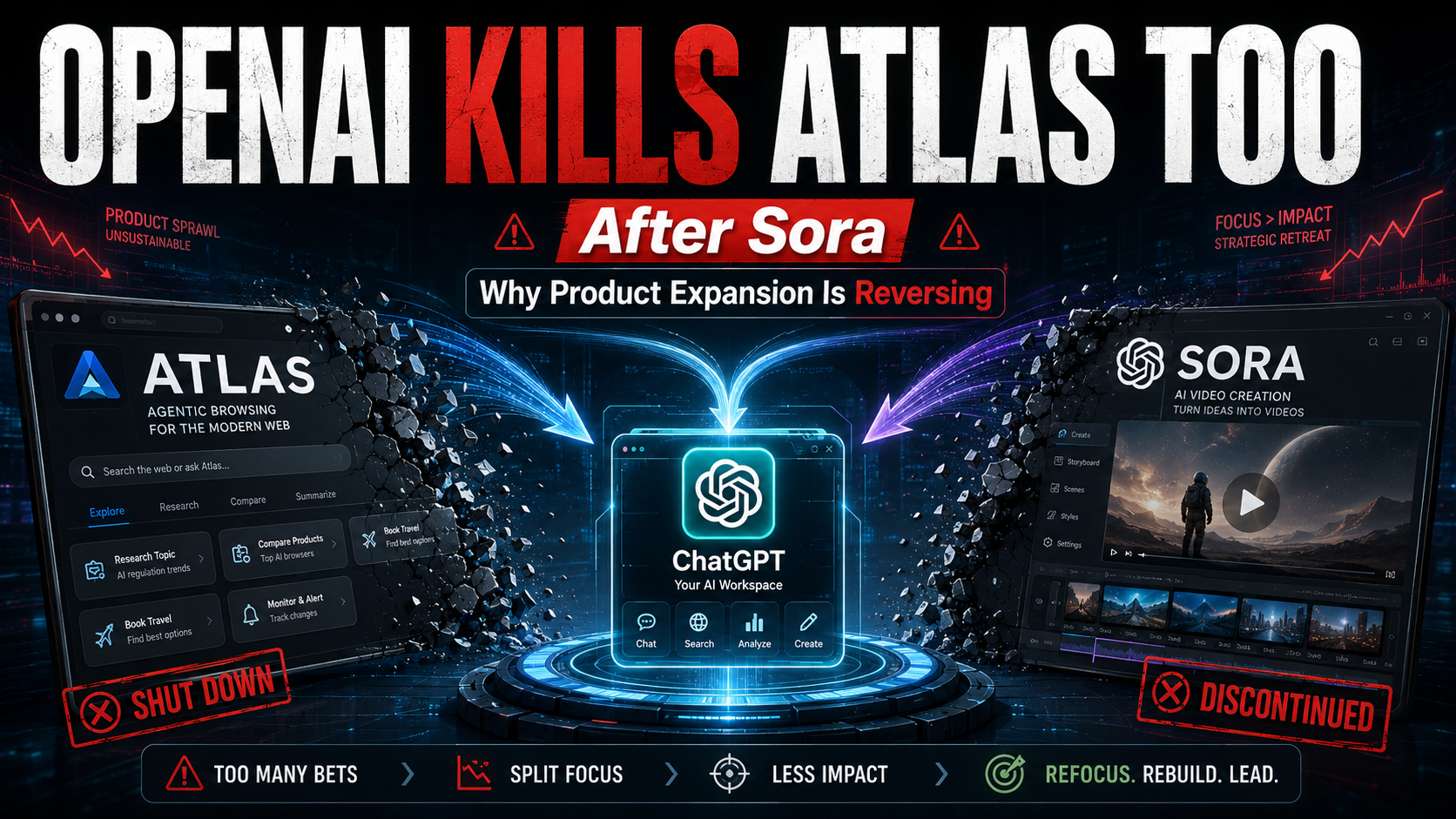
OpenAI launched ChatGPT Atlas on October 21, 2025, with one of the most ambitious product pitches in the company’s history.
Atlas was not presented as a small ChatGPT extension or an experimental browser assistant.
It was presented as a new web browser built around ChatGPT.
OpenAI argued that artificial intelligence created a rare opportunity to rethink how people use the web. Instead of opening a traditional browser and visiting ChatGPT separately, users could make ChatGPT part of the browser itself.
Atlas could understand the page a user was viewing, answer questions about it, remember browsing context and perform tasks across websites. OpenAI described it as a step toward a “true super-assistant” capable of understanding a user’s world and helping them complete work directly inside the browser.
Less than ten months later, Atlas is being discontinued.
OpenAI has scheduled the browser to stop working on August 9, 2026. Users are being told to export bookmarks, save important tabs and move to another browser before Atlas stops receiving support.
The shutdown comes only months after another major reversal.
OpenAI discontinued the Sora web and app experiences on April 26, 2026. The Sora API is scheduled to follow on September 24, 2026.
These were not obscure internal experiments.
Sora was one of the most anticipated artificial intelligence products ever announced. Its first demonstrations in 2024 appeared capable of transforming filmmaking, advertising and digital content.
Atlas was OpenAI’s attempt to challenge the browser itself, one of the most important software categories in the world.
Both products were backed by extraordinary technology.
Both received enormous attention.
Both were discontinued surprisingly quickly.
The pattern deserves more than a news recap.
OpenAI did not suddenly lose the ability to build powerful AI models. Nor does the shutdown of Atlas mean browser agents have no future.
The deeper problem is strategic.
OpenAI expanded into too many standalone products before proving that each capability deserved to become its own business.
Sora became a video-generation product, creative community and social feed.
Atlas became a browser.
Operator became a separate browser agent before being folded into ChatGPT.
Codex became a separate coding environment.
ChatGPT remained the company’s central product while OpenAI simultaneously attempted to establish new destinations around video, browsing, coding, agents, search and workplace productivity.
That expansion looked powerful from the outside.
It also fragmented OpenAI’s attention, distribution, engineering resources and product identity.
The company is now reversing course.
Capabilities that were once launched as independent products are increasingly being consolidated into ChatGPT, Codex and a broader ChatGPT desktop experience.
Atlas is being killed as a standalone browser, but its browsing capabilities are moving into ChatGPT’s desktop application and Chrome extension.
Operator’s standalone website was shut down after its computer-use capabilities were integrated into ChatGPT agent mode.
Codex is being merged more deeply into the ChatGPT desktop application.
Sora was discontinued as OpenAI redirected resources toward other priorities.
This is not merely normal product cleanup.
It is a correction to a period of strategic overexpansion.
OpenAI Started Acting Like It Could Enter Every Software Market
After ChatGPT’s success, OpenAI found itself in a rare position.
It had one of the fastest-growing consumer technology products in history.
It controlled models that could generate text, code, images, audio and video.
It had enormous brand recognition.
It had access to vast amounts of capital.
It appeared to have a technological advantage over nearly every established software company.
From that position, entering adjacent markets seemed logical.
If ChatGPT could search the web, why not challenge Google Search?
If AI could write code, why not build a development environment?
If AI could operate websites, why not build a browser?
If AI could create video, why not build a video platform?
If ChatGPT could work with documents and company data, why not challenge Microsoft Office and enterprise software?
The problem was not that any one of these ideas was irrational.
The problem was attempting too many of them at once.
OpenAI began moving from a model company with one dominant application into a company trying to operate across multiple mature software categories.
Each category came with its own competitors, customer expectations and operational requirements.
A browser is not simply ChatGPT wrapped around Chromium.
A social video application is not simply a video model with a feed.
A coding platform is not simply a model that can generate code.
An enterprise productivity suite is not simply a chatbot connected to company files.
Each product requires focus.
Each needs its own user experience, distribution system, reliability standards, safety policies, business model and long-term roadmap.
OpenAI had the underlying intelligence to enter these categories.
It had not necessarily developed the organizational capacity to win all of them simultaneously.
The Difference Between Technical Capability and Product-Market Fit
Artificial intelligence companies frequently confuse model capability with product demand.
A model performs an impressive task.
The company assumes people will want a new standalone product built around that task.
Sometimes they do.
Often they do not.
A technology can be impressive without becoming a durable product.
A product can attract millions of curious users without creating a stable habit.
A product can go viral without developing a sustainable business model.
A product can demonstrate the future without being the form in which that future ultimately arrives.
Sora is a clear example.
When OpenAI first made Sora available as a standalone product in December 2024, it created a dedicated interface at Sora.com. Users could generate and remix video, use storyboards and browse community creations.
The company expanded the concept dramatically in September 2025.
Sora 2 was not launched only as an improved generation model. OpenAI built a social iOS application around it, complete with a customizable feed, remixing, friend-based creation and a feature that allowed people to insert themselves into generated scenes. OpenAI described the app as the beginning of a new era of co-creative communication.
The launch generated genuine excitement.
OpenAI later reported that the Android version reached number one in the Play Store on launch day and that Android users created more than one million videos during the first 24 hours.
Those numbers demonstrated demand for the experience.
They did not prove that OpenAI had built a sustainable social network.
Generating an amusing AI video once is different from returning every day.
Sharing a few clips with friends is different from replacing TikTok, YouTube or Instagram.
A viral launch is different from long-term retention.
Sora’s technology attracted attention, but the product attempted to compete simultaneously in video generation, creative software and social media.
Those are three different businesses.
The same mistake appeared with Atlas.
People may want ChatGPT to understand webpages.
They may want an agent to research information, complete forms or work across tabs.
They may want an AI assistant inside Chrome.
That does not prove they want to abandon Chrome, Safari, Edge or Firefox and move their entire digital life into a new OpenAI browser.
The useful capability and the product container were not the same thing.
Atlas Asked Users to Replace One of Their Strongest Digital Habits
Switching a chatbot is easy.
A user can open ChatGPT, Claude, Gemini or another AI tool in separate tabs. They can move between models depending on the task.
Switching a browser is much harder.
A person’s browser may contain years of accumulated digital infrastructure:
Passwords
Bookmarks
Browsing history
Extensions
Saved payment information
Work profiles
Personal profiles
Authentication sessions
Developer tools
Accessibility settings
Synced tabs
Company security policies
Familiar keyboard shortcuts
The browser is not just another application.
For many people, it is the operating layer through which most work happens.
Atlas therefore faced a much larger adoption barrier than an ordinary AI application.
OpenAI was not simply asking users to test a useful assistant.
It was asking them to move the center of their digital activity.
That would have been difficult even if the browser market were competitive.
It is much harder when one incumbent controls the majority of the market.
In June 2026, Chrome held approximately 69.65 percent of worldwide browser usage, according to StatCounter. Safari held about 15.31 percent, while Edge held roughly 5.21 percent.
Google’s advantage is not based only on browser quality.
Chrome is connected to:
Android
Google Search
Gmail
Google Workspace
YouTube
Google accounts
Password synchronization
Enterprise administration
Advertising
Developer tooling
Apple has a similar distribution advantage through Safari on the iPhone, iPad and Mac.
Microsoft can distribute Edge through Windows.
OpenAI did not control an operating system.
It did not manufacture a major smartphone platform.
It could not place Atlas in front of billions of users by making it a default application on their devices.
It was entering a market where distribution may be more important than technological novelty.
Atlas Never Escaped Its Initial Platform Limitation
Atlas launched globally on macOS.
OpenAI said versions for Windows, iOS and Android would arrive later.
They never became the foundation of a meaningful cross-platform browser strategy before the shutdown was announced.
That created a serious strategic limitation.
Windows remains central to business computing.
Android dominates smartphone usage in many markets.
iOS is essential for affluent consumer distribution.
A browser available mainly to Mac users could demonstrate OpenAI’s ideas, but it could not realistically challenge Chrome on a global scale.
Launching on macOS first may have made engineering sense.
OpenAI wanted to use native Apple frameworks to create a distinctive interface rather than simply reskinning Chromium.
But a browser must eventually follow users across their devices.
People do not want one browser on their work computer, another on their home computer and a third on their phone unless synchronization between them is effortless.
Atlas began as an ambitious platform.
In practice, it remained closer to an advanced product experiment.
Building a Browser Was Far More Expensive Than Adding AI to One
OpenAI published a detailed engineering article only days after Atlas launched.
The article revealed how much work had gone into the browser.
OpenAI did not simply place a ChatGPT sidebar beside Chromium.
Its team built a new architectural layer called OWL, or OpenAI’s Web Layer. The company separated the Chromium browser process from the main Atlas application and rebuilt the user interface using Apple frameworks including SwiftUI, AppKit and Metal.
This was serious engineering.
It also demonstrated the scale of the commitment.
OpenAI needed to maintain:
Chromium integration
Browser security updates
Native user interfaces
Tab management
Process isolation
Memory performance
Password systems
Bookmark systems
Download handling
Website compatibility
Browser agents
Authentication
Privacy controls
Data export
Enterprise policies
The browser engine itself was supported by Chromium’s global development community, but Atlas still required OpenAI to maintain its own integration, user experience and security responsibilities.
OpenAI’s shutdown guidance makes the maintenance burden explicit.
The company warns that browsers require continuing security maintenance and that users should leave Atlas before it becomes unsupported.
This matters because every engineer working on browser architecture was not working on another OpenAI priority.
Every security review for Atlas competed with security work elsewhere.
Every platform port required additional investment.
Every browser-specific problem consumed organizational attention.
For Google, Chrome supports search, advertising, Android and the wider Google ecosystem.
For Microsoft, Edge supports Windows, Bing and Copilot.
For Apple, Safari supports the company’s hardware platforms.
OpenAI needed Atlas to justify itself primarily through AI distribution.
Once OpenAI discovered that it could place similar AI capabilities inside ChatGPT and Chrome, the case for maintaining a complete browser became much weaker.
OpenAI Had a Distribution Problem, Not an AI Problem
Atlas’s underlying vision was probably correct.
AI will become deeply integrated into browsing.
Users will increasingly ask questions about pages, summarize information, compare sources and delegate multi-step web tasks.
The mistake was assuming that OpenAI needed to own the browser to deliver those capabilities.
OpenAI’s replacement strategy makes the lesson obvious.
The new ChatGPT desktop application includes a built-in browser that can gather information, use online tools, open websites, log into accounts, download files and support agentic work.
OpenAI is also updating its Chrome extension so that ChatGPT can appear directly in Chrome’s sidebar.
The company explicitly says these features build on what it learned from Atlas.
In other words, OpenAI is moving from:
Download our browser and move your workflow into it.
To:
Use ChatGPT inside the browser and desktop environment you already have.
That is a dramatically lower-friction strategy.
It does not require users to migrate bookmarks.
It does not require them to replace passwords.
It does not require a company to approve an entirely new browser.
It does not require OpenAI to win a browser-distribution war against Google, Apple and Microsoft.
OpenAI can still provide browser intelligence without operating a general-purpose browser.
Atlas may therefore have reached the correct product insight through an expensive detour.
The browser was not necessarily the product.
Browser-based agency was the feature.
Sora Created an Even Larger Strategic Distraction
Atlas was expensive in engineering terms.
Sora was expensive in compute, safety, legal and product terms.
AI video generation requires substantial computing resources.
Unlike text generation, which can often return a useful response relatively quickly, video generation involves producing and maintaining consistency across many frames, visual elements and audio components.
Reuters reported that running Sora consumed significant computational resources and left other OpenAI teams with less capacity. The report also said OpenAI was redirecting attention toward enterprise products, coding, robotics and a broader unified application strategy.
The opportunity cost was therefore not theoretical.
Every Sora generation used infrastructure that could have supported another OpenAI product.
Every engineer working on the Sora social experience was not working on ChatGPT, Codex or enterprise deployment.
Every safety controversy required policy, moderation and public-relations attention.
Every partnership created obligations.
OpenAI had announced a significant agreement with Disney involving investment and access to well-known characters, but Reuters reported that the transaction did not close before Sora’s discontinuation.
Sora was no longer simply a model research project.
It had become a consumer app, social platform, developer API, creative tool and entertainment partnership strategy.
That was an enormous number of businesses to attach to one emerging technology.
The product’s viral popularity may have made it harder to admit that the expansion was strategically expensive.
Popularity creates political pressure inside a company.
Teams can point to downloads, generated content and media attention.
But attention is not the only resource allocation metric.
OpenAI had to ask whether Sora was the best use of its limited compute and talent while competitors were advancing in coding, enterprise AI and agentic productivity.
Its eventual answer was no.
The Problem Was Not Experimentation
Technology companies should experiment.
OpenAI needed real-world information about how people would use AI video and browser agents.
Internal research alone could not provide that knowledge.
Sora and Atlas gave OpenAI valuable data about:
User behavior
Interface design
Safety risks
Browser automation
Agent reliability
Social AI content
Video-generation demand
Platform integration
Memory
Privacy
Long-running workflows
The failure was not launching experiments.
The failure was presenting too many experiments as major standalone product directions before their long-term value had been proven.
There is a difference between:
A research preview
A product experiment
A durable product
A strategic platform
A separate business
OpenAI frequently blurred those categories.
Operator originally launched as a standalone research preview at its own website.
Within months, its capabilities were integrated into ChatGPT agent mode and the standalone Operator site was scheduled to disappear.
That was probably the right outcome.
The agent capability belonged inside ChatGPT, where users already described tasks and interacted with OpenAI’s models.
Atlas repeated the pattern on a larger scale.
Instead of testing browser functions inside ChatGPT first, OpenAI built a complete browser around them.
The company eventually reached the same conclusion: the capability was valuable, but the standalone destination was unnecessary.
OpenAI’s Brand Was Becoming Harder to Understand
A focused product strategy tells users what a company is.
Google organizes much of its identity around search, advertising, cloud software and Android.
Microsoft is understood through Windows, Office, Azure and enterprise software.
Adobe is associated with creative tools.
OpenAI’s identity became increasingly complicated.
Was it:
A research laboratory?
A model provider?
A chatbot company?
A search engine?
A browser company?
A social video platform?
A coding-tools company?
An enterprise software company?
An agent platform?
A robotics company?
A hardware company?
The answer could technically be all of them.
That does not mean it should operate a separate product for each identity.
OpenAI’s strongest brand asset is ChatGPT.
Users understand ChatGPT as the place where they interact with OpenAI’s intelligence.
Launching separate brands and destinations fragments that advantage.
A user may know that ChatGPT can write and reason but not know whether video belongs in Sora, whether browsing belongs in Atlas, whether coding belongs in Codex or whether task execution belongs in Operator.
Each separate interface creates another decision.
Each decision creates friction.
A unified product can allow the model to choose the right capability automatically.
A fragmented product portfolio requires users to understand OpenAI’s internal organizational structure.
That is rarely a good consumer strategy.
OpenAI Mistook Technological Breadth for Product Breadth
Frontier AI models are general-purpose technologies.
One model can potentially support writing, research, coding, planning, analysis, browsing and tool use.
That breadth creates a temptation.
If the technology can perform ten categories of work, the company may assume it should build ten products.
But general-purpose intelligence may support the opposite product strategy.
Instead of creating a separate product for every capability, the company can create one adaptive interface that applies intelligence across many tasks.
ChatGPT’s original advantage was precisely this flexibility.
The same conversation box could help with:
Writing
Coding
Translation
Brainstorming
Learning
Analysis
Research
Planning
Users did not need separate OpenAI applications for each category.
As models became more capable, OpenAI moved away from that simplicity.
It began creating specialized containers around individual capabilities.
Sora separated video.
Atlas separated browsing.
Operator separated web actions.
Codex separated coding.
The current reversal suggests OpenAI is rediscovering the value of the unified interface.
The long-term product may not be a collection of AI applications.
It may be one intelligent operating layer capable of selecting tools, opening interfaces and executing tasks as needed.
ChatGPT Work Represents the Strategic Reversal
OpenAI’s new direction is visible in ChatGPT Work.
The company describes ChatGPT Work as a unified environment for connected applications, documents, websites, code, browser tasks and longer-running workflows.
The desktop application now includes browser capabilities.
Codex is merging into the same desktop application.
Plugins connect ChatGPT to workplace systems.
Scheduled tasks can monitor websites, update documents and perform recurring work.
Computer Use can interact with applications and browsers.
Instead of requiring users to move between multiple OpenAI destinations, ChatGPT is becoming the container in which those capabilities meet.
This is a reversal of product expansion, even if OpenAI describes it as evolution.
The company is moving from horizontal product creation toward platform consolidation.
The old approach asked:
What standalone product can we build around this new model capability?
The new approach asks:
How can this capability strengthen ChatGPT, Codex and the core OpenAI platform?
That is a more disciplined question.
It prioritizes distribution.
It reduces duplicated interfaces.
It makes cross-product integration easier.
It allows OpenAI to concentrate engineering effort around fewer surfaces.
It also creates a clearer subscription strategy.
Users are more likely to pay for one powerful environment than maintain separate subscriptions and habits across many experimental applications.
The Shutdowns Reveal a Business Strategy Failure
OpenAI will understandably avoid calling Sora and Atlas failures.
Companies often describe discontinued products as experiments, transitions or evolutions.
There is truth in that framing.
Atlas technology is being reused.
Sora produced research and product lessons.
Operator’s capabilities survived inside ChatGPT.
A failed product can still create valuable technology.
But the business strategy should still be judged honestly.
Atlas was launched as a browser and abandoned as a browser in less than a year.
Sora was expanded into a social video platform and then discontinued.
Operator launched separately before being consolidated.
These decisions represent more than healthy iteration.
They show that OpenAI repeatedly overestimated the need for standalone products.
The company spent resources building:
Separate interfaces
Separate onboarding
Separate brands
Separate infrastructure
Separate user habits
Separate safety systems
Separate data-management tools
Separate shutdown and migration processes
Users now have to export Atlas bookmarks and preserve Sora content because OpenAI created products it was not prepared to maintain.
That is a real cost.
The company also created uncertainty among partners, developers and users.
A developer building around the Sora API now faces its discontinuation.
A user who moved browsing activity into Atlas must migrate again.
A company choosing whether to adopt a future OpenAI product may reasonably ask whether it will still exist one year later.
Product trust is not only about uptime.
It is also about strategic continuity.
Killing Atlas Is Still the Correct Decision
Calling the expansion a strategic failure does not mean OpenAI should keep funding every product indefinitely.
Continuing to support a weak strategy because resources have already been invested would create a larger failure.
Atlas required constant security maintenance.
It lacked the distribution advantages of Chrome, Safari and Edge.
Its strongest capabilities could be delivered through ChatGPT and a Chrome extension.
Maintaining the standalone browser would have divided engineering attention while offering limited additional strategic value.
The rational decision was to shut it down.
The mistake happened earlier, when OpenAI elevated browser agency into a complete browser strategy before proving that users wanted to switch.
The same applies to Sora.
If video generation consumed disproportionate compute and distracted from more strategically valuable products, discontinuing it was reasonable.
The earlier mistake was expanding the technology into an ambitious social platform before establishing a sustainable use case and business model.
Strong companies do not avoid mistakes.
They recognize and reverse them before they become permanent.
The speed of OpenAI’s reversals may therefore be interpreted in two ways.
It reveals weak product discipline during the expansion period.
It also reveals a willingness to correct course quickly.
Both can be true.
OpenAI Is Under Pressure to Focus
The timing of the consolidation is not accidental.
OpenAI is no longer operating in a market where it can assume permanent technological leadership.
Anthropic has become a serious competitor in coding and enterprise workflows.
Google can integrate Gemini across Search, Chrome, Android and Workspace.
Microsoft controls Windows, Office, GitHub and Azure.
Meta is investing heavily in models, devices and social distribution.
Chinese laboratories are releasing increasingly competitive models at much lower prices.
OpenAI must also fund enormous infrastructure requirements.
In this environment, every side product has an opportunity cost.
A browser team may produce an impressive browser while Google improves Gemini inside Chrome.
A social video team may generate viral clips while Anthropic gains developer adoption.
A consumer experiment may attract attention while enterprise customers demand reliability, security and workflow integration.
OpenAI’s most valuable assets are not unlimited.
They include:
Frontier research talent
Compute
Product engineering
Brand attention
Capital
Management focus
Distribution through ChatGPT
Spreading those assets across too many independent businesses weakened the company’s ability to concentrate them.
The Atlas and Sora shutdowns suggest OpenAI has finally recognized the cost.
Why Google Can Maintain Chrome but OpenAI Could Not Justify Atlas
Comparing Atlas with Chrome reveals the difference between a technically possible product and a strategically supported one.
Chrome protects Google’s access to users.
It influences how search is distributed.
It supports Google accounts and services.
It gives Google control over important web standards.
It reinforces the advertising business.
It connects with Android and ChromeOS.
Even if Chrome generated no direct subscription revenue, it would remain strategically essential to Google.
Atlas did not have the same role.
OpenAI wanted direct control over browsing context and agentic interaction.
But once similar capabilities could be offered through the ChatGPT desktop app and Chrome sidebar, Atlas’s strategic necessity declined.
OpenAI did not need to control page rendering, password storage, tab synchronization and browser updates simply to help users work across websites.
It needed access to web context and permission to take actions.
That can be provided at a higher layer.
The distinction is important:
Google needs a browser because the browser protects Google’s distribution.
OpenAI needs browser access because web context improves ChatGPT.
Those are not the same strategic requirement.
Why Sora Was Different From ChatGPT
ChatGPT solved an obvious recurring problem.
People constantly need to:
Write
Learn
Summarize
Research
Plan
Analyze
Generate ideas
Solve problems
Work with information
These activities occur daily.
Sora solved a narrower need.
Many people enjoy creating videos, but high-quality video generation is not a daily workflow for the average user.
The Sora social feed attempted to manufacture a recurring habit around the content.
That moved OpenAI into competition with platforms optimized for entertainment, creators, social graphs and recommendation algorithms.
OpenAI possessed advanced video-generation technology.
TikTok, Instagram and YouTube possessed social distribution, existing audiences and creator economies.
The technology did not erase those advantages.
Sora’s viral launch demonstrated curiosity.
Its shutdown suggests curiosity did not justify the product’s ongoing cost and strategic complexity.
This is one of the most important lessons of the AI era:
A spectacular demonstration can create demand for an experience without creating demand for a permanent standalone application.
AI Will Enter Existing Products More Often Than It Replaces Them
The Atlas decision may predict a broader industry trend.
Early in the generative AI boom, many startups assumed artificial intelligence would replace existing software categories.
There would be:
AI browsers
AI search engines
AI email clients
AI calendars
AI document editors
AI project managers
AI social networks
AI operating systems
Some replacements will succeed.
But many AI capabilities will be absorbed into products users already use.
Chrome can add Gemini.
Edge can add Copilot.
Microsoft Office can add AI.
Adobe can add generation to Photoshop and Premiere.
Existing task managers can add agents.
Browsers can add summaries, research and automation.
OpenAI itself is following this logic by placing ChatGPT inside Chrome instead of maintaining Atlas.
The competitive advantage may not belong to the company that creates the most AI-native applications.
It may belong to the company that inserts intelligence into the strongest existing workflows with the least friction.
The Lesson for Founders: Do Not Turn Every Capability Into a Company
The OpenAI reversal offers a valuable lesson for smaller technology companies.
Founders often see every successful feature as evidence of a new product opportunity.
A customer uses one feature heavily.
The team considers separating it.
A technical experiment receives attention.
The company builds a new landing page, pricing plan and brand.
Soon, one company is maintaining several products without enough adoption to support any of them properly.
Every standalone product creates hidden costs:
Marketing
Documentation
Support
Billing
Analytics
Authentication
Onboarding
Infrastructure
Compliance
Roadmaps
Customer expectations
A feature can be extremely valuable while remaining part of a larger product.
It does not become more important merely because it receives its own brand.
OpenAI could afford to make this mistake at enormous scale.
Most startups cannot.
The correct question is not:
Can this technology become a product?
Almost any useful technology can be wrapped in a product.
The better questions are:
Does it create a recurring user habit?
Does it require a separate interface?
Does it serve a distinct customer?
Does it have independent distribution?
Can it support its own economics?
Does separating it improve the experience?
Will maintaining it weaken the core business?
If the answers are weak, the capability probably belongs inside the existing product.
Focus Is Not the Opposite of Ambition
Closing Atlas and Sora does not mean OpenAI is becoming less ambitious.
A unified ChatGPT capable of browsing, coding, creating, analyzing and operating software may be more ambitious than a collection of separate applications.
Focus does not mean doing only one technical thing.
It means concentrating multiple capabilities around one coherent product strategy.
OpenAI can continue researching video models without operating a social video network.
It can continue developing browser agents without maintaining a browser.
It can continue improving coding models without forcing users into a disconnected environment.
It can continue expanding ChatGPT’s capabilities without multiplying the number of products users must understand.
The reversal may ultimately make OpenAI stronger.
But that does not erase the lesson from the expansion period.
The company behaved as though frontier AI gave it the right to enter every adjacent software market.
The market reminded it that technology is only one part of a product.
Atlas Was Not Useless
Atlas should not be remembered as a pointless project.
OpenAI learned how users wanted an AI agent to interact with webpages.
It developed architecture for connecting ChatGPT with Chromium.
It explored browser memory, tab context, navigation and agentic tasks.
It discovered which parts of browser intelligence belonged in a broader work environment.
The new ChatGPT desktop experience directly builds on those lessons.
OpenAI says the replacement browser capabilities include multiple tabs, downloads, improved navigation and account-login support.
Atlas therefore produced valuable knowledge.
But successful experimentation does not automatically mean successful product strategy.
A laboratory prototype can be valuable even if the commercial product fails.
The distinction matters because companies often use the value of the technology to avoid admitting that the product decision was wrong.
Atlas succeeded as an experiment.
It failed to establish itself as a browser worth maintaining.
Sora Was Not Technologically Irrelevant Either
Sora changed expectations around AI-generated video.
Its early demonstrations pushed competitors to accelerate their own work.
It revealed both the creative potential and social dangers of realistic generated video.
It gave OpenAI experience with video interfaces, identity systems, moderation and large-scale generation.
But its influence should not be confused with commercial durability.
Some technologies matter historically without becoming successful standalone products.
Sora may eventually prove more important as research toward world models, robotics and physical intelligence than it was as a consumer social application.
That possibility strengthens the argument against OpenAI’s earlier expansion.
The technology may have been strategically important.
The product built around it may have been strategically premature.
What OpenAI’s Reversal Means for Its Future
The company’s next stage appears more concentrated.
ChatGPT is becoming the primary interface.
Codex remains an important specialized identity, particularly for developers, but is being integrated into the desktop environment.
Browser agents are becoming capabilities inside ChatGPT rather than a separate browser.
Operator has already been absorbed.
Standalone experiments are being evaluated against more practical priorities.
This strategy gives OpenAI several advantages.
Clearer distribution
New capabilities can reach existing ChatGPT users without requiring another download or account.
Better cross-feature integration
Research, browsing, coding, document creation and connected applications can work together.
Lower product duplication
OpenAI can reduce the number of separate interfaces, support systems and infrastructure layers it maintains.
Stronger subscription value
A unified product gives users more reasons to remain inside one paid ecosystem.
Greater organizational focus
Teams can work toward improving a smaller number of strategic surfaces.
The risk is that ChatGPT becomes overloaded.
A super-app can become confusing when too many features compete inside one interface.
OpenAI will still need strong product design, specialization and clear workflows.
Consolidation alone does not guarantee success.
But it is more coherent than launching a separate application for every major model capability.
Conclusion: OpenAI Expanded Faster Than Its Product Strategy Could Support
The shutdown of Atlas is not an isolated event.
It follows the discontinuation of Sora.
It follows the integration and sunset of standalone Operator.
It arrives as Codex and browser capabilities are being pulled into a larger ChatGPT desktop experience.
Together, these moves reveal a company reversing a period of aggressive product expansion.
OpenAI believed its frontier technology could support a browser, social video platform, coding environment, search product, agent platform and enterprise suite at the same time.
Technically, it could build many of those things.
Strategically, it could not justify maintaining all of them as independent products.
Sora proved that viral generative technology does not automatically create a sustainable social platform.
Atlas proved that useful browser intelligence does not automatically persuade people to replace their browser.
Operator proved that a powerful capability may belong inside ChatGPT rather than at a separate destination.
The mistake was not inventing these technologies.
The mistake was confusing technological possibility with product necessity.
OpenAI is now making the difficult but correct decision to concentrate its capabilities.
Atlas will disappear, but browser agency will remain.
Sora will disappear as a consumer product, but its research may influence future systems.
Codex will remain, but it will operate more closely with ChatGPT.
The expansion is reversing because OpenAI is learning the same lesson every ambitious technology company eventually confronts:
Being capable of building everything does not mean you should turn everything into a product.
OpenAI’s next era may be less defined by how many applications it launches.
It may be defined by how effectively it combines its best technology into a smaller number of products people already use.
That is a more focused strategy.
It is also an admission that the previous strategy went too far.
Frequently Asked Questions
Is OpenAI shutting down ChatGPT Atlas?
Yes.
OpenAI says Atlas is scheduled to stop working on August 9, 2026. Users should export bookmarks and save important pages before that date.
When did OpenAI launch Atlas?
OpenAI launched ChatGPT Atlas on October 21, 2025.
It was introduced as a web browser built around ChatGPT, with page understanding, browser memory and agentic web capabilities.
Why is OpenAI shutting down Atlas?
OpenAI says it is moving browser-based agentic capabilities into ChatGPT and Codex.
The company has not publicly released detailed Atlas usage or financial figures. However, the rapid shutdown and product consolidation suggest that maintaining a standalone browser did not justify the engineering, security and distribution costs when similar capabilities could be delivered through ChatGPT and Chrome.
Will Atlas features disappear completely?
No.
OpenAI is transferring browser-based capabilities into its desktop application and Chrome extension. These include improved navigation, multiple tabs, downloads, account login support and agentic browser workflows.
Is OpenAI also shutting down Sora?
The Sora web and app experiences were discontinued on April 26, 2026.
The Sora API is scheduled to be discontinued on September 24, 2026.
Was Sora unsuccessful?
Sora attracted significant initial demand. OpenAI said its Android app reached number one in the Play Store on launch day and users created more than one million videos during the first 24 hours.
However, initial popularity did not make the product strategically sustainable. Video generation required substantial compute, while OpenAI was under pressure to prioritize coding, enterprise products and broader AI research.
Does shutting down Atlas mean AI browsers have failed?
No.
AI capabilities are becoming standard features inside Chrome, Edge, ChatGPT and other products.
Atlas’s shutdown suggests that users may prefer AI inside their current browser rather than switching to a completely new browser.
Was Atlas a feature rather than a product?
That is one strong interpretation.
Page understanding, summarization and browser agents remain valuable. OpenAI is preserving those capabilities while removing the standalone browser.
This suggests that the intelligence was valuable, but the browser itself was not the best product container.
What happened to OpenAI Operator?
Operator launched as a standalone browser agent in January 2025.
In July 2025, OpenAI integrated its capabilities into ChatGPT agent mode and announced that the standalone Operator site would be discontinued.
Is OpenAI combining its products into ChatGPT?
OpenAI is consolidating several capabilities around ChatGPT.
Its desktop application now includes browser functionality, connected tools and computer use. Codex is also being merged more closely with the ChatGPT desktop experience.
Is this a failure for OpenAI?
It is a failure of product-portfolio strategy more than a failure of technology.
OpenAI built technically impressive products but expanded into too many separate categories before proving that each one needed to exist independently.
The decision to consolidate may correct that mistake.
Why is building a browser so difficult?
Browsers require continuous work involving security, website compatibility, passwords, extensions, synchronization, performance, downloads, tabs, privacy and platform support.
OpenAI also built a custom architectural layer around Chromium for Atlas, increasing the scale of its engineering commitment.
Why was it difficult for Atlas to compete with Chrome?
Chrome benefits from Google’s distribution through Android, Search, Gmail, Workspace and Google accounts.
It also held approximately 69.65 percent of worldwide browser usage in June 2026.
Atlas had no comparable operating-system distribution and initially launched only on macOS.
What can founders learn from Atlas and Sora?
The most important lesson is that technical capability does not automatically justify a standalone product.
Founders should evaluate whether a capability creates a separate recurring habit, customer group, distribution channel and sustainable business before giving it its own brand and product infrastructure.
What is OpenAI’s likely strategy now?
OpenAI appears to be concentrating on ChatGPT as a unified platform for research, workplace tasks, browsing, connected applications and agents, with Codex retaining a strong role in coding.
The company is reducing separate product destinations while integrating their most useful capabilities into its core products.
What is the main lesson behind the Atlas shutdown?
OpenAI did not discover that browser agents were useless.
It discovered that it could deliver browser intelligence without maintaining an entire browser.
Atlas failed as a standalone product, but its most important ideas are continuing inside ChatGPT.