
How AI Coding Agents Changed Programming Education - And Why Beginner Coding Courses Lost Demand
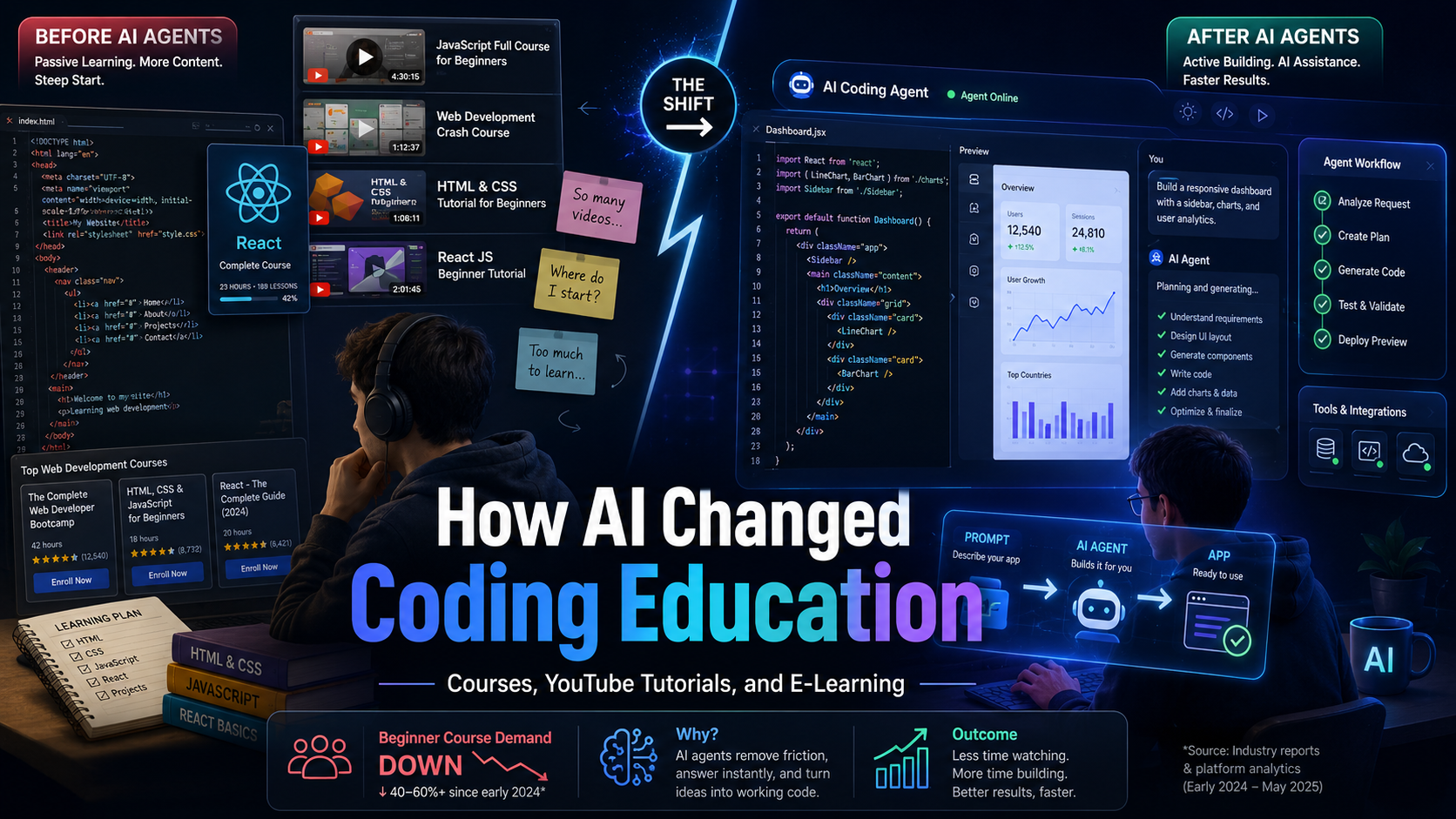
Introduction
For most of the last decade, learning web development followed a predictable path.
A beginner would search YouTube for an HTML, JavaScript, or React tutorial. They would watch someone build a to-do app, weather app, portfolio website, or e-commerce interface. When they wanted more structure, they would purchase a course on Udemy, subscribe to Codecademy, join a bootcamp, or follow a multi-month curriculum.
The fundamental promise was simple:
Watch someone write code, copy what they do, complete several projects, and eventually become capable of building software independently.
This model created an enormous online education industry.
YouTube became filled with programming tutorials. Entire creator businesses were built around React, JavaScript, Python, Node.js, CSS, and full-stack development. Course platforms accumulated thousands of programming courses, often competing on length, price, instructor reputation, project count, and how recently the course had been updated.
Then AI changed the learning process.
ChatGPT began that transition in late 2022 by giving programmers an interactive place to ask questions, generate examples, and debug errors. But the larger shift arrived in 2025, when AI coding agents moved from experimental tools into mainstream developer products.
Anthropic released Claude Code as a research preview in February 2025 and made it generally available in May. OpenAI introduced its cloud-based Codex software engineering agent on May 16, 2025. GitHub expanded Copilot from code completion and chat into agent modes capable of planning, editing multiple files, running commands, and iterating on errors. Cursor also increasingly positioned itself around agents rather than simple autocomplete.
By the middle of 2025, AI was no longer merely answering coding questions.
It was writing features, creating files, running tests, reading repositories, fixing errors, refactoring applications, and generating pull requests.
That changed the economics of learning programming.
A beginner no longer had to watch a three-hour React tutorial before seeing an application work. They could describe the application to an agent and receive a functioning starting point within minutes.
They no longer had to search through ten Stack Overflow answers to understand an error. They could paste the error into an AI assistant and ask for an explanation specifically based on their code.
They no longer had to wait for an instructor to publish an updated course whenever a framework changed. They could ask an AI model about the current version, request a migration, or regenerate the implementation.
The result was not the end of programming education.
It was the weakening of the traditional beginner coding course.
Demand moved away from passive, linear, syntax-first education and toward interactive, project-based, AI-assisted learning.
This transition has affected YouTube creators, course marketplaces, platforms such as Udemy and Codecademy, independent instructors, coding bootcamps, and the expectations beginners have when they decide to learn programming.
The Previous Golden Age of Online Coding Tutorials
Between roughly 2015 and 2024, web development was one of the strongest categories in online education.
Several conditions supported that growth.
Web development had a clear entry path
The typical learning sequence was easy to understand:
Learn HTML.
Learn CSS.
Learn JavaScript.
Learn React.
Learn Node.js or another back-end technology.
Build portfolio projects.
Apply for junior developer positions.
The reality was always more complicated, but the roadmap was simple enough to market.
A course creator could publish titles such as:
Complete JavaScript Course
React From Beginner to Advanced
Full-Stack Web Development Bootcamp
Build Ten Projects With React
Become a Web Developer in Six Months
Students understood what they were buying.
Framework tutorials had strong recurring demand
Frameworks changed frequently, creating a constant need for updated content.
When React released new patterns, when Next.js changed its routing system, or when a library introduced a new API, creators could publish another tutorial.
A new version often made the previous course appear outdated, even when most fundamentals remained the same.
This created a powerful content cycle:
A framework changed.
Developers searched for explanations.
Creators published tutorials.
Students purchased updated courses.
The framework changed again.
React became especially important within this system.
For several years, learning React was treated almost as a default step for anyone entering front-end development. YouTube accumulated countless React crash courses, project builds, portfolio tutorials, interview guides, state-management explanations, and complete multi-hour classes.
Video had an advantage over documentation
Official documentation could explain what an API did, but video showed the process.
Students could watch an experienced developer organize folders, name components, debug errors, style interfaces, and connect an application to an API.
The instructor was not merely transferring information. The instructor was demonstrating the workflow.
This was extremely valuable before AI assistants could provide personalized explanations.
Courses organized an overwhelming field
The internet already contained most of the information someone needed to learn programming.
The problem was organization.
A good course selected the right concepts, arranged them in a logical order, provided exercises, and removed the need to decide what to learn next.
That structure justified paying for information that was technically available for free.
Why Mid-2025 Became the Inflection Point
AI had been generating code before 2025. GitHub Copilot launched years earlier, and ChatGPT was already widely used by developers.
However, early AI coding tools were primarily assistants.
They completed lines, generated functions, explained errors, or responded to questions. The developer still controlled most of the workflow manually.
Agentic development changed the unit of work.
Instead of asking:
How do I create a React form?
A user could ask:
Create a responsive registration page using React and TypeScript. Add validation, connect it to the existing authentication service, display API errors, and write tests.
The agent could inspect the project, identify relevant files, create components, update services, execute tests, encounter failures, and attempt corrections.
The difference was not merely better code generation.
The difference was delegated execution.
This is why the middle of 2025 represents an important turning point. Claude Code, Codex, GitHub Copilot’s agent capabilities, and Cursor’s agent workflows made the idea of delegating substantial development tasks visible to ordinary developers.
Agent adoption was not yet universal. Stack Overflow’s 2025 survey found that a majority of developers either did not use agents or continued using simpler AI tools. But the category itself had clearly entered mainstream developer discussion. The same survey found that 84% of respondents were already using or planning to use AI tools in development.
In other words, AI coding agents became mainstream as a product category before they became universally used.
That was enough to reshape education.
Course creators could no longer assume that a beginner would spend several weeks manually building basic interfaces before seeing a meaningful result.
The learner’s expectations had changed.
The Old Learning Loop Versus the New Learning Loop
The traditional learning loop looked something like this:
Watch a tutorial.
Copy the instructor’s code.
Encounter an error.
Rewatch the relevant section.
Search Google or Stack Overflow.
Copy a possible solution.
Continue the tutorial.
Repeat the process in another project.
The new AI-assisted loop is different:
Describe what you want to build.
Ask an AI agent to create a starting implementation.
Run the application.
Ask the AI to explain unfamiliar sections.
Request changes.
Review the result.
Debug problems with the AI.
Continue refining the same project.
The traditional model begins with concepts and slowly moves toward an outcome.
The AI-assisted model often begins with an outcome and works backward toward understanding.
That reversal has major consequences.
A beginner may see a functioning product before understanding the syntax used to create it. This can be motivating because the learner reaches a visible result quickly.
It can also be dangerous because the application may contain code the learner cannot evaluate.
Nevertheless, the experience feels more productive than watching an instructor type code for several hours.
Once learners experience that level of interaction, returning to a completely passive course becomes difficult.
Why AI Reduced Demand for Beginner Coding Courses
There is no single public dataset proving that AI alone caused a specific percentage decline in beginner coding course purchases.
Course platforms combine many categories, rarely disclose revenue by individual subject, and are affected by pricing changes, subscriptions, competition, economic conditions, and changes in consumer spending.
However, several structural reasons explain why traditional beginner courses became less attractive.
1. AI Became an On-Demand Personal Tutor
A recorded instructor explains one version of a concept to every student.
An AI assistant can explain the same concept in multiple ways.
A learner can ask:
Explain this like I am completely new to programming.
Show me a smaller example.
Compare this React pattern to normal JavaScript.
Explain every line.
Why is my version producing an error?
Give me an exercise without revealing the answer.
Review my solution.
Translate this explanation into my language.
A recorded course cannot respond when a learner becomes confused.
The learner either understands the lesson or searches for another explanation.
AI reduces that friction.
This does not mean the AI explanation is always correct. It means the learner receives immediate, personalized feedback, which was previously difficult to provide at scale.
2. AI Compresses the Time Between an Idea and a Result
Traditional courses require delayed gratification.
A student might spend hours learning variables, arrays, objects, functions, modules, components, hooks, routing, APIs, and state management before building something that resembles a real product.
AI allows the student to begin with the product.
Someone can describe a dashboard, marketplace, task manager, portfolio, booking application, or internal business tool and quickly receive a basic implementation.
The result may be incomplete or poorly structured, but it exists.
That changes the beginner’s question from:
How do I learn everything required to build this?
To:
How do I improve, understand, and control what the AI created?
The second question creates a different education market.
3. Syntax Became Less Valuable as a Product
Many beginner courses dedicate substantial time to syntax.
They teach how to write loops, create arrays, declare functions, build components, pass properties, handle events, and call APIs.
These concepts remain important.
But memorizing the exact syntax has become less valuable because AI can generate it instantly.
The learner still needs to understand what the code does, when to use it, and whether it is correct. However, the need to remember every method or framework option has declined.
A course that primarily demonstrates syntax is now competing against a nearly instant generator.
That is an uncomfortable competitive position.
4. AI Can Adapt to the Learner’s Actual Project
Traditional tutorials usually teach through generic applications:
To-do lists
Weather applications
Movie search tools
Expense trackers
Recipe applications
E-commerce interfaces
Social media clones
These projects were never the learner’s real objective.
They were substitutes designed to demonstrate concepts.
An AI assistant can work directly on the learner’s idea.
Someone who wants to build software for a local restaurant, property management business, marketing agency, personal finance workflow, or online store no longer needs to complete five unrelated tutorial projects first.
They can begin with their actual use case.
Personal relevance makes the AI-assisted experience more compelling than a generic course project.
5. Framework Updates Made Recorded Content More Fragile
Programming courses have always become outdated.
A library changes its configuration. A framework replaces an API. A deployment platform modifies its interface. A package is deprecated. A command no longer works.
Before AI, students had to search comments, discussion forums, or newer tutorials to resolve these differences.
Now they can show the outdated code to an AI model and ask for a version compatible with the current environment.
This weakens one of the strongest reasons to purchase a new version of a beginner course.
The value can no longer depend primarily on showing the newest syntax.
The course must provide something deeper.
6. The Perceived Cost of Experimentation Fell
Before AI coding agents, starting a software project required a minimum level of technical confidence.
A beginner had to know how to initialize the project, install dependencies, create the structure, connect services, and interpret errors.
AI lowered that threshold.
People who would previously have purchased a course before attempting a project may now attempt the project first.
Some will eventually return to structured education after encountering complexity. Others will continue by asking the AI for each next step.
Either way, the purchase decision happens later.
That alone reduces impulse demand for introductory courses.
What Happened to React Tutorials on YouTube?
React tutorials illustrate the change particularly well.
For years, React was one of the largest web-development education categories. It had strong search demand, frequent updates, a large employment ecosystem, and an endless supply of project ideas.
The classic YouTube formula was effective:
Learn React by building this application from scratch.
The instructor would create the project, explain components, add state, connect an API, implement routing, and deploy the result.
AI agents disrupted that format because scaffolding a React application is one of their most visible capabilities.
A learner can now request:
Create a responsive React dashboard with authentication, a collapsible sidebar, charts, loading states, and a Firebase back end.
The agent may generate a large portion of the structure immediately.
This does not mean React knowledge is unnecessary.
React applications still require decisions about architecture, rendering, state management, performance, accessibility, security, testing, APIs, data consistency, and long-term maintenance.
But a video whose main value is showing how to type the initial components now provides less value.
The valuable React educator of the AI era must explain:
Why one architecture is better than another
How to review AI-generated components
How to detect unnecessary complexity
How to manage application state
How to prevent performance problems
How to design secure authentication flows
How to test generated code
How to migrate a real application
How to maintain a large codebase
How to give an agent useful project context
The market is moving from typing demonstrations toward engineering judgment.
YouTube Coding Creators Are Not Disappearing
It would be wrong to conclude that YouTube is no longer important for people learning programming.
Stack Overflow’s 2025 developer survey found that respondents learning to code used YouTube as a community platform more frequently than professional developers, at 70% compared with 60%.
Video remains valuable because learners want to see how experienced people think.
They want opinions, comparisons, reassurance, community, personality, and real-world demonstrations.
What changed is the kind of video that attracts attention.
Traditional videos often focused on questions such as:
How do you create a React component?
How do you use a JavaScript array?
How do you connect to an API?
How do you build a navigation menu?
The newer generation increasingly focuses on:
Which AI coding tool is best?
How should developers use agents?
What are the risks of vibe coding?
How do you review AI-generated code?
Can an agent build a complete application?
Which development skills still matter?
How do you combine Claude Code, Codex, Copilot, or Cursor?
How do you build an AI agent?
How do you add AI features to an existing product?
Popular education brands have already adapted.
FreeCodeCamp published courses and handbooks on building AI coding agents, creating agent systems, and becoming effective at AI-assisted development. Its AI-assisted coding curriculum includes GitHub Copilot, agent modes, Claude Code, Gemini, and complete AI-supported workflows.
Web Dev Simplified published material specifically addressing how developers use AI and the mistakes they make when incorporating it into application development. Fireship increasingly covered AI coding products, agents, model launches, and how AI platforms could reshape the development stack.
This is not evidence that every established creator abandoned conventional tutorials.
It shows that the center of attention moved.
The successful programming creator is becoming less like a digital textbook and more like an analyst, reviewer, project leader, and guide to working with intelligent tools.
What Happened to Udemy?
Udemy provides one of the clearest examples of how demand is changing rather than simply disappearing.
The company reported that its total consumer segment revenue declined 9% in 2025. Monthly average buyers also declined slightly, and fourth-quarter consumer revenue was down 14% year over year.
However, Udemy explicitly connected part of this change to its strategy of moving consumers away from individual transactional course purchases and toward recurring subscriptions.
At the same time, consumer subscription revenue increased 44%, and the company ended 2025 with 343,000 paid consumer subscribers.
Most importantly, enrollment in AI-related content grew 120% during 2025, with learners spending more than 700 million minutes developing AI skills.
These numbers should be interpreted carefully.
They do not prove that AI caused people to stop purchasing JavaScript or React courses.
Udemy changed its business model, prioritized subscriptions, expanded its enterprise offering, and operated within a broader shift in consumer spending.
But the direction is revealing.
Demand for online learning still exists.
What people want to learn, how they want to access it, and how they want to pay for it are changing.
A learner who previously purchased separate courses on JavaScript, React, Node.js, and deployment may now prefer a subscription that provides access to constantly changing material across AI tools, programming languages, cloud platforms, and business skills.
The shelf life of a single course is shorter.
A subscription is better suited to a market where the relevant tools can change within months.
Udemy is therefore not only competing with other course marketplaces.
It is competing with ChatGPT, Claude, YouTube, documentation, interactive coding environments, AI-powered search, and the coding agent inside the learner’s editor.
What Happened to Codecademy?
Codecademy was designed around interactive learning.
Instead of only watching videos, learners wrote code inside guided environments and received immediate feedback.
That model should theoretically be more resistant to AI disruption than passive video courses.
Even so, Codecademy’s parent company, Skillsoft, reported changing demand within its consumer-oriented Learner Platform.
In its fiscal 2026 annual reporting, Skillsoft said revenue in its Talent Development Solutions segment decreased primarily because of lower consumer revenue associated with its Learner Platform. It also referred to updated expectations regarding demand trends and customer purchasing behavior in the digital learning market.
The Learner Platform had approximately 59 million registered learners, but Skillsoft did not publicly isolate enough financial detail to attribute the revenue movement specifically to AI or to Codecademy alone.
What is more revealing is how the product changed.
Skillsoft described the integration of generative AI into the Learner Platform, including:
An AI code generator
AI-generated explanations
Contextual project hints
An intelligent hint system
A virtual coding assistant
Real-time personalized guidance
The platform is effectively acknowledging that a modern coding learner expects AI to be present inside the educational experience.
This is the larger lesson.
An interactive learning platform can no longer provide only prewritten instructions and fixed validation.
It must respond to the learner.
It must understand the learner’s current code, explain the specific mistake, adapt the difficulty, and help the student move forward without immediately revealing everything.
In other words, traditional e-learning is becoming AI tutoring.
Why AI Has Not Eliminated the Need to Learn Programming
The strongest argument against traditional coding education is that AI can already produce substantial amounts of code.
The strongest argument for programming education is that AI often produces code that looks correct while containing subtle problems.
Stack Overflow’s 2025 survey found that 84% of respondents were using or planning to use AI tools. Yet 46% actively distrusted the accuracy of AI output, compared with 33% who trusted it.
Only 3% said they highly trusted AI output.
The survey also found that 66% of developers were frustrated by AI solutions that were almost correct but not completely correct. Another major frustration was spending additional time debugging AI-generated code.
This creates the central contradiction of AI-assisted programming:
AI makes it easier to generate code while increasing the importance of knowing whether that code is good.
A complete beginner can now produce a larger application than before.
But the beginner may not know:
Whether authentication is secure
Whether private data is exposed
Whether database rules are correct
Whether the application can scale
Whether dependencies are trustworthy
Whether the code is accessible
Whether error handling is sufficient
Whether tests cover meaningful behavior
Whether the architecture will become difficult to maintain
Whether the AI invented an API or configuration option
Whether a generated migration could destroy data
Whether the code solves the actual business requirement
AI reduces the barrier to production.
It does not remove production responsibility.
This is why the future is unlikely to belong entirely to people who cannot code or entirely to programmers who refuse to use AI.
It will belong to people who combine technical understanding with effective AI delegation.
Tutorial Hell Is Being Replaced by AI Dependency
Traditional programming education had a well-known problem called tutorial hell.
A learner could complete one tutorial after another without becoming capable of building something independently.
The student felt productive while following instructions but became stuck as soon as the instructor disappeared.
AI may reduce traditional tutorial hell, but it introduces a similar risk.
A learner can repeatedly ask an agent to:
Add the next feature
Fix the next error
Create the next component
Write the next query
Configure the next service
Deploy the next version
The product grows, but the learner’s understanding may not.
This is AI dependency.
The symptoms are similar to tutorial dependency:
The learner cannot explain the code.
The learner cannot make changes without assistance.
The learner does not recognize incorrect output.
The learner has no mental model of the system.
The learner cannot debug when the agent becomes stuck.
The learner accepts unnecessary complexity.
The learner cannot estimate risk.
The difference is speed.
Tutorial dependency might produce a small copied application.
AI dependency can produce a large, complex application that appears ready for real users.
That makes the educational problem more serious.
The New Value of a Programming Course
A programming course can no longer justify its existence merely by transferring information.
Information is abundant.
Code generation is immediate.
Basic explanations are available on demand.
The new course must provide structure, judgment, practice, and verification.
It must teach the fundamentals that AI hides
Students still need to understand:
Variables and data types
Functions and control flow
Data structures
Asynchronous operations
State
APIs
Databases
Authentication
Security
Testing
Version control
Deployment
System architecture
Performance
Debugging
The difference is that these concepts should be taught in the context of AI-assisted work.
It must teach students how to review generated code
Reviewing AI output is becoming a core development skill.
Students should learn to ask:
Does this code satisfy the requirement?
Is there a simpler approach?
What assumptions did the model make?
What data can the user control?
What happens when the API fails?
Is this logic duplicated?
Are the tests meaningful?
Could this expose private information?
Does this create unnecessary dependencies?
How will this behave at a larger scale?
It must include controlled difficulty
A useful learning system should not solve every problem immediately.
Sometimes the student needs a hint rather than a complete answer.
Sometimes the AI should ask the learner to predict what will happen.
Sometimes the learner should debug manually.
Sometimes the learner should compare two implementations.
The objective is not maximum generation speed.
The objective is durable understanding.
It must use real projects
Generic projects are still helpful for isolated concepts, but advanced learning should connect to realistic applications.
Students should encounter:
Incomplete requirements
Changing requirements
Legacy code
Authentication problems
Data migrations
Failing tests
Performance issues
Deployment failures
Third-party APIs
Security constraints
User feedback
These are the areas where software engineering becomes more than typing code.
What Programming Learners Should Focus on in 2026
Someone beginning programming today should not learn exactly as someone did in 2018.
But skipping all fundamentals would also be a mistake.
A stronger learning path would combine four layers.
Layer 1: Learn basic programming logic
A beginner should understand values, conditions, loops, functions, collections, errors, input, output, and asynchronous behavior.
They do not need to memorize every method.
They need a mental model of how instructions become behavior.
Layer 2: Build with AI from the beginning
AI should not be treated as something added after learning programming.
It is part of the modern development environment.
Students should learn how to provide context, divide tasks, request explanations, review changes, use version control, and revert bad output.
Layer 3: Rebuild important pieces manually
After an agent generates a feature, the learner should sometimes recreate a smaller version without assistance.
This reveals whether the concept was actually understood.
Manual implementation remains valuable as an educational exercise even when it is no longer the fastest production method.
Layer 4: Learn engineering judgment
The most durable skills involve decisions:
Which solution is appropriate?
Which trade-off is acceptable?
What should be tested?
What could fail?
What creates security risk?
What belongs in the client or server?
What data model will remain maintainable?
When should the AI be trusted?
When should the developer stop and investigate?
These questions remain difficult even when code generation becomes nearly free.
The Future of YouTube Programming Education
YouTube coding education will probably become more polarized.
At one end, there will still be beginner tutorials for people who prefer human explanations, complete learning paths, and visual demonstrations.
At the other end, creators will produce increasingly advanced content about architecture, AI workflows, agents, production problems, security, and real-world engineering.
The middle category may struggle most.
A generic two-hour tutorial that builds a standard application without offering a unique teaching method, strong personality, community, credential, or advanced insight is easy to replace.
Future creators will need to offer something AI cannot easily reproduce:
A trusted point of view
Real professional experience
Honest tool comparisons
Production case studies
Live debugging
Code reviews
Community interaction
Accountability
Curated learning paths
Taste and judgment
Explanations of why a solution failed
Long-term updates to a real application
The creator is no longer only the source of the code.
The creator is the source of confidence about the code.
The Future of Udemy, Codecademy, and E-Learning Platforms
Large learning platforms still have several important advantages.
They can provide assessments, credentials, progress tracking, enterprise administration, curated pathways, practice environments, community, and access to recognized instructors.
But their products must become more adaptive.
A static course catalog is less defensible when learners can ask an AI assistant to create a personalized curriculum in seconds.
The strongest platforms will combine:
High-quality human instruction
Interactive exercises
AI tutoring
Personalized recommendations
Code-aware hints
Skills assessments
Real projects
Human-reviewed credentials
Community and mentorship
Enterprise reporting
Frequently updated content
The course itself may become only one component.
The larger product will be a learning environment that understands the learner’s objectives, observes their work, identifies gaps, and generates the next appropriate challenge.
Did AI Kill Coding Courses?
No.
But it weakened a specific product:
The long, passive, beginner course whose primary value is watching another person type code that an AI agent can now generate immediately.
That product will not disappear completely. Some learners prefer structured video, and human teaching remains powerful.
However, its economic position has changed.
Before AI, the alternative to purchasing a course was often hours of fragmented searching.
After AI, the alternative is an interactive assistant available inside the coding environment.
That is a much stronger competitor.
Course platforms and creators must therefore sell more than access to explanations.
They must sell direction, verification, judgment, practice, community, and proof of competence.
The Larger Shift: From Learning to Write Code to Learning to Direct Software Creation
Programming education was historically organized around writing code.
The learner’s progress was measured by how much syntax they understood and how independently they could produce an implementation.
AI agents are shifting the objective.
Developers increasingly need to:
Define requirements
Communicate constraints
Provide context
Break work into tasks
Review generated changes
Detect incorrect assumptions
Test behavior
Protect data
Control complexity
Integrate multiple systems
Maintain the result over time
These are not less technical responsibilities.
In many cases, they require more understanding.
The mechanical portion of coding becomes easier, while the responsibility for the complete system remains.
Programming education must reflect that reality.
Conclusion
AI coding agents did not make learning programming irrelevant.
They made the old method of teaching programming less competitive.
The beginner coding course was built for a world where creating software required manually producing nearly every line. YouTube tutorials, Udemy courses, Codecademy lessons, and bootcamps helped learners cross that enormous initial barrier.
AI lowered the barrier.
A beginner can now create applications, add features, and fix errors before understanding the technologies involved.
That reduces demand for courses focused on syntax and repetitive project walkthroughs.
At the same time, it creates demand for a more important kind of education.
Learners need to understand what the AI produced. They need to review it, test it, secure it, improve it, and take responsibility for it.
Platforms such as Udemy and Codecademy are already shifting toward AI content, subscriptions, personalized guidance, code generation, contextual hints, and interactive assistance. YouTube creators are moving toward tool analysis, AI workflows, architecture, reviews, and the practical realities of AI-assisted development.
The programming course of the future will not ask students to choose between learning to code and using AI.
It will teach them how to do both.
The winners in programming education will be the creators and platforms that understand this distinction:
AI can generate code.
Education must create understanding.
Frequently Asked Questions
Has AI reduced demand for beginner coding courses?
AI has likely reduced demand for traditional syntax-first and project-following courses because learners can now receive personalized explanations, generate starting projects, and debug errors instantly. However, there is no single public dataset that isolates AI as the only cause of declining course purchases.
Demand is shifting toward AI-assisted development, practical projects, architecture, code review, and advanced problem-solving.
Are people still learning programming through YouTube?
Yes. YouTube remains an important learning and community platform, especially for people learning to code.
What is changing is the type of content people watch. Interest is moving from basic syntax tutorials toward AI coding tools, real-world projects, architecture, debugging, career guidance, and methods for reviewing generated code.
Did AI replace Udemy programming courses?
No. Udemy continues to operate a large consumer and enterprise learning business.
However, its consumer business is moving from individual course purchases toward subscriptions, while enrollment in AI-related content increased significantly during 2025. This suggests that demand is changing in both subject matter and purchasing model.
How has Codecademy responded to AI?
Codecademy’s broader Learner Platform has integrated AI-powered features such as code generation, contextual explanations, project hints, intelligent assistance, and real-time guidance.
This reflects the transition from fixed, prewritten lessons toward adaptive AI-supported learning.
Is learning React still useful when AI can generate React applications?
Yes.
AI can scaffold components and generate common application patterns, but developers still need to understand state, rendering, architecture, performance, accessibility, security, APIs, testing, and maintenance.
React knowledge is becoming less about memorizing syntax and more about evaluating and controlling complete applications.
Can someone become a developer by using AI without learning to code?
Someone can build basic software with AI without deeply understanding programming.
However, creating reliable production software requires the ability to evaluate output, diagnose failures, protect data, understand architecture, test behavior, and maintain the system.
AI can reduce how much code a person writes manually. It does not remove responsibility for what the code does.
What should modern programming courses teach?
Modern programming courses should combine fundamentals with AI-assisted development.
They should teach students how to generate code, review it, test it, detect errors, manage context, use version control, understand architecture, protect security, and solve real-world problems.
Will coding tutorial creators lose their audiences?
Creators who rely entirely on generic beginner walkthroughs may face more pressure.
Creators who provide trusted opinions, real experience, code reviews, production examples, communities, updated learning paths, and guidance on AI-assisted workflows can remain highly valuable.