
Which AI Company Is Best at What? 10 AI Use Cases Compared in Mid 2026
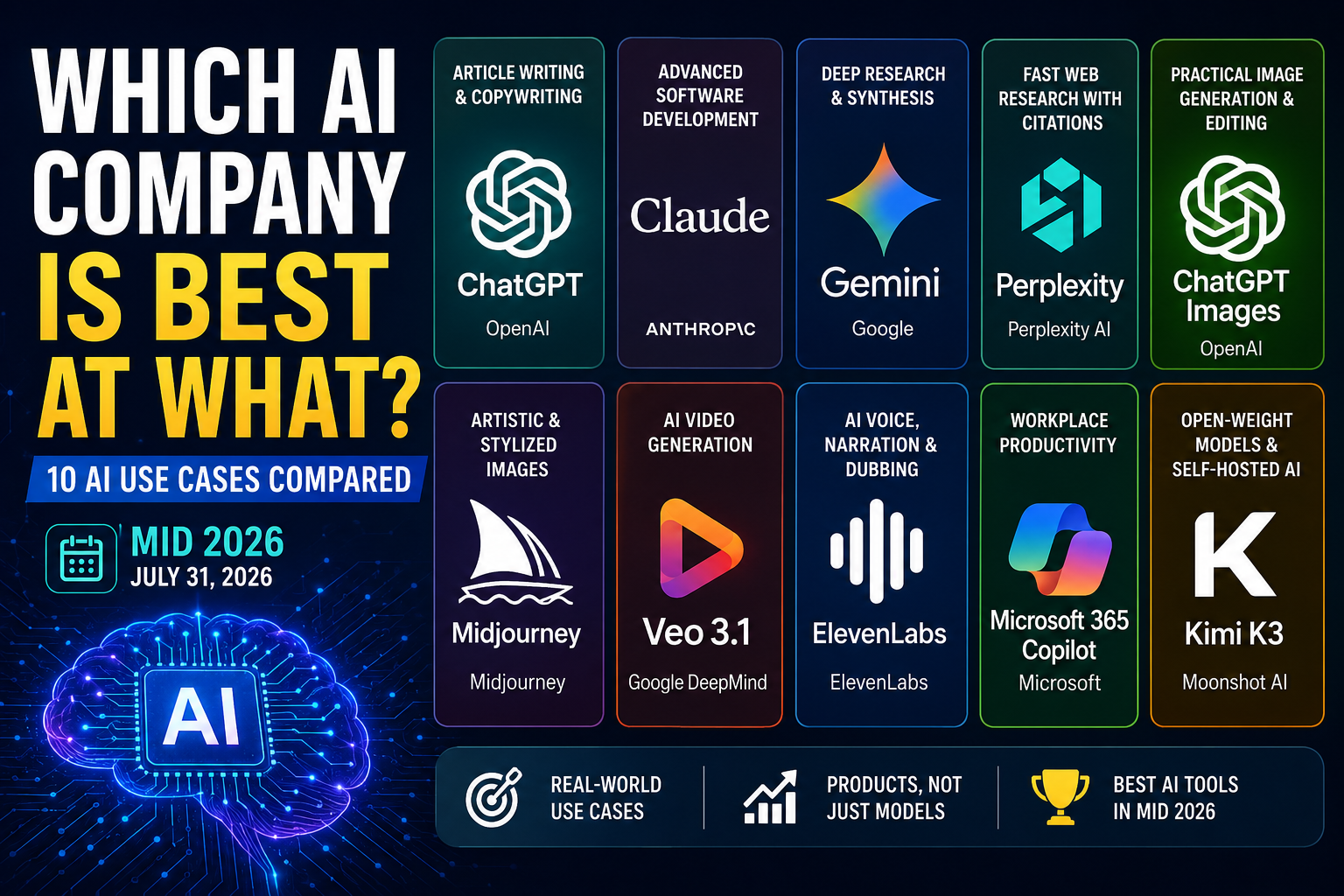
There is no longer one simple answer to the question, “Which is the best AI?”
ChatGPT may be the strongest overall product for writing and content production. Claude may be the better choice for advanced software development. Gemini has a strong case for deep research. Perplexity remains one of the fastest ways to investigate current information with visible sources. Midjourney still specializes in highly aesthetic images, while ElevenLabs has built one of the most complete platforms around AI-generated voices.
The AI market is becoming specialized.
The largest AI companies are no longer competing only to build the smartest general-purpose model. They are building complete products, workflows, integrations and ecosystems around particular types of work.
That distinction matters because the model with the highest score on a benchmark is not necessarily the best product for a real user.
A coding model also needs a capable coding agent, repository access, reliable file editing and a strong understanding of large software systems.
A writing model needs more than good prose. It benefits from research, file uploads, editing tools, persistent project context, images and easy repurposing.
An image model needs more than beautiful generations. It also needs prompt accuracy, readable text, editing and a practical revision process.
A workplace assistant may not have the single strongest underlying model, but it can still be the best choice when it understands a company’s emails, documents, meetings, permissions and internal systems.
This comparison therefore evaluates complete AI products, not only isolated model benchmarks.
It represents the market as of July 31, 2026. These winners will not remain permanent. The AI industry changes quickly enough that one major release can shift a category within weeks.
The Best AI for Each Use Case in Mid-2026
| Use case | Winner | Company | Why it wins |
|---|---|---|---|
| Article writing and copywriting | ChatGPT | OpenAI | Best complete content-production environment. |
| Advanced software development | Claude | Anthropic | Strongest combination of codebase understanding and agentic coding. |
| Deep research and large-scale synthesis | Gemini | Excellent long-horizon research and large-context capabilities. | |
| Fast web research with citations | Perplexity | Perplexity AI | Search-first experience with clear, visible sources. |
| Practical image generation and editing | ChatGPT Images | OpenAI | Strong prompt adherence, readable text and conversational editing. |
| Artistic and highly stylized images | Midjourney | Midjourney | Strongest specialization in aesthetics and visual style. |
| AI video generation | Veo 3.1 | Google DeepMind | Best overall combination of video quality, native audio, controls and production ecosystem. |
| AI voice, narration and dubbing | ElevenLabs | ElevenLabs | Most complete specialized platform for AI speech, narration and localization. |
| Workplace productivity inside business software | Microsoft 365 Copilot | Microsoft | Deepest integration with workplace data, documents, email and collaboration tools. |
| Open-weight models and self-hosted AI | Kimi K3 | Moonshot AI | Strongest current open-weight frontier model for coding, agents, reasoning and long context. |
How These Winners Were Selected
The rankings consider ten factors:
Final output quality
Reliability over repeated use
Product design and workflow
Ease of revising the result
Context and memory
Available integrations
Specialized features
Speed and usability
Ecosystem maturity
Suitability for real professional work
This is not a list of the ten highest-scoring language models.
It is a comparison of which AI company currently offers the best product for a specific job.
That is why the same company can win more than one category. There is no reason to award every category to a different company simply to make the list look more diverse.
OpenAI, for example, can reasonably win both content production and practical image generation. The company has integrated these capabilities into one environment rather than treating them as isolated tools.
The opposite is also true. A smaller specialist can defeat a trillion-dollar technology company within a narrowly defined use case.
ElevenLabs does not need to build the best general-purpose chatbot to lead AI voice generation. Midjourney does not need to create enterprise productivity software to remain a leading artistic-image platform.
Specialization is increasingly important.
1. Best AI for Article Writing and Copywriting: ChatGPT
Winner: OpenAI with ChatGPT
ChatGPT is the best overall AI product for article writing, copywriting and complete content-production workflows in mid-2026.
This does not mean it produces the most beautiful first draft in every comparison.
Claude can sometimes write prose that feels more restrained or naturally human. Gemini may be useful when the article depends heavily on Google-connected research. Perplexity is excellent for quickly locating sources.
ChatGPT wins because it combines more of the complete production process inside one environment.
A professional content workflow may include:
Finding and validating a topic
Researching current information
Analyzing uploaded documents
Developing the argument
Producing an outline
Writing a long-form draft
Editing individual sections
Changing tone and reading level
Creating tables
Generating a meta description
Producing a thumbnail
Exporting the document
Repurposing the article for social media
ChatGPT Projects can preserve chats, files and custom instructions around a continuing body of work. OpenAI describes Projects as persistent workspaces suited to recurring activities such as writing, research and planning. Canvas adds a dedicated editing interface where users can select specific passages, request revisions, adjust length and export documents into formats including Word, PDF and Markdown.
That combination makes ChatGPT more than a text generator.
It can function as a content-production workspace.
A company can create a Project containing its writing guidelines, audience information, existing articles, brand positioning, products, research documents and previous campaigns. New articles can then be developed inside that context instead of beginning with an empty prompt every time.
ChatGPT also connects writing with image creation. A writer can complete the article, develop several thumbnail concepts and generate the final image without transferring the project to another platform.
That integrated workflow is the main reason ChatGPT wins this category.
Where ChatGPT is strongest
ChatGPT is particularly effective for:
SEO articles
Business blog posts
Landing-page copy
Email campaigns
Social-media repurposing
Article research
Content calendars
Product descriptions
Structured comparisons
Documents that combine text, images and data
Where ChatGPT can lose
ChatGPT can still produce generic writing when the request lacks clear instructions, original information or a strong argument.
It is not a substitute for having something meaningful to say.
Claude may produce the stronger first draft for reflective essays, sophisticated opinion pieces or writing that requires a particularly restrained tone.
Perplexity may be faster for a source-heavy research brief.
However, when the use case includes the entire process from idea to publishable article, ChatGPT currently offers the strongest overall product.
2. Best AI for Advanced Software Development: Claude
Winner: Anthropic with Claude
For advanced software development, Claude is the strongest choice in mid-2026.
The key word is advanced.
Many leading models can produce a small component, explain an error message, write a database query or generate a simple application. The differences become more visible when the work involves:
A large existing repository
Multiple interconnected files
An unfamiliar architecture
Long-running implementation tasks
Complex debugging
Refactoring without breaking existing behavior
Front-end work that must match a design
Infrastructure changes
Production risk
Following detailed instructions across many steps
Anthropic released Claude Opus 5 on July 24, 2026. Its platform documentation lists a one-million-token context window and up to 128,000 output tokens, giving it substantial room for large repositories, specifications and long implementation sessions. Anthropic has also continued developing Claude Code as a dedicated coding-agent product rather than treating coding as only another chatbot capability.
Claude’s advantage is not simply that it can generate code.
It is often better at maintaining a coherent mental model of the system while working.
Advanced development requires understanding why the existing code was written a particular way, which parts of the application depend on it and what could fail after a change.
The hardest software tasks rarely involve creating one isolated function. They require navigating constraints.
A senior developer may ask an agent to:
Trace a bug across the front end, API and database
Replace a deprecated framework pattern
Migrate authentication without breaking existing users
Rebuild a feature while preserving data compatibility
Implement a design across desktop and mobile layouts
Reduce performance problems across a large application
Understand code written over several years
Review an architecture before making changes
Claude performs especially well when the instructions are detailed and the task requires sustained reasoning over many files.
Why not automatically choose the highest benchmark score?
Coding benchmarks are useful, but they do not fully represent software development.
A benchmark may measure whether a model resolved a specific repository issue. The result can also depend heavily on the agent harness, available tools, reasoning settings and test environment.
Real professional development includes ambiguous requirements, design judgment, architecture, communication and the ability to avoid damaging code that already works.
Claude wins this category based on the complete development experience, not one isolated score.
Where Claude can lose
OpenAI Codex can be highly competitive for autonomous coding, implementation speed and tasks that fit naturally into its agent environment.
Gemini can be attractive for developers already using Google Cloud, Firebase or Google’s broader developer platform.
Open models may be preferable when a company requires local deployment or complete infrastructure control.
Claude is also not always the most cost-efficient option for repetitive or low-complexity coding tasks.
For advanced repository-level work, however, Anthropic currently offers the strongest combination of model capability, long context and coding-agent design.
3. Best AI for Deep Research and Large-Scale Synthesis: Gemini
Winner: Google with Gemini
Google Gemini is the strongest choice for deep research in mid-2026.
Research is a broad category, so it is important to define what this means.
Gemini wins when the task requires:
Investigating a complex question
Searching across many sources
Reading large document collections
Comparing conflicting claims
Creating a structured report
Analyzing scientific information
Producing charts or visualizations
Working across private and public sources
Maintaining a long research process
Google introduced Deep Research Max in April 2026, powered by Gemini 3.1 Pro. Google says the system supports long-horizon research across the web and custom sources, with MCP connectivity and native visualizations. Gemini’s wider ecosystem also connects naturally to Google products and research services.
Gemini’s large-context strengths are particularly relevant when the source material is too substantial for a normal chatbot session.
A research project may include hundreds of pages of company reports, academic papers, technical documentation, spreadsheets and current web sources.
The model must not only retrieve facts. It must identify the structure of the problem, distinguish stronger evidence from weaker evidence and produce a coherent final document.
A 2026 research benchmark covering expert consulting-style work compared Gemini 3.1 Pro Deep Research, OpenAI deep research and Claude with web search. The benchmark found that all systems still struggled with demanding professional research tasks, but Gemini achieved the highest acceptance rate among the three. The researchers also found that each system failed differently, emphasizing that even the current leaders require human verification.
That caveat is important.
“Best for research” does not mean “always correct.”
AI research agents can:
Misread sources
Omit important evidence
Use weak sources
Make arithmetic errors
Produce unsupported conclusions
Confuse publication dates with event dates
Generate citations that do not fully support a claim
Gemini wins because it currently offers one of the strongest combinations of long-context processing, research-agent capabilities, scientific support and integration with Google’s information ecosystem.
Where Gemini is strongest
Gemini is particularly attractive for:
Market research
Scientific research
Literature reviews
Large document collections
Competitive intelligence
Google Workspace research
Research involving charts and visual material
Long, structured reports
Where Gemini can lose
Perplexity provides a more direct and transparent experience for quick web research.
ChatGPT may be better when the research needs to become a polished article, presentation, spreadsheet or complete creative project.
Claude can be stronger at carefully reading a limited collection of supplied documents and turning them into a coherent analytical narrative.
Gemini wins deep research, but not every form of information retrieval.
4. Best AI for Fast Web Research With Citations: Perplexity
Winner: Perplexity AI
Perplexity is the best AI product for fast, source-led web research in mid-2026.
This category is different from deep research.
A user may not need a 30-page report, a large private document collection or a long-running analytical agent.
They may simply want to know:
What happened today?
What does this company currently charge?
Which product has a specific feature?
Is a claim circulating online accurate?
What are the best primary sources on a subject?
Which recent reports contain a particular statistic?
How do two current products compare?
Perplexity is designed around that behavior.
The product searches the web and presents a synthesized answer with visible citations to the underlying sources. Its interface encourages the user to open those sources, ask follow-up questions and continue refining the search.
Perplexity’s strength is not necessarily that it owns the single best underlying language model.
The platform can use models from multiple AI companies. Its advantage is the search product built around them.
The answer begins with retrieval rather than treating web search as an optional addition to a general chatbot.
Perplexity also released an Advanced Deep Research update in July 2026. The company says the system searches more sources, cross-references information, handles uploaded documents and includes an improved code environment for calculations and data analysis.
Why Perplexity is useful even when you subscribe to another AI
People often compare Perplexity with ChatGPT, Claude or Gemini as though they must choose only one.
In practice, Perplexity can serve as the discovery layer.
A researcher can use it to:
Identify the relevant sources
Understand the basic debate
Find primary documentation
Check whether information is current
Move the verified material into another AI for deeper writing or analysis
This is especially useful when the main danger is outdated information.
Where Perplexity can lose
A citation does not guarantee that the generated sentence accurately represents the source.
Users still need to open important citations.
Perplexity may also produce a thinner analytical narrative than Gemini Deep Research or a weaker polished document than ChatGPT.
For immediate web investigation, however, its search-first design remains difficult to beat.
5. Best AI for Practical Image Generation and Editing: ChatGPT Images
Winner: OpenAI with ChatGPT Images
ChatGPT is the best overall AI image product for practical users in mid-2026.
The word practical separates this category from purely artistic image generation.
A business user may need:
A blog thumbnail
A social-media graphic
A product mockup
A presentation visual
An infographic
A revised client image
A transparent background
A new version in another format
A graphic containing readable text
A visual that follows a detailed layout
OpenAI released ChatGPT Images 2.0 in April 2026, with an emphasis on improved precision and control. The product supports both generating new images and editing uploaded images through conversational instructions. Users can request text inside the image, transparent backgrounds and specific changes to existing visuals.
Independent blind-vote data also supports OpenAI’s position. As of July 2026, GPT Image 2 led Artificial Analysis’ text-to-image arena and its image-editing arena. These rankings are based on users comparing outputs without being told which model created them.
The product experience is as important as the raw image model.
A user can say:
Make the headline larger, remove the background object, change the interface to dark mode and produce a landscape version.
The model can apply those revisions within the existing conversation.
This is far more useful for business production than repeatedly starting from a new prompt.
Where ChatGPT Images is strongest
Editorial thumbnails
Marketing graphics
Image editing
Text inside images
Product concepts
Presentation visuals
Social-media content
Conversational revisions
Creating visuals alongside written content
Where ChatGPT Images can lose
Midjourney can still create more distinctive or sophisticated artwork.
Specialized design applications may provide better manual control over layers, typography and brand systems.
Professional photography, illustration and graphic design also remain valuable when originality, legal ownership, precision or a consistent human-created style matters.
ChatGPT wins the practical image workflow, not every artistic category.
6. Best AI for Artistic and Highly Stylized Images: Midjourney
Winner: Midjourney
Midjourney remains the best AI company for aesthetic, stylized and visually distinctive image generation in mid-2026.
This is the category where the objective is not simply to follow a layout accurately.
The user may want:
Concept art
Fashion imagery
Cinematic compositions
Surreal scenes
Editorial artwork
Visual world-building
Mood exploration
Sophisticated lighting
A distinctive artistic direction
Midjourney released Version 8.2 as its default model on July 24, 2026. The company says the update focuses on aesthetics, image quality and personalization, producing work that is more creative, bold and sophisticated while better understanding a user’s visual preferences.
Midjourney’s continued strength comes from specialization.
OpenAI, Google and other large AI companies must build models that satisfy many practical requirements.
Midjourney can focus intensely on visual taste.
Its generations often feel less like straightforward prompt execution and more like a strong creative interpretation of the prompt.
That can be a disadvantage when a user needs exact placement or predictable branding. It can be an advantage when the user wants the model to contribute visual imagination.
The difference between ChatGPT and Midjourney
Choose ChatGPT Images when you need:
Accuracy
Editing
Readable text
A business workflow
A thumbnail with a specific layout
Revisions through conversation
Choose Midjourney when you need:
Atmosphere
Style
A premium visual feeling
Conceptual imagery
Unexpected creative direction
Strong artistic interpretation
ChatGPT is the more complete production tool.
Midjourney remains the stronger artistic specialist.
7. Best AI for Video Generation: Kling AI
Winner: Kuaishou with Kling AI
Kling AI is the strongest overall AI video generator in mid-2026.
This is one of the most competitive and unstable categories in the entire AI industry.
Google Veo, Runway, Kling, Seedance, Hailuo and other video systems regularly overtake one another on particular benchmarks and prompt types.
Kuaishou launched Kling AI 3.0 in February 2026, including Video 3.0 and Video 3.0 Omni. The company emphasized stronger narrative control, consistency and multimodal orchestration rather than limiting the product to simple text-to-video clips.
Public video arenas in July 2026 placed Kling 3 among the leading text-to-video systems, with some current leaderboards ranking it first overall.
Kling’s strengths include:
Realistic movement
Image-to-video generation
Character consistency
Longer sequences
Camera movement
Visual storytelling
Multimodal controls
Native audiovisual generation in supported modes
The company has also developed specialized systems for motion control, including transferring detailed movement from a reference video onto another character while preserving identity and appearance.
Why this category is close
Google Veo remains a particularly strong alternative.
Veo 3.1 supports native audio, realistic motion and advanced controls such as first-and-last-frame guidance, object insertion and scene extension. Google also benefits from integrating Veo into Gemini, Flow, AI Studio and its wider creative ecosystem.
Runway may be the better platform for professional creators who need a broader production and editing workflow rather than only the strongest generation model.
Kling wins this snapshot because of its overall output quality, consistency and creative flexibility.
This is also one of the rankings most likely to change before the end of 2026.
8. Best AI for Voice, Narration and Dubbing: ElevenLabs
Winner: ElevenLabs
ElevenLabs is the clearest specialist winner on this list.
The company has built a broad audio platform covering:
Text-to-speech
Voice cloning
Voice design
Audiobook narration
Podcast production
Real-time voice agents
Speech-to-text
Sound effects
Music
Multilingual dubbing
Video localization
ElevenLabs currently offers thousands of voices across dozens of languages, with products covering both generated media and conversational voice agents.
The company introduced Dubbing v2 in May 2026.
Instead of generating a translated voice using only a written transcript, the model conditions on the original performance. It attempts to preserve tone, pacing, emotion and delivery across more than 90 languages.
That is an important improvement because accurate translation alone does not create convincing dubbing.
A speaker may sound excited, hesitant, sarcastic, tired, authoritative or emotional. Traditional automated dubbing often removes those characteristics.
ElevenLabs is attempting to carry the performance into the translated version.
Best use cases
ElevenLabs is particularly strong for:
YouTube narration
Audiobooks
International video localization
Podcasts
Advertising voiceovers
Training materials
Customer-support agents
Voice cloning with permission
Accessibility
Multilingual content distribution
Where ElevenLabs can lose
A general-purpose assistant may be more convenient for quickly reading a short response aloud.
Specialized music platforms may be better for complete song production.
Professional actors and audio engineers remain superior for work requiring unique performance, direction and legal clarity around voice ownership.
For scalable AI-generated speech and dubbing, however, ElevenLabs remains the leading specialist.
9. Best AI for Workplace Productivity: Microsoft 365 Copilot
Winner: Microsoft
Microsoft 365 Copilot is the best AI product for companies whose work already lives inside Microsoft’s ecosystem.
This includes organizations built around:
Outlook
Word
Excel
PowerPoint
Teams
SharePoint
OneDrive
Microsoft Graph
Microsoft identity and security systems
Microsoft’s advantage is context.
A separate chatbot may produce an excellent answer, but it does not automatically understand the organization’s meetings, documents, permissions, emails, projects and working relationships.
Microsoft introduced Work IQ as an intelligence layer connecting workplace data, context and tools. Microsoft says Work IQ builds a permission-aware understanding across Microsoft 365 and external systems so Copilot and agents can reason over the reality of an organization’s work.
The company has also been moving Copilot beyond short prompts.
Copilot Cowork supports longer-running, multi-step work using organizational context, while Microsoft embeds agentic capabilities directly into Word, Excel, PowerPoint, Outlook and Copilot Chat. Microsoft can also use models from multiple AI companies instead of restricting the product to one model provider.
This creates a different type of advantage.
Microsoft does not need to prove that its own model writes the best paragraph.
It can choose suitable models while providing access to the company’s actual work environment.
Where Microsoft Copilot is strongest
Summarizing email threads
Preparing documents from company information
Analyzing spreadsheets
Building presentations
Reviewing meetings
Finding internal knowledge
Working with SharePoint
Creating enterprise agents
Applying existing company permissions
Managing AI within corporate governance systems
Where Microsoft Copilot can lose
For an individual user who does not live inside Microsoft 365, ChatGPT or Claude may be more flexible.
Copilot’s quality also depends on the organization’s data structure, permissions, licensing and implementation.
If documents are scattered, outdated or poorly organized, AI will not automatically repair the underlying information architecture.
Microsoft wins the enterprise workplace category because of integration and context, not because every isolated Copilot response is better than every response from Claude, ChatGPT or Gemini.
10. Best AI for Open-Weight Models and Self-Hosting: Qwen
Winner: Alibaba with Qwen
Alibaba’s Qwen is the strongest overall open-model ecosystem in mid-2026.
The open-model category needs careful definition.
“Open source” is often used loosely in AI. A company may release downloadable model weights while keeping the training data, complete training process or other components private.
The practical question for many businesses is whether they can:
Download the model
Run it on their own infrastructure
Fine-tune it
Control where the data goes
Avoid dependence on one API provider
Reduce costs at high usage volumes
Build specialized internal systems
Qwen has developed a broad family spanning general reasoning, coding, multimodal understanding, agents, image generation and smaller models suitable for more constrained infrastructure.
Alibaba released Qwen 3.7 in May 2026 as an agent-focused model family. Its wider ecosystem includes open coding models and multimodal systems across multiple model sizes.
Qwen wins this category because it is not only one impressive model.
It is an expanding ecosystem.
A developer can select different models based on:
Available hardware
Latency requirements
Coding needs
Multimodal requirements
Deployment costs
Desired level of customization
Why not DeepSeek?
DeepSeek remains one of the most important open-weight AI companies and may outperform Qwen on particular reasoning, coding or cost benchmarks.
Kimi, GLM and other Chinese model families have also become serious competitors.
The open-weight market has become too competitive for one permanent winner. Recent reporting has emphasized that Chinese models are approaching leading Western systems while offering substantially lower costs and more deployment flexibility.
Qwen wins this edition because of the breadth of the ecosystem, available model sizes and coverage of multiple use cases.
The hidden cost of self-hosting
Open weights do not automatically mean inexpensive deployment.
A large model may require:
Expensive GPUs
Infrastructure engineers
Security controls
Monitoring
Model optimization
Backup systems
Evaluation
Regular updates
For small teams, paying for an API may still be less expensive than operating the infrastructure themselves.
Self-hosting becomes more attractive when privacy, customization, high usage volume or control over the deployment environment matters enough to justify the complexity.
Why There Is No Single Best AI Company
The ten categories reveal how the market is developing.
OpenAI offers the strongest general consumer and creator platform.
Anthropic is particularly strong in advanced coding and long-form knowledge work.
Google combines frontier models with search, research, media generation and a huge information ecosystem.
Microsoft has the workplace distribution and enterprise context.
Perplexity has specialized in AI-native search.
Midjourney focuses on visual aesthetics.
ElevenLabs focuses on audio.
Kuaishou has become a major competitor in generative video.
Alibaba has built one of the broadest open-model families.
These are different strategies.
A company can have the smartest model and still lose a particular category because another company created the better workflow around a slightly weaker model.
The product layer is becoming as important as model intelligence.
Models Are Becoming Components
Microsoft Copilot can incorporate models from several companies.
Perplexity allows users to choose among multiple leading models.
Creative platforms increasingly provide access to several image or video models in one interface.
Software companies can route different requests to different AI providers depending on cost and complexity.
This makes it increasingly difficult for one model company to own every user relationship.
The winning AI businesses may be those that control one of four layers:
The strongest models
The best specialist applications
The most valuable distribution
The most important data and integrations
OpenAI and Google compete across all four.
Anthropic is building models and specialist work products.
Microsoft dominates distribution inside many companies.
Perplexity, Midjourney and ElevenLabs built recognizable specialist experiences.
The market is not converging around one winner. It is separating into layers.
Which AI Subscriptions Should You Combine?
Most serious users should not choose one AI for everything.
A small set of complementary products usually works better.
For a founder or general business professional
Use:
ChatGPT for writing, documents, images and general work
Claude for difficult coding, analysis and complex reasoning
Perplexity for quick current research
For a software developer
Use:
Claude for advanced implementation and codebase work
ChatGPT or Codex as a second coding perspective
Qwen or another open model for local and inexpensive experiments
For a researcher or analyst
Use:
Gemini Deep Research for long-horizon investigation
Perplexity for source discovery and current verification
ChatGPT for transforming the research into documents and presentations
For a content creator
Use:
ChatGPT for scripts, articles and practical images
Midjourney for high-end artistic visuals
Kling for generated video
ElevenLabs for narration and dubbing
For a Microsoft-based organization
Use:
Microsoft 365 Copilot for internal work and company context
Claude or ChatGPT for specialist work outside the Microsoft environment
A governed open model where privacy or customized deployment requires it
Which Rankings Are Most Likely to Change?
Some categories are more stable than others.
Most stable
ElevenLabs for voice and dubbing
Microsoft for Microsoft-based workplace AI
Perplexity for search-first AI research
These companies have strong product specialization or distribution advantages that cannot be erased by one benchmark improvement.
Moderately stable
ChatGPT for content production
Claude for advanced software development
Gemini for deep research
Qwen for open-weight AI
A major model or product release could change these categories, but the current winners also have mature ecosystems.
Least stable
AI image generation
Artistic image generation
AI video generation
Creative-model rankings can shift rapidly.
A model may lead in realism but lose in editing. Another may lead text-to-video but perform worse with reference images. A third may create the best short clips but lack a professional production environment.
Video generation is particularly unstable because the models are improving quickly and public access can lag behind technical announcements.
Final Verdict
The best AI company depends on the work.
For complete article writing and copywriting, choose ChatGPT.
For advanced software development, choose Claude.
For deep research and large-scale synthesis, choose Gemini.
For fast web research with clear citations, choose Perplexity.
For practical image generation and editing, choose ChatGPT Images.
For artistic and highly stylized visuals, choose Midjourney.
For AI video generation, Kling AI leads this mid-2026 snapshot.
For voice generation, narration and dubbing, choose ElevenLabs.
For workplace AI inside Microsoft-based organizations, choose Microsoft 365 Copilot.
For open-weight models and self-hosted deployments, choose Qwen.
The larger conclusion is that AI is moving away from the idea of one universal assistant.
Different companies are becoming best at different kinds of intelligence.
The smartest strategy for users is therefore not to become loyal to one AI brand.
It is to understand what each company does best and use the right system for the job.
Frequently Asked Questions
What is the best overall AI in mid-2026?
ChatGPT is arguably the best overall AI product for general users because it combines writing, research, files, images, data analysis, Projects and other tools in one environment. However, it does not win every specialist category.
Is Claude better than ChatGPT?
Claude is generally the stronger choice for advanced software development, large codebases and some forms of long analytical work. ChatGPT is the more complete general-purpose product for content production, images, documents and varied everyday workflows.
Is Gemini better than ChatGPT for research?
Gemini has a strong advantage for long-horizon research, large source collections, scientific work and information connected to Google’s ecosystem. ChatGPT may be better when the research must become a finished article, presentation or other publishable artifact.
Is Perplexity better than Gemini for research?
Perplexity is usually better for fast web research with immediately visible citations. Gemini is better suited to larger and more complex research assignments requiring long-term synthesis across many sources.
Which AI is best for coding?
Claude is the best overall choice for advanced coding in this mid-2026 comparison. OpenAI Codex is a close competitor and may outperform Claude on particular autonomous implementation tasks.
Which AI is best for image generation?
ChatGPT Images is the best practical image-generation and editing product. Midjourney remains the better specialist for artistic, aesthetic and highly stylized images.
Which AI is best for video generation?
Kling AI is the winner in this mid-2026 snapshot. Google Veo is particularly strong for native audio and realism, while Runway may be better for creators who need a complete professional video workflow.
Which AI is best for voice generation?
ElevenLabs is the leading specialist for realistic text-to-speech, voice cloning, narration, dubbing and multilingual audio production.
Which AI is best for business?
Microsoft 365 Copilot is the best option for organizations already centered on Outlook, Teams, Word, Excel, PowerPoint and SharePoint. ChatGPT is more flexible for general small-business and entrepreneurial work outside a tightly integrated enterprise environment.
Which AI is best for self-hosting?
Qwen currently offers one of the strongest and broadest open-weight model ecosystems. DeepSeek, Kimi and GLM are also major competitors and may be stronger for individual tasks.
Will these rankings still be accurate at the end of 2026?
Not necessarily. This article reflects the market as of July 31, 2026. Image and video rankings can change especially quickly, while coding and research leadership may shift after major model releases.