
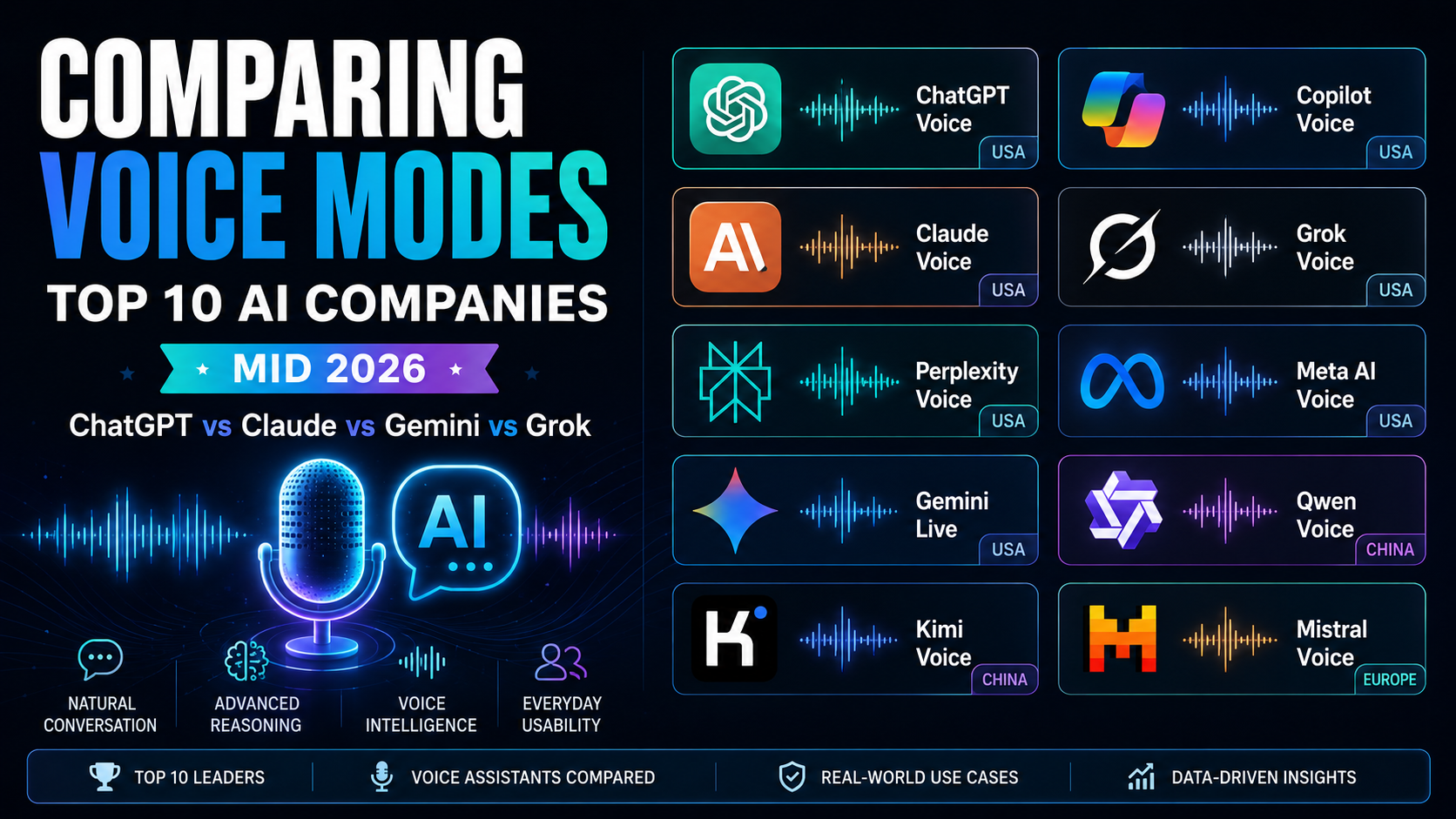
Comparing Voice Modes From the Top 10 AI Companies in Mid-2026
Voice mode is becoming one of the most important interfaces in artificial intelligence.
Typing remains better for code, detailed editing, structured documents and information that needs to be reviewed carefully. Voice becomes more useful when someone is driving, walking, exercising, cooking, working around the house or simply wants to think aloud without sitting in front of a keyboard.
The largest AI companies increasingly treat voice as more than a speech-recognition feature.
Modern voice assistants can listen continuously, detect interruptions, interpret tone, reason over a conversation, search the web, inspect a camera feed, translate between languages and perform actions through connected software.
However, the quality differences remain substantial.
Some AI voice modes sound impressively human but provide shallow answers. Others use intelligent language models but still feel like text chat with a synthetic voice attached. Some respond quickly but interrupt too often. Others understand complex questions but pause so long that the conversation stops feeling natural.
There is also an important technical distinction that many comparisons ignore.
A true native voice model can process speech and produce speech directly. It can potentially understand pace, hesitation, emphasis and tone without first reducing everything to written text.
A pipeline-based voice mode usually works in three stages:
Convert the user’s speech into text.
Send that text to a language model.
Convert the written answer back into audio.
Both approaches can produce useful products. However, a native speech-to-speech model has more potential to create a natural conversation because it does not need to flatten every interaction into text.
This article compares voice experiences from ten major AI companies across the United States, China and Europe as of July 31, 2026.
The ranking considers the complete consumer product rather than only the underlying speech model.
The Top 10 AI Voice Modes in Mid-2026
| Rank | Voice mode | Company and region | Best for |
|---|---|---|---|
| 1 | ChatGPT Voice | OpenAI United States | Best overall voice assistant for natural conversation, intelligence and connection to a complete AI workspace. |
| 2 | Microsoft Copilot Voice | Microsoft United States | Most natural everyday conversation, especially for Windows and Microsoft 365 users. |
| 3 | Claude Voice | Anthropic United States | Thoughtful reasoning, strategic discussion, technical brainstorming and working through complex ideas. |
| 4 | Grok Voice | xAI United States | Personality, expressive voices, fast responses and entertaining real-time conversation. |
| 5 | Perplexity Voice | Perplexity AI United States | Current information, spoken web research, citations and browser-based voice interaction. |
| 6 | Meta AI Voice | Meta United States / global | Hands-free multimodal assistance, social apps, camera use and smart-glasses experiences. |
| 7 | Gemini Live | Google United States | Translation, visual context, Android integration, camera assistance and Google ecosystem access. |
| 8 | Qwen Studio Voice | Alibaba China | Chinese-language use, open audio models, voice cloning, translation and developer experimentation. |
| 9 | Kimi Voice | Moonshot AI China | Long-context Chinese conversations and users who already rely on the Kimi ecosystem. |
| 10 | Mistral Vibe Voice | Mistral AI France / Europe | Privacy-conscious European users, multilingual speech systems and developer-controlled voice infrastructure. |
This ranking requires several qualifications.
The difference between the top five is not absolute. A user may reasonably prefer Copilot’s speaking style, Claude’s intelligence, Grok’s personality or Perplexity’s web grounding over ChatGPT.
The lower positions do not necessarily mean that the companies have weak audio research. Qwen and Mistral have highly capable speech models. Their consumer voice experiences are simply less complete or globally established than the leading products.
Kimi is also more prominent as a reasoning, coding and agent platform than as a dedicated global voice assistant.
How the Voice Modes Were Compared
A useful voice assistant needs more than a pleasant voice.
This comparison evaluates ten areas:
Speech naturalness
Intelligence and reasoning
Response speed
Interruption handling
Ability to follow a long conversation
Factual reliability
Web access and current information
Visual and multimodal capabilities
Language coverage
Daily usefulness
This is not a controlled laboratory benchmark.
Companies do not expose every voice mode under identical conditions. Some products use different models depending on the subscription, country, device, traffic level or question complexity.
The ranking therefore combines publicly documented capabilities, product design and practical usefulness.
It also includes a long-term user observation provided for this article: after using AI voice modes constantly for approximately one year, Gemini Live was experienced as the weakest in conversational intelligence, while Microsoft Copilot Voice was surprisingly natural and capable.
That personal assessment should not be treated as a universal benchmark. It is still valuable because voice products are experienced through extended conversations, not only through short demonstrations selected by the companies that built them.
1. ChatGPT Voice
Company: OpenAI
Best overall AI voice mode
ChatGPT Voice is the strongest overall voice assistant in mid-2026.
OpenAI released GPT-Live in July 2026 as a new generation of models specifically designed for real-time human-AI conversation. GPT-Live is full duplex, meaning it can listen and respond continuously rather than waiting for a rigid turn to end. It can respond to interruptions, pauses and changes in speaking pace while deciding whether to continue listening or begin answering.
This addresses one of the biggest historical weaknesses of AI voice systems.
Normal human conversation does not occur in perfectly separated turns. People hesitate, restart sentences, interrupt, add details and use short reactions such as “right,” “wait” or “exactly.”
Earlier voice assistants frequently treated these sounds as complete new prompts or cut off their own answers too aggressively.
GPT-Live is designed to make this interaction more fluid.
ChatGPT Voice also benefits from the wider ChatGPT product.
A voice conversation can happen inside the same environment used for:
Research
Writing
Images
File analysis
Data analysis
Projects
Memory
Web search
Workflows
Coding assistance
This context makes voice mode more useful than a standalone speaking demonstration.
A user can discuss a business idea during a walk, return to the same chat on a desktop and transform the conversation into a structured strategy document.
The user can upload a file, discuss it verbally and later edit the written output.
Voice is therefore one interface into a larger working environment.
Where ChatGPT Voice is strongest
ChatGPT is particularly good at open-ended discussion.
It can help someone:
Think through a business decision
Develop an article idea
Practice an interview
Learn a difficult concept
Discuss personal goals
Brainstorm a product
Analyze competing arguments
Translate a conversation
Continue work from an existing chat
Ask follow-up questions without restating all the context
Its balance of natural speech and model intelligence gives it the top position.
A voice assistant can sound human while saying little of value. It can also be intelligent while sounding robotic. ChatGPT currently provides the best overall compromise between the two.
Where ChatGPT Voice still struggles
ChatGPT can become overly agreeable.
It may mirror the user’s assumptions rather than challenge them strongly enough. Long spoken answers can also become repetitive, especially when the user asks broad questions.
Voice mode does not always provide access to every tool or application available in ordinary ChatGPT conversations. Developers have also reported that some connected applications and MCP tools do not work directly from native voice mode.
The experience can vary depending on the selected model, subscription and system capacity.
Despite these limitations, ChatGPT Voice is currently the safest overall recommendation.
2. Microsoft Copilot Voice
Company: Microsoft
Best for natural everyday conversation and workplace integration
Microsoft Copilot Voice is one of the most underrated voice assistants in the market.
The product rarely receives the same attention as ChatGPT, Gemini or Grok when people discuss AI voice. In practical conversation, however, it can feel surprisingly relaxed and natural.
Microsoft supports dedicated voice chat across Copilot’s consumer and Microsoft 365 experiences. Voice conversations produce a transcript after the session, and users can choose different voices and adjust playback speed. Microsoft also supports voice chat across a broad range of languages.
One of Copilot Voice’s strengths is conversational pacing.
It often sounds less like a model delivering a prepared answer and more like an assistant responding in the moment.
This matters because naturalness does not come only from the quality of the generated voice.
It depends on:
How quickly the assistant responds
Whether sentences are too long
How it acknowledges the user
Whether it varies its rhythm
Whether it allows the conversation to move forward
Whether it sounds emotionally appropriate
Whether it overexplains simple points
Copilot can be very good at this everyday conversational layer.
The workplace advantage
Microsoft has another major advantage: distribution.
Copilot Voice can increasingly act as a spoken interface into Microsoft’s work ecosystem, including Word, Outlook, Teams and other Microsoft 365 surfaces.
Microsoft also supports hands-free activation through “Hey Copilot” on compatible Windows experiences. The assistant can remain available while the user works across applications.
This creates a practical direction for voice AI.
Instead of only asking a general knowledge question, an employee may eventually say:
Summarize my latest email thread.
Explain the spreadsheet I have open.
Draft a response to this meeting.
Find the document we discussed yesterday.
Turn these notes into a PowerPoint outline.
Remind me what my team decided.
The value comes from connecting spoken interaction to the user’s real work.
A long-term user observation
The experience behind this article found Copilot Voice surprisingly good and natural during extended use.
That result is notable because Microsoft Copilot is often perceived as less exciting than the products from OpenAI, Anthropic or xAI.
In voice mode, however, product polish and conversational rhythm can matter more than the reputation of the underlying model.
Where Copilot Voice loses
Copilot can be less intellectually consistent than ChatGPT or Claude during complex analytical discussions.
It can move too quickly toward a simplified answer. The experience also becomes much more valuable when the user already operates inside Microsoft’s ecosystem.
For someone who does not use Windows or Microsoft 365, its integration advantage is reduced.
Copilot earns second place because it combines strong naturalness, broad availability and meaningful workplace potential.
3. Claude Voice
Company: Anthropic
Best for thoughtful discussion and reasoning aloud
Claude Voice is one of the most intelligent voice experiences, even though Anthropic entered the consumer voice competition later than some of its rivals.
Anthropic supports voice mode across Claude’s mobile, web and desktop experiences. Users can begin speaking from a chat and continue the conversation while Claude responds aloud. The company also provides separate voice-language settings.
Claude’s main advantage is not the theatrical quality of the voice.
It is the underlying intelligence and conversational character.
Claude is often strong at:
Understanding nuanced questions
Preserving uncertainty
Examining several sides of an issue
Avoiding overly confident conclusions
Helping users reason through difficult decisions
Working through technical ideas
Maintaining a coherent argument
Producing thoughtful follow-up questions
This makes Claude Voice particularly useful for people who use speaking as a way to think.
A founder can explain an incomplete strategy aloud. Claude can identify assumptions, organize the idea and challenge weak parts.
A developer can describe a difficult architecture problem while away from the computer.
A writer can talk through the argument of an article before creating the outline.
The experience resembles verbal collaboration more than simple question answering.
Why Claude is not ranked first
Claude’s voice product still feels less mature than ChatGPT Voice as a complete real-time interface.
Anthropic’s strength remains the intelligence and character of Claude rather than industry-leading speech interaction.
The product can feel closer to speaking prompts and hearing model responses than holding a truly fluid, full-duplex conversation.
It also offers fewer voice personalities and fewer entertainment-oriented features than Grok.
Claude earns third place because the quality of the thinking can compensate for a less advanced voice layer.
Best use cases
Claude Voice is especially suitable for:
Technical brainstorming
Strategic thinking
Reviewing difficult decisions
Explaining long or complicated ideas
Practicing an argument
Working through written material
Coding discussions
Reflective conversations
Users who value intelligence over performance or personality may reasonably rank Claude above Copilot.
4. Grok Voice
Company: xAI
Best for personality, expression and fast conversation
Grok Voice is one of the most ambitious voice products in the market.
xAI has invested heavily in making voice a distinct product rather than simply reading Grok’s text answers aloud.
The company offers full-duplex, speech-to-speech interaction with sub-second latency, built-in reasoning and tool use. It also released a Voice Agent Builder for configuring production voice agents without writing code.
In July 2026, xAI introduced 21 additional flagship voices, joining its original set. These voices are multilingual and also available through xAI’s voice-agent and text-to-speech products.
Grok’s defining characteristic is personality.
Many AI companies deliberately make their assistants neutral, restrained and predictable.
Grok is more willing to sound playful, opinionated, casual or dramatic.
This can make spoken conversations feel more entertaining.
The variety of voices also makes Grok attractive for users who care strongly about how the assistant sounds.
Strong voice infrastructure
xAI is not limiting voice to the Grok consumer application.
Its developer platform includes:
Speech-to-speech models
Text-to-speech
Custom voices
Voice-agent APIs
Real-time search
Tool calling
No-code agent configuration
xAI says its voice services support multilingual conversations, sub-second latency and complex workflows.
This positions Grok as both a consumer assistant and a platform for businesses building customer-service, sales or support agents.
Where Grok Voice loses
Personality can become a weakness when the user wants precision.
Grok may sound confident or entertaining even when the underlying answer requires caution.
Its style may also be inappropriate for formal, sensitive or professional conversations.
Users who want a calm analytical partner may prefer Claude. Users who want the strongest general workflow may prefer ChatGPT.
Grok earns fourth place because it is fast, expressive and technically serious about real-time voice.
5. Perplexity Voice
Company: Perplexity AI
Best for spoken web research and browser interaction
Perplexity Voice is most useful when the conversation depends on current information.
The core Perplexity product is built around web search and visible sources. Voice adds a hands-free interface to that search-first experience.
This makes it suitable for questions such as:
What happened in the market today?
What are the latest changes to this product?
Which company released a model this week?
What are the current prices?
Find recent information about this topic.
Compare several live sources.
Explain the webpage on my screen.
Perplexity has also integrated voice into Comet and Perplexity Computer.
In Comet, users can talk about the content visible in the browser, interact with websites and continue across multiple tabs. The company upgraded Comet Voice Mode in February 2026 using an OpenAI real-time model, reporting improvements in reliability and expressiveness.
In Perplexity Computer, Voice Mode can be used to describe a project, give feedback while the agent is working and redirect it without typing.
This reveals an important point about AI competition.
Perplexity does not need to build every underlying component itself.
Its product can combine its search and agent environment with voice technology from another model provider.
The result can still be differentiated because the user interacts with Perplexity’s research system and browser tools.
Where Perplexity Voice is strongest
Current information
Research while walking or driving
Asking questions about open webpages
Giving spoken instructions to a browser agent
Following live news
Source discovery
Shopping and product research
Travel research
Redirecting long-running agent work
Where Perplexity Voice loses
Perplexity can feel more transactional than ChatGPT, Claude or Copilot.
It is excellent at answering questions but less distinctive as a long-term thinking companion.
Because its voice technology may come from another provider, it also has less control over the entire model stack than OpenAI, Google, xAI or Meta.
Perplexity earns fifth place because voice combined with live web search is genuinely useful.
6. Meta AI Voice
Company: Meta
Best for smart glasses and multimodal everyday assistance
Meta AI has one distribution advantage that no other company can easily reproduce.
It can reach users through WhatsApp, Instagram, Messenger, Facebook, the Meta AI application and Meta’s smart glasses.
In April 2026, Meta introduced Muse Spark as the model powering its updated assistant. Meta says its voice experience allows users to interrupt, change topics and switch languages naturally. The assistant can also generate images and surface recommendations during the conversation.
Meta is also adding live visual assistance.
A user can point the camera at an object or scene and ask questions about what the assistant sees.
This capability becomes especially important on smart glasses.
The ideal voice assistant is not always something the user opens on a phone. It can become an ambient interface that is present while the user moves through the physical world.
A person wearing smart glasses can ask:
What am I looking at?
Translate this sign.
Take a picture.
What building is that?
Read this label.
Remember where I parked.
Send this message.
Play music that matches this place.
Meta has been developing exactly this type of hands-free interaction.
Why Meta is not higher
Meta AI’s reasoning quality and professional workflow are less established than those of ChatGPT, Claude or Gemini.
Its strongest advantage is accessibility and hardware integration rather than consistently producing the best complex answer.
There are also significant privacy questions because Meta AI exists inside social platforms built around personal communication and recommendation systems.
Meta has introduced privacy-focused options such as Incognito Chat, but users should still understand the data settings of the product they use.
Meta earns sixth place because smart glasses may become one of the most important long-term homes for AI voice.
7. Gemini Live
Company: Google
Best for translation, visual context and Android integration
Gemini Live is one of the most technologically capable voice platforms.
Google’s Gemini 3.1 Flash Live model is designed for low-latency real-time dialogue. Google describes it as its highest-quality audio and voice model at the time of release, with improved conversational rhythm, precision and responsiveness.
Gemini also has several major structural advantages.
It can connect to:
Android
Google Search
Google Maps
Gmail
Google Calendar
Google Home
YouTube
The phone camera
Google’s translation systems
Google also released Gemini 3.5 Live Translate, supporting near-real-time speech-to-speech translation across more than 70 languages.
From a feature perspective, Gemini Live should be one of the strongest voice assistants.
It can support camera-based questions, screen sharing, translation and integration with Google applications.
The difference between capability and conversational intelligence
Gemini’s position at number seven is not primarily a criticism of its audio engineering.
Its voice technology can be fast, expressive and technically advanced.
The issue is the quality of the assistant’s reasoning during extended spoken conversations.
The long-term user experience informing this article found Gemini Live to be the least intelligent voice mode among the major Western assistants, despite using it constantly for approximately one year.
It was described as frequently misunderstanding the point, giving shallow answers and failing to follow the deeper direction of a conversation.
This is a subjective experience rather than a controlled benchmark.
Other users may have a very different result, especially in translation, Android assistance or camera-based use.
However, it illustrates an important lesson:
A voice assistant is not useful merely because it speaks naturally.
It must understand what the user is trying to accomplish.
Where Gemini Live is strongest
Gemini is still one of the best options for:
Live translation
Android users
Camera-based questions
Screen-based assistance
Google Maps and local information
Google Home
Google Workspace
Multilingual conversations
A user who values those integrations may rank Gemini much higher.
A user who primarily wants a thoughtful conversational partner may find ChatGPT, Claude or Copilot substantially better.
8. Qwen Studio Voice
Company: Alibaba
Best for Chinese-language voice technology and open audio models
Alibaba’s Qwen is one of the most important AI model families in China.
Qwen Studio supports audio, images and video, and its mobile experience includes voice conversations.
Alibaba has also invested in dedicated audio models.
Qwen2-Audio supports voice chat and audio analysis across multiple languages and dialects. Qwen3-TTS adds capabilities including voice cloning and voice design, while Qwen3-ASR focuses on speech recognition and alignment.
This gives Qwen a broad technical audio stack:
Speech recognition
Audio understanding
Voice conversation
Text-to-speech
Voice design
Voice cloning
Real-time translation
Open model releases
Qwen is therefore more significant than its eighth-place consumer ranking might suggest.
The company may be especially attractive to Chinese developers or businesses that want more control over their voice infrastructure.
Why Qwen ranks below the Western products
Qwen Studio’s global consumer voice experience is less established.
The product is not yet as recognizable, polished or consistently accessible internationally as ChatGPT Voice, Gemini Live or Copilot Voice.
Language performance can also vary substantially outside Chinese and English.
Qwen’s advantage is the breadth and openness of its technical ecosystem rather than being the best universal voice assistant today.
Best use cases
Chinese-language conversations
Developers experimenting with open audio models
Voice cloning
Real-time translation
Audio analysis
Locally controlled deployments
Businesses using Alibaba Cloud
Qwen is one of the products most likely to move higher in future editions.
9. Kimi Voice
Company: Moonshot AI
Best for long-context Chinese conversations
Moonshot AI’s Kimi has become one of China’s most closely watched AI platforms.
Kimi is known primarily for long-context processing, research, agentic work and coding rather than its voice experience.
The Kimi application nevertheless supports voice calls and translation as part of its consumer feature set.
Moonshot has also published Kimi-Audio research covering speech recognition, audio understanding, audio question answering and spoken conversation. Its technical report claimed strong results across several audio benchmarks.
Kimi’s potential voice advantage comes from the intelligence behind the conversation.
The Kimi family emphasizes long context and increasingly powerful reasoning. Kimi K3, released in July 2026, is a 2.8-trillion-parameter mixture-of-experts model with native vision and a one-million-token context window.
If Moonshot connects that capability to a highly polished native voice system, Kimi could become a serious competitor.
Why Kimi ranks ninth
Kimi is not yet primarily recognized as a global real-time voice assistant.
Public information about its consumer voice experience is less detailed than the material available for OpenAI, Google, xAI or Microsoft.
Its voice features also appear more mature for Chinese-language users than for a broad global audience.
The distinction matters:
A company can have excellent audio research without yet providing the best everyday voice-mode product.
Kimi earns a place in the top ten because of Moonshot’s model quality, long-context advantage and audio research. It ranks below Qwen because Alibaba currently offers a wider public audio ecosystem.
10. Mistral Vibe Voice
Company: Mistral AI
Region: France and Europe
Best for European AI infrastructure and privacy-conscious deployments
Mistral is the most important European company in this comparison.
Its consumer assistant, formerly called Le Chat and now named Vibe, includes a voice input mode powered by the Voxtral model family.
Mistral describes the feature as low-latency speech recognition designed to let users speak naturally without typing.
However, Mistral’s strongest voice work currently exists at the model and developer-platform level rather than in a polished full-duplex consumer assistant.
The Voxtral family includes:
Speech recognition
Audio understanding
Real-time transcription
Speech translation
Text-to-speech
Voice adaptation
Voice cloning
Tools for building voice agents
In March 2026, Mistral released Voxtral TTS, a four-billion-parameter speech model supporting emotionally expressive output, low latency and nine major languages.
The company also offers open-weight and deployable options, making it attractive to organizations that want European infrastructure or greater control over their AI deployment.
Why Mistral ranks tenth
Mistral does not yet provide a consumer voice conversation experience as complete as ChatGPT, Copilot, Grok or Gemini.
Its voice input can feel closer to automatic transcription than a continuously flowing conversation.
The company has many of the required components, but the end-user experience has not fully caught up with the underlying technology.
This makes Mistral an important platform to watch rather than the current consumer winner.
Where Mistral is strongest
European organizations
Multilingual speech systems
Private deployments
Voice-agent development
Speech recognition
Low-latency transcription
Open or adaptable voice models
Companies that want alternatives to US and Chinese providers
Which AI Voice Mode Sounds the Most Human?
There is no completely objective answer because voice preference depends on accent, language, pacing and personality.
In overall conversation, the strongest candidates are:
ChatGPT Voice
Microsoft Copilot Voice
Grok Voice
ChatGPT offers the best balance of naturalness and intelligence.
Copilot can feel surprisingly relaxed and conversational.
Grok offers the widest variety of expressive personalities.
Claude may provide the best reasoning, but its speech layer is less distinctive.
Gemini’s voices can sound natural while the underlying conversation still feels shallow.
This demonstrates why vocal realism should not be evaluated separately from intelligence.
Which Voice Mode Is the Most Intelligent?
For complex spoken reasoning, the strongest choices are:
Claude Voice
ChatGPT Voice
Grok Voice
Microsoft Copilot Voice
Claude can be particularly strong when the user explains an incomplete or nuanced idea.
ChatGPT provides better balance across reasoning, current information and continuing workflows.
Grok is increasingly capable but can allow personality to dominate precision.
Copilot is natural and useful, though it may simplify complex discussions too quickly.
Which Voice Mode Is Best for Current Information?
Perplexity Voice is the clearest specialist for current information because its entire product is built around live web research and citations.
ChatGPT Voice is the stronger general assistant that can also research current information.
Grok is useful for real-time information connected to the X ecosystem and web search.
Gemini has access to Google’s search and information infrastructure, although the quality of the final reasoning may vary.
Which Voice Mode Is Best for Driving?
For hands-free conversations, the strongest options are:
ChatGPT Voice
Microsoft Copilot Voice
Perplexity Voice
Gemini Live
Copilot has specific advantages for Windows, Microsoft accounts and supported automotive integrations.
Perplexity is useful for spoken research.
Gemini benefits from Android and Google Maps.
ChatGPT remains the best option for extended open-ended discussion.
Drivers should avoid tasks that require reading, reviewing sources or interacting visually with a screen.
Which Voice Mode Is Best for Brainstorming?
Claude and ChatGPT are the strongest brainstorming partners.
Claude is better when the user wants careful questioning and deeper analysis.
ChatGPT is better when the conversation will later become a complete output such as an article, plan, image or presentation.
Copilot can be effective for lighter everyday brainstorming.
Grok is better when the user wants creativity, energy or a less restrained personality.
Which Voice Mode Is Best for Translation?
Gemini is the strongest overall choice for real-time multilingual translation.
Google’s Gemini 3.5 Live Translate supports speech-to-speech translation across more than 70 languages.
Qwen is an important alternative, particularly for Chinese and Asian-language contexts.
ChatGPT also performs well in multilingual conversations and can explain translations rather than only repeat them.
Which Voice Mode Is Best for Business?
The answer depends on the company’s existing software.
Choose Microsoft Copilot Voice when the organization is deeply invested in Microsoft 365.
Choose ChatGPT Voice for general business thinking, writing and cross-functional work.
Choose Claude Voice for strategy, technical reasoning and complex analysis.
Choose Perplexity Voice for market research and current information.
Choose Mistral when deployment control, European infrastructure or privacy requirements matter more than consumer polish.
Why Voice Benchmarks Are Difficult
Text models can be compared using standardized questions and measurable outputs.
Voice conversations introduce additional variables:
Microphone quality
Background noise
Accent
Internet connection
Device
Language
Voice selection
Subscription level
Regional availability
Server load
Conversation length
User speaking style
A model may perform well during a scripted demonstration and poorly during a spontaneous 30-minute conversation.
It may understand a native American English speaker but struggle with a Romanian accent.
It may handle a clean studio microphone but fail in a car.
It may sound natural in English and artificial in German.
A meaningful evaluation must therefore involve repeated real-world use.
That is why the long-term Gemini and Copilot observations in this article matter even though they are subjective.
Voice mode is not only an output to score.
It is an interaction that must continue working over time.
The Biggest Problem With AI Voice in 2026
The biggest limitation is no longer speech synthesis.
Most major companies can generate a voice that sounds reasonably human.
The larger problem is maintaining intelligent, useful and trustworthy conversation.
Voice encourages users to accept answers immediately.
They are less likely to inspect sources, compare exact wording or notice subtle errors than when reading text.
A confident voice can make a weak answer sound convincing.
This creates a serious risk.
The assistant may:
Invent a fact
Misunderstand the question
Forget an earlier qualification
Give outdated information
Oversimplify a complex issue
Agree too readily
Hide uncertainty behind a natural tone
The more human the voice sounds, the more important factual discipline becomes.
Users should treat voice as a convenient interface, not proof that the model understands the subject.
Final Ranking
1. ChatGPT Voice
Best overall combination of natural conversation, intelligence and connection to a complete AI workspace.
2. Microsoft Copilot Voice
One of the most natural everyday speaking experiences, with strong workplace and Windows potential.
3. Claude Voice
Best for thoughtful discussion, strategic reasoning and complex brainstorming.
4. Grok Voice
Best for expressive personalities, speed and developer-facing voice agents.
5. Perplexity Voice
Best for live web research, sources and browser-based voice interaction.
6. Meta AI Voice
Best positioned for smart glasses, social applications and multimodal everyday assistance.
7. Gemini Live
Technically advanced and excellent for translation, camera use and Android, but inconsistent as an intelligent conversational partner.
8. Qwen Studio Voice
A broad Chinese audio ecosystem with strong open models and significant technical potential.
9. Kimi Voice
Promising because of Kimi’s intelligence and long-context models, but not yet a leading global voice-mode product.
10. Mistral Vibe Voice
Important European voice infrastructure, though the consumer experience remains less complete than the leaders.
Final Verdict
ChatGPT Voice is the best overall AI voice mode in mid-2026.
It does not necessarily have the most entertaining voices, the deepest answer to every question or the strongest integration with every device.
It wins because it provides the most balanced combination of:
Natural conversation
Strong reasoning
Interruption handling
Multimodal context
Ongoing chat memory
Research
Workflows
Availability
Connection to a broader AI product
Microsoft Copilot Voice is the surprise of the comparison.
It can feel more natural and pleasant than its position in the wider AI market might suggest.
Claude is the best alternative for users who care most about the quality of the thinking.
Grok is the strongest personality-driven competitor.
Perplexity has the clearest role for live research.
Gemini has perhaps the largest gap between technical capabilities and the quality some long-term users experience in actual conversation.
China’s Qwen and Kimi demonstrate that voice AI is not only a US competition. Both companies have serious audio and language-model capabilities, but their international consumer voice products remain behind the most mature Western experiences.
Mistral provides Europe with a credible voice-model stack, especially for businesses that want greater infrastructure control.
The larger trend is clear.
Voice mode is moving from a secondary feature into a primary AI interface.
The winning product will not be the one with the most realistic synthetic voice.
It will be the assistant that can listen naturally, understand what the user actually means, preserve context, respond intelligently and connect the conversation to useful actions.
Frequently Asked Questions
What is the best AI voice mode in mid-2026?
ChatGPT Voice is the best overall choice because it combines natural conversation, strong reasoning, interruptions, multimodal capabilities and connection to the wider ChatGPT product.
Which AI voice sounds the most natural?
ChatGPT, Microsoft Copilot and Grok are the strongest candidates. Copilot can sound particularly relaxed in everyday conversation, while Grok offers more expressive voice personalities.
Which AI voice is the smartest?
Claude and ChatGPT are the strongest for complex spoken reasoning. Claude may be more thoughtful, while ChatGPT provides a broader and more practical overall product.
Is Gemini Live better than ChatGPT Voice?
Gemini Live is stronger for some Google integrations, live translation, Android and camera-based assistance. ChatGPT Voice generally offers a more intelligent and coherent open-ended conversation.
Why is Gemini ranked so low?
Gemini has advanced audio technology and extensive integrations. Its lower ranking reflects concerns about conversational reasoning and its ability to follow deeper discussions consistently. A long-term user contributing to this article found it substantially weaker than competing voice modes.
Is Microsoft Copilot Voice good?
Yes. Copilot Voice is surprisingly natural and useful. It is particularly attractive for Windows and Microsoft 365 users.
Does Claude have a real voice mode?
Yes. Claude supports spoken conversations across its mobile, web and desktop products. Its main advantage is the quality of Claude’s reasoning rather than the most advanced speech interface.
Is Grok Voice better than ChatGPT Voice?
Grok may be better for expressive voices, speed and personality. ChatGPT remains the stronger balanced product for reasoning, workflows and general daily use.
Which voice assistant is best for research?
Perplexity Voice is best for current web research and visible sources. ChatGPT is stronger when the research needs to continue into writing, analysis or another complete workflow.
Which AI voice is best for translation?
Gemini is currently the strongest specialist for real-time speech translation because of its language coverage and dedicated Live Translate technology.
Are Kimi and Qwen voice modes available outside China?
Their applications and some voice capabilities are available internationally, but feature availability, language quality and account access can vary by country and platform.
Which European AI company has the best voice technology?
Mistral AI is Europe’s leading major voice-model company. Its Voxtral family covers transcription, audio understanding, speech generation and voice-agent infrastructure.
Are AI voice conversations private?
Privacy policies vary significantly. Voice conversations may be transcribed and stored as part of chat history. Users should review the data and training settings of each application before discussing confidential business or personal information.
Will this ranking change?
Almost certainly. Voice AI is developing quickly, and the ranking reflects products available as of July 31, 2026. New full-duplex models, device integrations and agent capabilities could alter the order within months.