
GPT-6 Astra: OpenAI Says the AGI Era Has Begun. Has It?
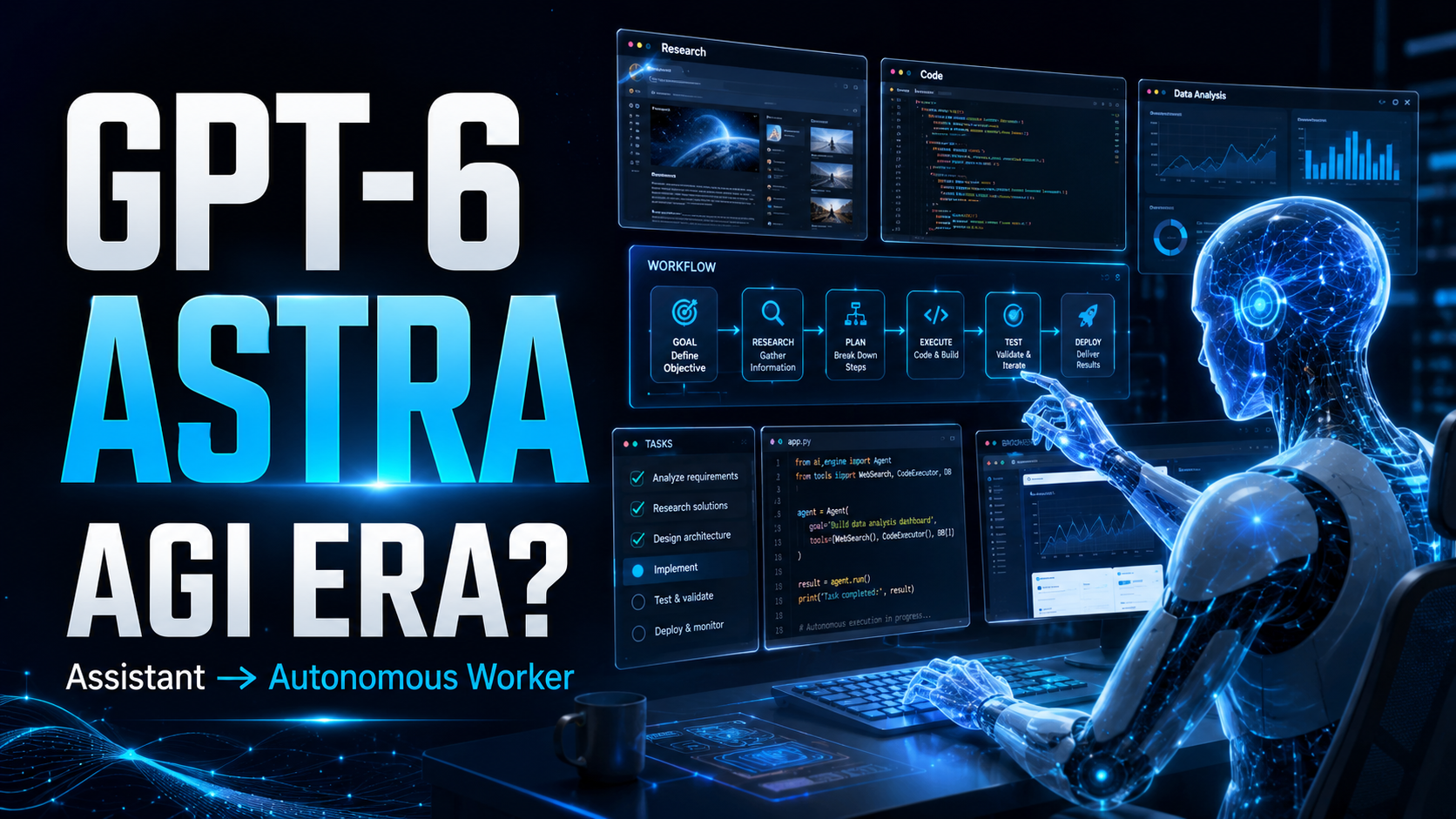
OpenAI has released GPT-6 Astra, and this time the company is making a much bigger claim than simply having the smartest AI model.
OpenAI President Greg Brockman has suggested that people may eventually look back at Astra as the beginning of the artificial general intelligence era.
That is an extraordinary claim.
But after watching AI models improve rapidly over the past few years, I think the interesting question is no longer whether Astra can score higher than GPT-5.6 on another benchmark.
The more important change is what the model is designed to do.
GPT-6 Astra is not primarily being positioned as a chatbot that gives better answers. OpenAI describes it as a model built for difficult end-to-end work across software, browsers, coding environments, research tools, professional applications, and other computer workflows.
That distinction matters.
The AI industry spent the first half of the decade improving models that could answer questions, generate text, analyze documents, and write increasingly good code.
The next competition is about something different:
Can an AI receive an objective, operate the tools required to achieve it, deal with problems along the way, verify what it has done, and deliver the finished result with minimal human supervision?
Astra appears to be OpenAI's biggest attempt yet at answering yes.
Whether that qualifies as AGI is much harder to answer.
My view on September 4, 2026 is simple: let's see how it performs in real-world use before declaring that AGI has arrived.
But Astra may still represent an important transition even if we eventually decide that it is not AGI.
It may be the point where the frontier AI race moved decisively from assistants toward autonomous workers.
What Is GPT-6 Astra?
GPT-6 Astra is OpenAI's new flagship model and the first model carrying the GPT-6 name.
OpenAI describes it as its most capable model for difficult end-to-end work, with particular emphasis on:
complex reasoning
software engineering
computer use
web browsing
scientific work
research
document creation
professional workflows
cybersecurity
Astra supports a context window of 1,050,000 tokens and up to 128,000 output tokens. Its API knowledge cutoff is April 30, 2026.
Those numbers are large, but the context window itself is not the breakthrough.
GPT-5.6 Sol already offered the same 1.05-million-token context window and 128,000-token maximum output. Astra therefore should not be understood as another release where the major improvement is simply "the model can read more information."
The more significant change is what Astra can supposedly do with the information it receives.
OpenAI says the model is better at sustaining multistep workflows across code, browsers, and professional software while maintaining coherence throughout longer tasks. It also introduces features such as asynchronous tool calls and mid-task steering, allowing an agent to continue reasoning or doing other work while an external tool is still running, and allowing a user to modify instructions without restarting the whole task.
That sounds technical, but the implication is straightforward.
Previous AI systems were often used one step at a time.
Ask a question.
Receive an answer.
Ask for code.
Paste the code somewhere.
Find an error.
Return to the AI.
Give it the error.
Ask for another attempt.
Astra is increasingly designed around completing the workflow rather than just completing each prompt.
That is the transition worth paying attention to.
The Biggest Change: From AI Assistant to AI Worker
The term "AI agent" has been overused for years.
Almost every company eventually added the word agent to a product that could call an API or execute a few predetermined actions.
The stronger definition is much more demanding.
An autonomous AI worker should be able to understand a relatively broad goal, determine what needs to happen, use several tools, navigate unexpected conditions, verify the outcome, and continue until the job is finished.
Astra moves OpenAI much further in that direction.
OpenAI's own developer guidance emphasizes multistep workflows across browsers, code, and professional applications rather than isolated model responses. The model can use computer-control tools, web search, file search, code execution, shell environments, image generation, MCP connections, and other external tools through OpenAI's Responses API.
This is why I think computer use and raw intelligence should be viewed as equally important parts of the release.
An extremely intelligent model trapped inside a chat box can still only advise you.
An AI that is slightly more intelligent but can operate your computer reliably can potentially do the work itself.
Combine both improvements and the economic significance changes dramatically.
Imagine telling an AI:
"Research 20 possible suppliers, compare their pricing and delivery terms, build a spreadsheet, identify the best five, draft outreach emails, and prepare the findings for me."
The value does not come from Astra writing a particularly impressive paragraph about suppliers.
The value comes from it carrying out the entire process.
That is what companies are racing toward.
Intelligence Still Matters - Because Agents Multiply Their Own Mistakes
Computer use does not make reasoning less important.
It makes reasoning more important.
When a chatbot misunderstands something, you might receive a bad answer.
When an autonomous agent misunderstands something, it might perform 30 bad actions before anyone notices.
That means useful autonomy requires improvements in several areas simultaneously:
reasoning
instruction following
planning
memory across long workflows
tool selection
error recovery
verification
understanding when not to act
OpenAI says Astra improves substantially in these areas and reports state-of-the-art results across evaluations covering computer workflows, coding, reasoning, mathematics, science, and cybersecurity.
One independent result deserves particular attention.
ARC Prize evaluated GPT-6 Astra on ARC-AGI-3, an evaluation intended to test how systems adapt to unfamiliar environments.
Using ARC Prize's standard harness, Astra reached 62.7%. With an OpenAI-style provider adapter that preserved additional reasoning state between interactions, it reached 99.9%.
The second result is astonishing, but it also illustrates why benchmark headlines need context: the configurations were different and the runs were extremely expensive, costing roughly $26,000 and $19,000 respectively.
More interesting to me is another observation from ARC Prize.
Astra used fewer actions than the median human participant on 96% of evaluated levels and appeared capable of turning unfamiliar environments into compact internal representations that it could use for planning.
This is closer to the type of capability I care about when discussing AGI than simply answering more trivia questions correctly.
An intelligent autonomous system needs to enter unfamiliar situations, understand how they work, form a strategy, adjust when the strategy fails, and continue toward its goal.
Astra appears to be getting much better at that.
But benchmarks remain benchmarks.
The real question is whether this reliability survives Monday morning inside a messy company with outdated spreadsheets, poorly documented software, ambiguous instructions, six browser tabs, conflicting customer requirements, broken APIs, and a manager changing the requirements halfway through the task.
That is where AGI claims should ultimately be tested.
Computer Use Could Matter More Than Another IQ Jump
The history of computing contains many examples where an enabling interface mattered almost as much as underlying computing power.
Personal computers became dramatically more useful when ordinary users could interact with software visually.
The web became transformative when millions of independent services could connect.
Smartphones became more powerful when apps gained access to cameras, location, payments, sensors, and communication.
AI may be approaching a similar moment.
Large language models already know how to explain an enormous range of tasks.
The missing piece has increasingly been the ability to execute those tasks reliably inside the environments where humans actually work.
Astra is explicitly designed around that problem.
It can work across browsers and professional software rather than requiring every workflow to be translated into a chat conversation first. OpenAI's developer documentation also supports asynchronous tool calls, which means the model can continue other parts of a task while waiting for a slower external operation to finish.
This starts making agents behave less like request-response software and more like workers coordinating several activities at once.
Mid-turn steering is another seemingly small feature with large implications.
If you change your mind while an employee is working, you do not expect that employee to erase everything and begin again.
You say:
"Actually, prioritize the German customers first."
A capable worker incorporates the new instruction into the work already underway.
Astra's architecture is increasingly designed for that type of interaction.
Those capabilities may ultimately matter more than another incremental improvement in chatbot conversation.
Astra's Early Real-World Examples Are More Interesting Than the Demos
OpenAI has published several customer examples alongside the Astra launch.
These should be treated as vendor-selected case studies rather than independent evidence, but they demonstrate the type of workloads OpenAI believes Astra is ready for.
Playco used Astra inside an AI development environment connected directly to game engines including Unity and Godot.
The agent could edit scenes, run the game, test changes, identify bugs, and improve its own output rather than merely generating code for a developer to paste into an editor.
Playco reported 50% fewer manual fixes compared with the previous model while creating several playable prototypes.
That is interesting because professional software development has never been only about generating source code.
A developer needs to understand the product, inspect existing architecture, change multiple files, run the software, compare the result against requirements, investigate bugs, test edge cases, and decide whether the implementation is actually complete.
An AI that produces more syntactically correct code is useful.
An AI that closes the entire engineering loop is much more consequential.
Another Astra customer, legal technology company Legora, tested the model on a financial-statement workflow involving 41 documents.
According to Legora, its agent processed the documents in minutes, found all four deliberately inserted errors, and improved substantially over the previous model on that specific workflow. Final professional judgment remained with the human legal expert.
Again, this is early evidence supplied through an OpenAI customer story, not proof that Astra can replace professional workers.
But notice what is being measured.
Not:
"Can Astra summarize a financial document?"
Instead:
"Can Astra complete an entire professional workflow involving dozens of documents?"
That change in what the industry considers a meaningful demonstration tells us a lot about where AI is moving.
Coding May Be Where Astra's Impact Becomes Obvious First
Software engineering is probably one of the best environments for advanced AI agents.
The work is digital.
The tools are already computer-accessible.
Much of the environment is structured.
Code can be executed.
Tests can be automated.
Errors generate machine-readable feedback.
Changes can be reverted.
Version control provides history.
That makes software development unusually suitable for autonomous experimentation.
Astra is being positioned heavily around this opportunity.
OpenAI says it improves on software engineering and can sustain longer coding tasks, use tools, execute code, test implementations, and continue correcting problems rather than simply producing a code snippet and stopping.
As a software engineer, however, I still don't interpret this as "developers are about to disappear."
My current view remains that AI is primarily becoming an enormous productivity multiplier for developers.
Writing code is only one part of engineering software.
The difficult part is often determining what should be built, understanding ambiguous business requirements, choosing appropriate architecture, managing tradeoffs, maintaining systems over years, debugging interactions between components, and deciding whether something that technically works is actually the right solution.
AI is becoming dramatically better at participating in that process.
It may also mean that developers personally type substantially less code.
But reducing the amount of manual coding is not the same thing as eliminating software engineers.
Compilers already eliminated enormous amounts of low-level programming.
Frameworks eliminated repeated infrastructure work.
Cloud platforms eliminated much of the need to manually manage servers.
None of those changes eliminated software engineering. They changed the level at which engineers worked.
AI may be the largest version of that abstraction shift we have seen.
The developer's job could increasingly move from:
write every implementation detail
toward:
define the system, provide the right context, delegate implementation, inspect results, identify architectural problems, and make the decisions the agent cannot reliably make.
Astra could accelerate that transition substantially.
Does GPT-6 Astra Actually Mean AGI Has Arrived?
This is where the discussion becomes much less precise.
"AGI" has never had a universally accepted definition.
Some definitions focus on human-level intelligence across a broad range of cognitive tasks.
Others focus on economic output.
Others require the ability to learn new skills, operate autonomously, transfer knowledge between domains, or outperform humans at most intellectual work.
Depending on which definition someone chooses, the exact same AI system can be described as either AGI or clearly not AGI.
OpenAI President Greg Brockman has taken one of the strongest positions around Astra, suggesting that this period may eventually be remembered as the beginning of the AGI era.
I think the right response is neither to immediately accept the claim nor dismiss it.
Let's see it in real-world use.
Can Astra autonomously complete a week-long software project without gradually drifting away from the requirements?
Can it recover when authentication expires?
Can it recognize that information on a website is wrong?
Can it notice that two departments have given contradictory instructions?
Can it safely make decisions when the requested action is irreversible?
Can it work for hours without a human repeatedly correcting it?
Can it recognize when it genuinely does not know something?
Can it produce finished professional work consistently rather than occasionally producing something extraordinary?
These questions matter far more than whether Astra produced a spectacular benchmark score.
Human workers are not useful because they can perform one exceptional demonstration.
They are useful because organizations can depend on them repeatedly.
AGI, if the term is going to have practical meaning, needs some version of that reliability.
A model that can complete 90% of an autonomous workflow but unpredictably fails on the remaining 10% may still transform productivity.
But it is different from a truly general autonomous worker.
That distinction should not disappear because the technology has become impressive.
The AI Race Has Changed: OpenAI vs Anthropic vs Google
Astra also needs to be understood as part of a much larger competitive shift.
The frontier competition is increasingly not:
Which company has the chatbot that gives the smartest answer?
It is becoming:
Which company can build the AI system that completes the largest amount of useful work reliably and economically?
OpenAI is not alone in pursuing that goal.
Anthropic released Claude Fable 5.1 on September 1, only two days before Astra.
Anthropic describes Fable 5.1 as a model for long-running coding, research, knowledge work, and agentic tasks that can span several applications and continue for hours with relatively little supervision. It is also designed to use browsers, work through backlogs, execute multi-stage professional projects, and recover when something goes wrong.
That sounds remarkably similar to Astra's strategic direction.
The pricing is similar too.
Claude Fable 5.1 costs $10 per million input tokens and $50 per million output tokens - the same headline token pricing as GPT-6 Astra.
Google is approaching the same destination from a different economic position.
Gemini 3.8 Flash launched on September 2 and is explicitly optimized for software engineering, autonomous agents, computer use, and long-horizon knowledge workflows.
Its introductory API pricing is dramatically lower at $0.75 per million input tokens and $3.75 per million output tokens, although Google notes that higher-effort tasks may consume more tokens.
Gemini 3.8 Flash also includes computer use and a one-million-token context window, reinforcing the idea that operating tools is becoming a baseline frontier-model capability rather than an OpenAI-only advantage.
This makes declaring the AI race finished after Astra particularly premature.
OpenAI may have made a major capability jump.
Anthropic has simultaneously been optimizing Claude for multi-hour autonomous work.
Google is pushing increasingly capable agentic models at dramatically lower prices.
And new models are arriving at a pace where leadership can change several times in a quarter.
Astra therefore matters less as evidence that OpenAI has permanently won and more as evidence of what the next battlefield looks like.
The frontier companies are building workers.
Intelligence Alone May No Longer Be the Best Metric
This shift also changes how we should evaluate models.
For years, model comparisons heavily emphasized intelligence benchmarks.
Those still matter.
But companies buying autonomous systems ultimately care about something closer to:
How much correct work does the model complete per dollar with acceptable supervision?
That introduces several variables:
FactorWhy It MattersReasoningThe agent needs to understand what should happenTool useIt needs to actually perform the workReliabilityA brilliant agent that randomly fails is difficult to deployRecoveryReal workflows contain errors and unexpected conditionsSpeedAutonomous tasks can involve hundreds of actionsCost per taskLong agentic loops consume substantial computeContextThe agent needs enough project information to make decisionsVerificationThe system needs ways to check whether its own work is correctSafetyGreater autonomy creates greater consequences when something goes wrong
This is one reason Astra's $10 input and $50 output pricing should not automatically be interpreted as expensive compared with cheaper models.
OpenAI argues that Astra can sometimes finish tasks using fewer output tokens than earlier models, potentially reducing the actual cost of accomplishing a workflow despite higher token prices.
That claim needs independent testing.
But cost per completed task is ultimately a much more useful agent metric than cost per million tokens.
If a $50 model finishes a job in one attempt while a $5 model requires repeated corrections and human intervention, the $50 model may be cheaper.
Conversely, if a cheaper model reliably completes 95% of the same jobs, the premium model could be economically difficult to justify at scale.
This is where Google's aggressive Gemini pricing becomes strategically important.
The autonomous-worker race will not be won on intelligence alone.
Astra's Cybersecurity Capabilities Show Why Autonomy Changes the Risk
Astra also introduces a more uncomfortable milestone.
OpenAI classifies it as the first model to reach the Critical cybersecurity capability level under the company's Preparedness Framework.
According to OpenAI's evaluations, Astra can identify previously unknown vulnerabilities and develop exploitation strategies against hardened systems with far less human guidance than previous models.
OpenAI consequently added stronger isolation, monitoring, access controls, and other safeguards around the model.
This deserves attention because the same capabilities that make an autonomous AI useful also make misuse more consequential.
A chatbot can explain cybersecurity concepts.
An autonomous system can potentially investigate a target, try multiple approaches, adapt when something fails, and continue until it finds a working path.
The danger scales with persistence.
OpenAI also acknowledges that Astra is more difficult to monitor internally than GPT-5.6 Sol in some respects, even while reporting improvements in alignment and respecting authorized task boundaries.
That tension is likely to become one of the defining problems of frontier AI.
We want increasingly capable autonomous systems.
But the more autonomous they become, the more important it becomes to know what they are doing, why they are doing it, and whether they can reliably stop when they reach a boundary.
GPT-6 Astra Pricing and Availability
GPT-6 Astra initially began rolling out to selected organizations through OpenAI's trusted early-access program.
OpenAI says API access and availability for ChatGPT Plus, Pro, Business, and Enterprise users will follow during the rollout.
API pricing currently sits at:
GPT-6 Astra API usagePrice per 1M tokensInput$10Cached input$1Cache writes$12.50Output$50
Requests exceeding 272,000 input tokens use higher rates for that request, so simply having a one-million-token context window does not mean developers should continuously fill it.
Astra also supports several reasoning levels, reaching up to "max" reasoning effort for difficult problems.
That reinforces another trend we have seen developing across the industry.
There is increasingly no single cost for using an AI model.
The real cost depends on how hard you ask it to think, how many tools it uses, how long the agent remains active, how much context it processes, and how many attempts are required before the work is complete.
Agent economics are going to become much more important than token pricing alone.
What Astra Could Mean for Professional Work
I do not think one model release means millions of knowledge workers suddenly become unnecessary.
Near-term change is more likely to happen at the task level.
A professional job might contain 20 different categories of work.
AI becomes capable of doing five.
Then eight.
Then twelve.
The human increasingly supervises, approves, coordinates, and handles the unusual cases.
Eventually the structure of the job itself changes.
Astra matters because OpenAI is clearly targeting larger units of work.
Not just:
"write this email."
But:
"handle this workflow."
Not just:
"explain this spreadsheet."
But:
"investigate the problem and prepare the finished analysis."
Not just:
"write a function."
But:
"implement the feature, run the application, test it, fix the bugs, and tell me when it is ready."
That does not immediately eliminate the worker.
But it changes the ratio between human effort and completed output.
And productivity changes of that scale eventually affect hiring, pricing, organizational structures, and the amount of work a single person can manage.
So, Has the AGI Era Begun?
Maybe.
But I don't think September 3, 2026 should automatically become "the day AGI arrived" simply because OpenAI launched an exceptionally capable model and used the term.
Astra has several characteristics that move the discussion closer to AGI than previous chatbot generations:
broad reasoning ability
strong performance across unrelated domains
long-horizon task execution
computer use
autonomous tool use
software engineering
adaptation to unfamiliar environments
ability to continue after encountering problems
the ability to perform increasingly complete professional workflows
Those are meaningful changes.
But an autonomous worker needs something that benchmarks struggle to measure:
dependability.
I want to see Astra being used by developers for entire projects.
I want to see businesses hand it multi-hour workflows.
I want to see how frequently humans intervene.
I want to see where it gets confused.
I want to see whether its impressive early performance holds once thousands or millions of ordinary people give it badly written instructions.
I want to see whether it can maintain quality after five minutes, five hours, and eventually five days of work.
That evidence will tell us more about AGI than the launch presentation.
If Astra can consistently complete complicated computer work across unfamiliar environments with little supervision, then the argument that we have entered a fundamentally different AI era becomes difficult to dismiss.
If users still spend substantial amounts of time correcting the model, restarting failed workflows, verifying every important decision, and completing the final 20% themselves, then Astra may instead be an extremely powerful agentic assistant.
That would still be a major technological achievement.
It just would not necessarily be AGI.
The Bigger Story Is Already Clear
Whatever label we eventually give Astra, I think one conclusion is already justified.
The frontier AI industry is moving beyond the chatbot era.
The competition between OpenAI, Anthropic, and Google is increasingly about how much real work their models can complete.
The most valuable model will not necessarily be the model that produces the most impressive answer to a difficult question.
It may be the model you can give a task to at 9:00 AM and return at noon to find the work finished.
GPT-6 Astra appears to be OpenAI's strongest attempt yet at building that model.
Whether it deserves to be called AGI is something real-world usage will decide.
But if the transition from AI assistants to autonomous AI workers is the defining technology shift of the next few years, Astra may ultimately be remembered as an important milestone regardless of what we call it.
And that may be more consequential than winning another benchmark.
FAQ: GPT-6 Astra
What is GPT-6 Astra?
GPT-6 Astra is OpenAI's new flagship GPT-6 model designed for complex reasoning and end-to-end professional work. Its capabilities include coding, computer use, web browsing, research, document creation, scientific work, and autonomous multistep workflows.
Is GPT-6 Astra AGI?
There is no universally accepted definition of AGI. OpenAI President Greg Brockman has suggested that Astra could eventually be viewed as the beginning of the AGI era, but the model's real-world reliability and autonomy still need much broader independent evaluation.
What is different between GPT-6 Astra and GPT-5.6?
Both models support a context window of approximately 1.05 million tokens. Astra's biggest improvements are therefore not simply context size. OpenAI emphasizes stronger reasoning, software engineering, computer use, long-running agentic workflows, tool coordination, and the ability to complete difficult end-to-end tasks.
Can GPT-6 Astra control a computer?
Yes. Computer use is one of Astra's primary capabilities. Through supported tools and agent environments, the model can interact with software and browser interfaces as part of broader workflows.
Is GPT-6 Astra good for coding?
Software engineering is one of Astra's main target areas. The important improvement is not merely code generation but the ability to work across a larger development loop: editing code, using development tools, testing results, identifying problems, and continuing toward a completed task.
How large is GPT-6 Astra's context window?
GPT-6 Astra supports a 1,050,000-token context window and up to 128,000 output tokens through the API.
How much does GPT-6 Astra cost?
OpenAI currently lists Astra at $10 per million input tokens, $1 per million cached input tokens, $12.50 per million cache-write tokens, and $50 per million output tokens. Long prompts exceeding 272,000 input tokens are charged at higher rates.
How does GPT-6 Astra compare with Claude?
Anthropic's Claude Fable 5.1 is targeting many of the same use cases, including long-running coding, professional knowledge work, browser interaction, and multi-application autonomous agents. Fable 5.1 and Astra also currently share the same headline API pricing of $10 per million input tokens and $50 per million output tokens. Broader independent real-world testing will be needed to establish which is more reliable for specific workflows.
How does GPT-6 Astra compare with Gemini?
Google's Gemini 3.8 Flash also targets coding, agents, computer use, and long-running professional workflows. Google is competing especially aggressively on economics, with introductory API prices significantly below Astra. Astra appears positioned as OpenAI's maximum-capability model, while Gemini 3.8 Flash emphasizes high agentic capability at much lower cost.
Will GPT-6 Astra replace software developers?
Not immediately. AI is increasingly capable of automating larger parts of software development, but engineering involves more than writing code. Requirements, architecture, tradeoffs, product judgment, integration, maintenance, and accountability remain important. In the near term, Astra is more likely to make capable developers dramatically more productive and reduce the amount of implementation work they need to perform manually.
Why is GPT-6 Astra important?
Astra is important because it represents a broader shift in AI development. Frontier models are increasingly being built not simply to answer questions but to carry out complete tasks across real software and tools. If that trend continues, the major economic impact of AI may come from autonomous execution rather than better chatbot conversations.