
AI Has a Brain. Now We’re Giving It Humanity’s Tools
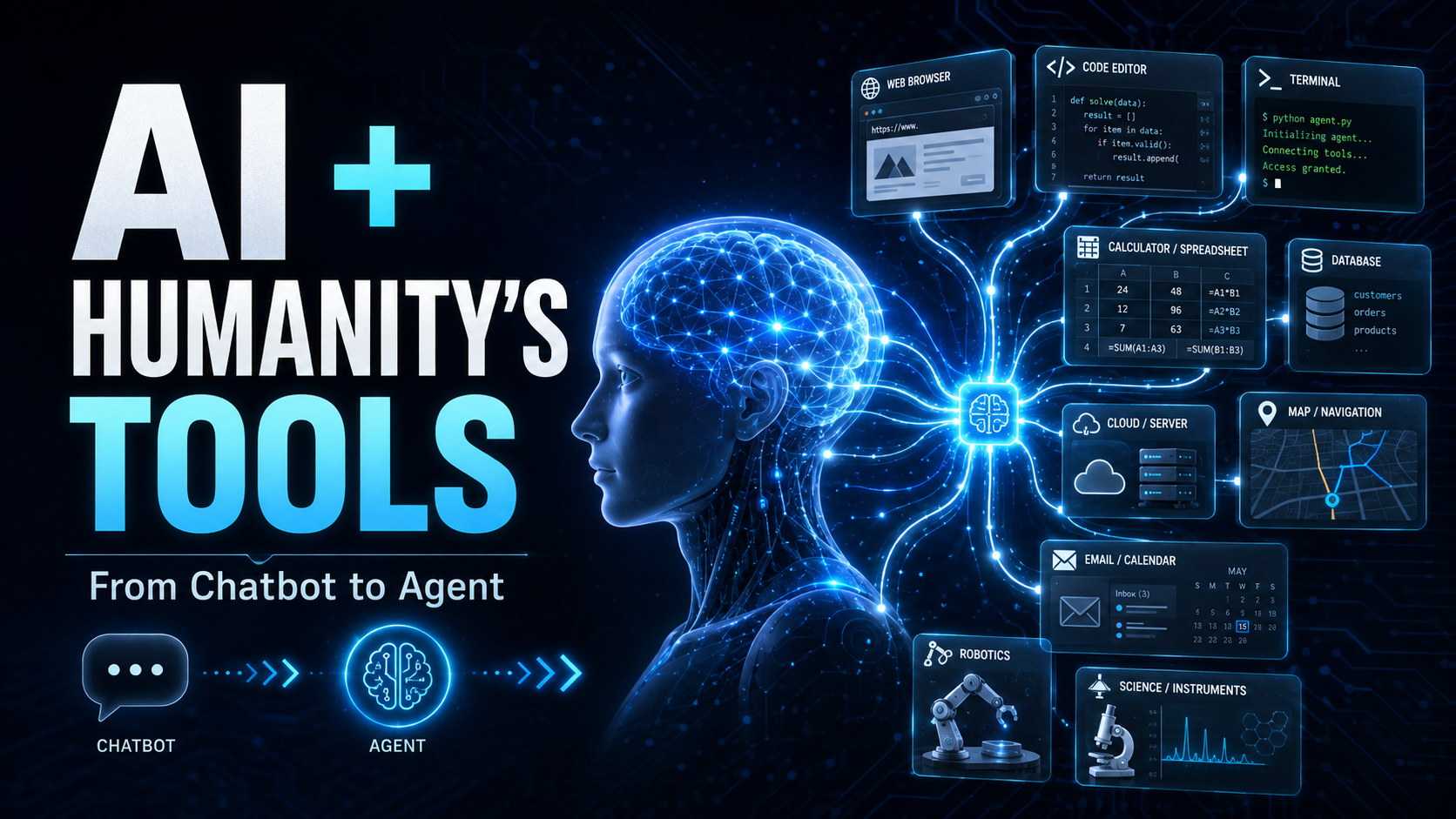
When GPT-4 arrived in March 2023, most of the discussion focused on intelligence.
It could reason better. It could write better. It performed dramatically better than GPT-3.5 on professional and academic benchmarks. OpenAI reported that GPT-4 scored around the top 10% on a simulated bar exam, compared with GPT-3.5 around the bottom 10%.
It looked like the beginning of a race to build increasingly intelligent machines.
And it was.
But looking back from 2026, another transition that started around the same time may prove just as important.
We began giving the intelligence tools.
Only nine days after GPT-4 launched, OpenAI introduced ChatGPT plugins that allowed the model to access current information, perform calculations and interact with external services. A few months later came function calling. Code Interpreter allowed ChatGPT to execute code and work with uploaded files. APIs connected language models to software. Browsing connected them to the web.
Then the industry moved toward agents.
Instead of asking an AI to tell us how to perform a task, we increasingly started giving it access to the systems required to perform the task itself.
Browsers.
Terminals.
Databases.
Search engines.
Spreadsheets.
Files.
Email.
Calendars.
Business software.
APIs.
Development environments.
And eventually the graphical interface of a normal computer.
That may turn out to be one of the most important changes in the history of artificial intelligence.
Because humanity has spent centuries, and in many cases millennia, building tools that increase what intelligence can accomplish.
AI does not need to invent that infrastructure again.
It can inherit it.
Human Progress Has Always Been Intelligence Plus Tools
Imagine one of the most intelligent humans alive placed alone in an empty field.
No computer.
No internet.
No electricity.
No books.
No telephone.
No vehicles.
No modern machinery.
No scientific instruments.
No databases.
No calculators.
No programming languages.
No communication networks.
That person may still possess extraordinary intelligence.
But intelligence alone has surprisingly limited leverage.
Now give the same person a modern laptop connected to the internet.
Suddenly that person can access information produced across thousands of years, communicate with someone on the other side of the planet, write software, control cloud infrastructure, analyze millions of records, move money, design products, publish information globally and operate businesses serving customers they may never meet.
The human brain did not become dramatically more intelligent when the laptop appeared.
Its leverage increased.
This is one of the fundamental stories of civilization.
Humans create tools.
Those tools extend what humans can accomplish.
Then future generations inherit those tools and build another layer on top.
Language allowed us to transfer ideas.
Writing gave information persistence.
Mathematics gave us a framework for manipulating quantities and relationships.
Printing multiplied access to knowledge.
Mechanical machines multiplied physical power.
Scientific instruments extended our senses.
Electricity allowed us to power increasingly complex systems.
Computers automated calculation.
Software automated information processing.
The internet connected people, knowledge and machines globally.
Cloud computing made enormous computational infrastructure available on demand.
None of these technologies replaced intelligence.
They amplified it.
AI may now be entering the same relationship with the technological world humans created.
Early Language Models Were Brains Trapped Inside a Box
The limitations of early ChatGPT become clearer when viewed through this lens.
You could ask the model:
“How do I analyze this dataset?”
It could explain the process.
You could ask:
“Write Python that analyzes this dataset.”
It could generate the code.
But then a human still had to take that answer and connect it to reality.
Create the file.
Install Python.
Install the packages.
Load the data.
Execute the script.
Read the errors.
Correct the problem.
Generate the output.
Interpret the result.
The model could think about the task, but it could not necessarily perform the task.
The same limitation appeared everywhere.
Ask AI how to book a hotel and it could explain.
But it could not open the booking website.
Ask it how to update a CRM and it could provide instructions.
But it could not access the CRM.
Ask it how to deploy an application and it could generate commands.
But it could not open a terminal and execute them.
Ask it about current events and, without browsing, it only knew what had been included in its training.
This was still enormously useful.
But it was intelligence separated from most of the mechanisms humans use to turn intelligence into action.
The history of AI since GPT-4 can partly be understood as the industry gradually removing that separation.
GPT-4 Was Followed Almost Immediately by Tool Use
The timing is interesting.
GPT-4 was publicly released on March 14, 2023.
OpenAI introduced ChatGPT plugins on March 23.
Plugins allowed language models to reach beyond the information contained inside the model itself. OpenAI described them as tools that could give ChatGPT access to current information, computations and third-party services.
In June came function calling.
Instead of simply generating text describing an action, a model could produce structured arguments that software could use to call an external function or API.
In July, Code Interpreter rolled out broadly to ChatGPT Plus users.
Now ChatGPT could run Python itself, work with uploaded files, perform calculations, manipulate data and create charts.
These features could initially look like accessories around the model.
In retrospect, they pointed toward something much bigger.
The AI was beginning to interact with the computational environment around it.
A Model Does Not Need to Know Everything If It Knows How to Use the Right Tool
This changes how we should think about AI capability.
Suppose an AI needs to calculate:
8,739,481 × 47,291.
We could spend enormous amounts of compute training a model to become increasingly reliable at performing large arithmetic operations internally.
Or we can give it a calculator.
The important intelligence then becomes recognizing:
this problem requires arithmetic,
a calculator is available,
these are the correct inputs,
this is how the result should be interpreted.
The same principle scales much further.
An AI does not need every current fact encoded inside its model weights if it can search the web.
It does not need to mentally execute a complicated program if it can write the program, run it and inspect the output.
It does not need to memorize a company's customer database if it can query the database.
It does not need to know every street if it can access mapping software.
It does not need to internally calculate an entire financial model if it can use a spreadsheet or Python.
And it does not need to understand every possible website API if it can eventually operate the same interface a human uses.
This leads to a different way of thinking about AI progress.
Effective AI capability is not just intelligence.
A rough conceptual equation might be:
Effective AI Capability = Intelligence × Tools × Autonomy × Reliability
Each component changes what the system can actually accomplish.
A brilliant model without tools may know exactly what should happen but be unable to make it happen.
A less intelligent model with powerful tools may accomplish much more.
A powerful model with tools but no autonomy still requires a human to direct every step.
And an intelligent autonomous model with unreliable tool use may be worse than all of them because it can make mistakes at machine speed.
The frontier race therefore becomes multidimensional.
Smarter models still matter enormously.
But intelligence is no longer the entire product.
APIs Gave AI Structured Hands
The cleanest way for software to interact with other software is usually an API.
An API exposes structured actions.
Instead of visually opening a weather website, finding the search box, typing a city name and reading the temperature, software can make a structured request:
give me the weather for Bucharest.
Instead of opening a CRM, navigating menus and filling several fields, an API might allow:
createContact(name, email, company).
This made function calling one of the most important developments of the GPT-4 era.
The language model could interpret messy human language while software handled precise execution.
A user could say:
Find the customer from yesterday's support conversation and update the account status.
The model determines the intent.
Tools perform the actions.
That combination is far more powerful than either component independently.
The language model provides flexibility.
The software provides precision.
But APIs have an obvious limitation.
Someone has to build them.
And the world contains an enormous amount of software that was created long before anyone expected an AI agent to operate it.
That is where computer use becomes especially important.
Computer Use May Be the Universal Adapter for AI
Humans already created an interface for operating almost every piece of digital technology.
The graphical user interface.
Buttons.
Menus.
Text fields.
Windows.
Icons.
Browsers.
Desktop applications.
Mobile applications.
If an AI can reliably see a screen, understand what is happening and control a mouse and keyboard, it suddenly gains potential access to a huge portion of existing software without requiring developers to redesign that software specifically for AI.
That is a profound idea.
In January 2025, OpenAI introduced Operator and its Computer-Using Agent technology.
The system was trained to interpret graphical user interfaces and interact with buttons, menus and text fields in a way resembling human computer use. OpenAI explicitly described computer use as a universal interface for AI to interact with the digital world.
The early system was far from perfect.
OpenAI reported only 38.1% performance on OSWorld at launch and specifically recommended human oversight for many operating-system tasks.
But the direction was more important than the initial reliability.
You no longer necessarily needed every application developer on Earth to create an AI integration.
The AI could potentially learn to use the existing application.
By 2026, Google had integrated computer use directly into Gemini 3.5 Flash, allowing developers to build agents that could see, reason and act across browser, mobile and desktop environments.
Computer use was moving from an experimental side model toward a normal capability of general AI systems.
If that trend continues, the implication is enormous.
The software world humanity already built becomes an enormous tool library for AI.
MCP Is Another Piece of the Same Story
A second problem emerged as models gained access to more systems.
Every integration was different.
Connecting an AI to Google Drive required one implementation.
Connecting it to GitHub required another.
Connecting it to a database required another.
Connecting it to internal company software required another.
Anthropic introduced the Model Context Protocol in November 2024 partly to address this fragmentation.
Anthropic described MCP as an open standard for connecting AI systems to data sources, business tools and development environments, arguing that even sophisticated models remained constrained when isolated from external systems.
The important part is not the acronym.
The important part is what it represents.
The AI industry is beginning to build standardized infrastructure between intelligence and tools.
You can think about this as another layer in computing.
We already have standards that allow computers to communicate over networks.
Standards that allow websites to work across browsers.
Standards that allow hardware devices to communicate.
Standards that allow applications to exchange data.
Now we are building standards for giving AI models access to capabilities.
That tells us something about where the industry believes the value is going.
The Agent Changes the Unit of Work
A traditional chatbot interaction has a very small unit of work.
Prompt → response.
You ask.
The AI answers.
Then you decide what happens next.
Agents change that relationship.
The user provides an objective.
The system determines several intermediate steps.
It may search for information.
Use a tool.
Read the result.
Change its plan.
Use another tool.
Encounter an error.
Recover.
Continue.
Check its work.
Then deliver the outcome.
The unit of work changes from an answer to a task.
OpenAI described agents in 2025 as systems capable of independently accomplishing tasks on behalf of users. Its Responses API combined models with built-in web search, file search and computer use specifically to support increasingly complex tasks involving multiple tools and model turns.
A few months later, ChatGPT agent combined research, browser interaction, code execution, external data sources and the ability to create artifacts such as spreadsheets and presentations.
That represents a fundamentally different interaction model.
Instead of:
Tell me how to research these competitors.
It becomes:
Research these competitors.
Instead of:
Tell me how to make this spreadsheet.
It becomes:
Make the spreadsheet.
Instead of:
Help me figure out what meetings I have next week.
It becomes:
Look at my calendar, research the companies I'm meeting and prepare me for every meeting.
That transition from advice to execution may eventually matter more economically than another jump in benchmark intelligence.
AI Progress Since GPT-4 Can Be Seen as Five Stages
The dates overlap and the categories are simplified, but conceptually the progression looks something like this.
Stage 1: AI Knows
The early chatbot model.
You ask a question.
It tells you what it knows.
How should I structure a marketing campaign?
Useful, but passive.
Stage 2: AI Creates
Models become strong at generating artifacts.
Text.
Code.
Images.
Plans.
Documents.
Write the marketing campaign.
The AI produces work, but humans still move it into the systems where the work becomes useful.
Stage 3: AI Uses Tools
Models gain access to search, code execution, files, databases, APIs and external services.
Analyze these campaign results and tell me what changed.
The AI can now interact with information rather than simply reason over what is inside the prompt.
Stage 4: AI Acts
Computer use and agents allow AI to perform actions.
Update the campaign based on these results.
Now the model can potentially navigate the advertising dashboard or call an API and make the change.
Stage 5: AI Works Toward Objectives
The direction the industry is increasingly pursuing is broader delegation.
Improve the performance of this campaign this week. Stay within this budget and ask me before making major changes.
That requires more than intelligence.
It requires planning, memory, tools, judgment, error recovery, permissions, monitoring and reliability.
The AI is no longer being used only as an interface for knowledge.
It is becoming an operator of systems.
Software Engineering Shows Where This Is Going
Software development is one of the clearest examples of the transition.
The first generation of coding assistants completed individual lines.
Then they generated functions.
Then files.
Then entire components.
But real software engineering is not simply producing source code.
A developer receives a requirement.
Inspects an existing codebase.
Finds the relevant systems.
Understands dependencies.
Makes changes.
Runs the application.
Reads errors.
Runs tests.
Inspects the visual output.
Finds something wrong.
Changes the implementation.
Tests again.
Deploys.
Monitors.
The biggest change in coding AI has therefore not simply been that models write better TypeScript, Python or Java.
It is that coding agents increasingly have access to the same surrounding tools developers use.
The repository.
The terminal.
The compiler.
The test suite.
The browser.
The documentation.
The issue tracker.
The deployment environment.
An AI that writes code but cannot execute it has to guess whether its solution works.
An AI that can write, execute, inspect and modify its code creates a feedback loop.
That feedback loop is powerful.
It allows the model to compensate for imperfection.
The first answer does not have to be correct if the system can discover that it is wrong and try again.
Humans work the same way.
A good engineer does not always produce the correct solution mentally before touching the keyboard.
We experiment.
We execute.
We observe.
We correct.
Agents give AI access to that same iterative process.
Tools Can Be More Valuable Than More Internal Knowledge
Consider two hypothetical AI systems.
Model A
Extremely intelligent.
Excellent reasoning.
Massive internal knowledge.
But no internet connection, no terminal, no APIs and no access to external applications.
Model B
Slightly less intelligent.
But it can search.
Run code.
Use a browser.
Access your company database.
Read documentation.
Create files.
Query APIs.
Use a computer.
Which one is more useful for running an actual business process?
For many tasks, Model B wins easily.
This does not mean model intelligence has stopped mattering.
Quite the opposite.
As AI gains access to more powerful tools, intelligence becomes more consequential because the model has more leverage.
A mistake from an isolated chatbot gives you a bad paragraph.
A mistake from an autonomous agent could send the wrong email, modify production software, purchase something, delete information or change a business record.
Tools amplify intelligence.
They can also amplify stupidity.
That is why reliability may become the most important frontier after raw capability.
Reliability Is What Turns Tool Use Into Work
A demo can show an agent booking a restaurant.
A worker needs to do it correctly 999 times out of 1,000.
Those are very different standards.
Real environments are messy.
Websites change.
Buttons move.
APIs fail.
Authentication expires.
Documentation is outdated.
Two databases disagree.
Users give incomplete instructions.
The customer changes their mind halfway through the task.
An autonomous system needs to decide whether to continue, retry, ask for clarification or stop.
This is why simply adding a browser to a model does not create an autonomous employee.
The difficult engineering problem is making the combination reliable.
Models need to know:
what the objective is
which tool should be used
what permissions they have
whether a result is trustworthy
whether an action is reversible
whether they have enough information
how to recover when something fails
when they need human approval
when they should stop
These may sound like implementation details.
They are actually the difference between an impressive AI demo and a useful AI worker.
Giving AI Tools Also Gives AI Power
There is an uncomfortable side to the same argument.
A model isolated inside a conversation has limited ability to affect the world.
Connecting it to tools increases its usefulness precisely because it increases its ability to act.
That also increases the consequences of mistakes and abuse.
If an AI can send emails, it can send the wrong email.
If it can modify code, it can break code.
If it can access databases, it can expose or corrupt data.
If it can operate websites, it can perform unintended actions.
If it can spend money, financial errors become possible.
And if future AI systems gain increasingly broad access to physical systems, the stakes become higher again.
This means permissions, sandboxing, monitoring, confirmation systems and audit trails become part of AI capability itself.
The best autonomous AI may not be the model capable of doing the largest number of things without asking.
It may be the one that best understands when it should act autonomously and when it should involve a human.
The Next Interface May Be Intent
There is another consequence that could eventually change software itself.
For decades, software interfaces have been designed around telling computers exactly what actions to perform.
Click this button.
Open this menu.
Fill this field.
Select this option.
Save.
AI potentially creates a higher-level interface.
Instead of specifying actions, we specify intent.
Rather than:
open Salesforce,
filter leads from last week,
export them,
open a spreadsheet,
compare them with campaign data,
calculate acquisition costs,
create a chart,
write a summary,
email it to the team,
you could eventually say:
Tell me which marketing channel generated our best leads last week and send the analysis to the team.
The agent chooses the tools.
That is a major abstraction.
Programming languages allowed developers to stop manually manipulating electrical states.
Operating systems allowed developers to stop directly managing hardware.
Cloud platforms allowed teams to stop manually provisioning much of their infrastructure.
AI agents may allow humans to stop specifying large numbers of software interactions.
We describe the desired outcome.
The machine determines the operations.
If this becomes reliable, the way software is designed may change significantly.
APIs Will Still Matter Even If AI Can Use Any Interface
There is a temptation to think that computer-using agents will make APIs obsolete.
I think the opposite is more likely.
APIs are faster, cheaper and more precise when they exist.
If an AI needs to retrieve 50,000 database records, visually clicking through an interface would be absurd.
A structured query is better.
If it needs to send an email, an email API is more deterministic than clicking through a web client.
Computer use is valuable because it fills the gaps.
So the future agent stack may look something like:
Use direct tools and APIs whenever possible.
Use computer interfaces when necessary.
That combination gives agents both efficiency and universality.
Structured integrations provide precision.
Computer use provides compatibility with the enormous amount of software that nobody will ever rebuild specifically for AI.
AI Is Inheriting Civilization’s Abstraction Layers
This is perhaps the part of the story I find most interesting.
AI arrives very late in technological history.
That is an advantage.
A newly created intelligence today does not begin with sticks and stones.
It begins in a world containing:
global communication networks,
billions of computers,
satellites,
scientific databases,
programming languages,
manufacturing infrastructure,
robotics,
financial networks,
navigation systems,
medical imaging,
engineering software,
cloud computing,
and more information than any human could consume in millions of lifetimes.
Human civilization has already built the abstraction layers.
An AI agent does not need to discover electricity to use a data center.
It does not need to invent mathematics to use numerical software.
It does not need to understand transistor manufacturing to execute Python.
It does not need to construct a global telecommunications network to send a message around the world.
It inherits all of it.
The same way a modern software engineer can build a global application without knowing how to manufacture a CPU, an AI agent can potentially operate extremely sophisticated systems without recreating the discoveries underneath them.
This is one reason AI development could move unusually quickly.
Every capability connects to an existing ecosystem of tools.
Better visual reasoning makes the entire graphical software world more accessible.
Better coding makes millions of APIs and libraries more useful.
Better planning makes longer workflows possible.
Better context allows the model to understand larger systems.
Better tool use gives it access to information and actions outside itself.
The improvements compound.
Robotics Could Extend the Same Pattern Into the Physical World
Most of today's agent revolution is happening in digital environments.
That makes sense.
Digital tools are easier to access, faster to operate and safer to experiment with than physical machinery.
But the same principle could eventually extend further.
A robot is, in one sense, another tool interface.
Give an AI visual perception, reasoning and access to a robotic system and software intelligence gains physical capabilities.
The distinction matters because the physical world contains another enormous collection of human-built tools.
Vehicles.
Warehouses.
Factories.
Laboratories.
Construction equipment.
Agricultural machinery.
Medical devices.
Drones.
Industrial robots.
An AI does not need a humanoid body capable of performing every physical task directly if it can learn to operate specialized machines humans already created.
The long-term story of agents may therefore be much larger than browser automation.
Digital tools come first because they are easiest to connect.
Physical tools may follow.
We May Have Been Asking the Wrong AI Question
For years one of the central questions in AI has been:
How intelligent can the model become?
That remains important.
But it may only be half the equation.
A second question is becoming equally important:
What can that intelligence access?
An AI with an IQ of 200 trapped inside an isolated text window has very different economic power from an AI with slightly lower reasoning ability that can operate software, write and execute code, access live information, communicate with other systems and work toward goals autonomously.
Tools turn intelligence into leverage.
Agents combine the two.
This also changes how we should compare frontier AI models.
Benchmarks measuring mathematics, coding and reasoning remain useful.
But increasingly we should also ask:
Can the model use the right tool?
Can it determine which tool is necessary?
Can it coordinate several tools?
Can it recover when a tool fails?
Can it verify the result?
Can it operate for long periods without drifting away from the objective?
How much human intervention does it require?
How much useful work does it complete per dollar?
Those questions look less like traditional AI benchmarks and more like evaluating an employee.
That is probably not a coincidence.
The Real AI Revolution May Be Leverage
The remarkable thing about modern humanity is not simply that individual humans are intelligent.
Humans have probably not become dramatically more biologically intelligent over the last few thousand years.
Yet what an individual can accomplish has changed beyond recognition.
The difference is accumulated leverage.
Knowledge.
Institutions.
Infrastructure.
Machines.
Software.
Networks.
Tools.
Each generation inherits what previous generations built.
AI is now beginning to inherit the same infrastructure.
GPT-4 showed us how powerful a general language model could become when its reasoning improved.
The years since have increasingly shown something else.
A model does not exist in isolation.
Give it search and it gains access to current knowledge.
Give it code execution and it gains computation.
Give it APIs and it gains structured actions.
Give it files and it gains working memory outside the conversation.
Give it business systems and it gains access to organizations.
Give it a browser and it gains access to much of the internet's functional layer.
Give it computer use and it can begin interacting with software that was never designed for AI at all.
Give it autonomy and those tools can be chained together toward an objective.
That is the architecture behind the agent era.
We Built the Tools Before We Built the Intelligence That Could Use Them
There is something almost strange about the order in which this happened.
Humanity spent centuries building machines that extend physical capability.
Then decades building software that extends cognitive capability.
Then we connected almost everything through networks.
Only afterward did we begin building artificial systems capable of understanding natural-language objectives and potentially choosing among those tools themselves.
In other words, much of the infrastructure an autonomous AI needs already exists.
We built calculators before AI could reason about when to use one.
We built search engines before AI could autonomously research a question.
We built programming languages before AI could write software.
We built cloud computing before AI could provision resources.
We built graphical interfaces before AI could see them.
We built APIs before AI could decide which endpoint to call.
We built the web before AI could navigate it.
We may have unknowingly spent decades preparing the environment in which AI agents would eventually operate.
That is why the current transition can feel so fast.
The intelligence does not need to build civilization from zero.
We are plugging it into civilization.
The Question Is No Longer Just How Smart AI Gets
The most important AI developments over the next few years may still involve better reasoning models.
But model intelligence alone does not explain where the technology is moving.
The larger architecture is becoming clear.
Intelligence.
Plus tools.
Plus memory.
Plus permissions.
Plus autonomy.
Plus feedback.
Plus reliability.
That combination transforms an AI from something that talks about work into something capable of participating in work.
We should still be careful with the language.
Today's agents remain imperfect.
They make mistakes.
They get stuck.
They misunderstand interfaces.
They require human supervision.
And many tasks that look easy in demonstrations become substantially harder in uncontrolled real-world environments.
But direction matters.
The industry is no longer trying only to create a machine that can answer almost any question.
It is increasingly trying to create a machine that can receive almost any digital objective, determine what tools are necessary and use them to achieve it.
That is a much bigger ambition.
For years, we asked how intelligent artificial intelligence could become.
We may have been asking only half the question.
The other half is what happens when that intelligence gains access to everything human intelligence has already built.
We are beginning to find out.
FAQ
Why are tools important for AI agents?
Tools allow an AI model to interact with systems outside its own training and conversation context. An agent can use tools to search for current information, execute code, access databases, interact with software, manipulate files and perform actions. This turns AI from a system that primarily generates responses into one that can increasingly complete tasks.
When did AI models start using external tools?
Tool use existed before GPT-4, but it became a mainstream part of the modern LLM ecosystem during 2023. OpenAI launched GPT-4 in March 2023, followed by ChatGPT plugins later that month, function calling in June and broader Code Interpreter access in July.
What is function calling in AI?
Function calling allows an AI model to generate structured instructions for an external software function or API. The model can interpret a user's natural-language request, determine which function is required and provide the necessary parameters so another system can execute the action.
What is an AI agent?
An AI agent is a system that can work toward an objective by combining a model with tools, memory and some level of autonomy. Rather than generating a single response, an agent may perform multiple steps, use several tools, inspect results, adapt its plan and continue until a task is completed.
What is computer use in AI?
Computer use allows an AI model to interact with graphical interfaces similarly to a human, using visual information and actions such as clicking, typing and scrolling. This is important because it potentially allows agents to operate software that does not provide a dedicated AI integration or API.
Why is computer use important if APIs already exist?
APIs are generally faster and more reliable for structured automation, but not every application provides the necessary APIs. Computer use acts as a more universal interface because agents can potentially operate the same screens, buttons and forms humans already use.
What is MCP?
The Model Context Protocol, introduced by Anthropic in 2024, is an open standard designed to make it easier for AI systems to connect to external data sources and tools. The broader goal is to reduce the need for separate custom integrations for every combination of model and external system.
Are smarter AI models still important if agents can use tools?
Yes. Tool access can actually make model intelligence more important because the consequences of reasoning errors become greater when the AI can take actions. An effective agent needs both strong reasoning and reliable tool use.
Will AI agents replace software interfaces?
Not necessarily. Interfaces will still matter for humans and for tasks where visual interaction makes sense. However, AI could create another abstraction layer where users increasingly describe outcomes in natural language while agents determine which applications and operations are needed underneath.
What is the biggest limitation of AI agents today?
Reliability remains one of the biggest challenges. Real environments contain ambiguous instructions, changing interfaces, failed APIs, incomplete data and unexpected situations. An agent must not only know how to act but also recognize errors, recover from failures, verify results and understand when human approval is necessary.
What comes after AI agents using digital tools?
One possible next step is broader interaction with the physical world through robotics and specialized machinery. The same principle applies: rather than requiring AI to physically perform every task itself, it could potentially learn to operate tools and machines that humans have already created.